

How much does a cold wallet cost? When we checked the makers' own US stores on 14 October 2026, prices ran from 54.90 USD for a Tangem two-card set to 399 USD for a Ledger Stax, and most of the well-known models sat between 59 and 249 USD. Within one brand the security chip often stays the same as the price climbs: Trezor's 59 USD Safe 3 and 249 USD Safe 7 both carry an EAL6+ certified secure element, so the other 190 USD goes on a bigger screen, touch control, Bluetooth and a battery. The number worth watching is the total at checkout, because a metal backup or a recovery subscription can add more than the gap between two devices.
We make the Ryder One, which appears in the table below at 149 USD, so read our numbers with that in mind. Each row links to the maker's own store and you can check every figure yourself in a few minutes, which is worth doing because prices move often and several models were on sale when we looked.
How much does a cold wallet cost from each maker?
The table lists the base price on each maker's US store on 14 October 2026, before tax and shipping, with the screen as the maker describes it. A cold wallet keeps your private keys offline, and every device below does that job; what changes from row to row is mostly how you read and approve a transaction.
| Device | Price at the maker's US store | Screen and controls | How it connects |
|---|---|---|---|
| Tangem Wallet, 2-card set | 54.90 USD | No screen; you confirm on your phone | NFC |
| Trezor Safe 3 | 59 USD | 0.96-inch monochrome display, two buttons | Cable |
| Ledger Nano S Plus | 69 USD | Small screen, multi-step navigation | Cable |
| Tangem Wallet, 3-card set | 69.90 USD | No screen; you confirm on your phone | NFC |
| Ledger Nano X | 99 USD (listed as a new price) | Small screen, multi-step navigation | Cable, Bluetooth |
| Trezor Safe 5 | 129 USD | 1.54-inch color touchscreen | Cable |
| Keystone 3 Pro | 149 USD | 4-inch color touchscreen | QR codes, microSD |
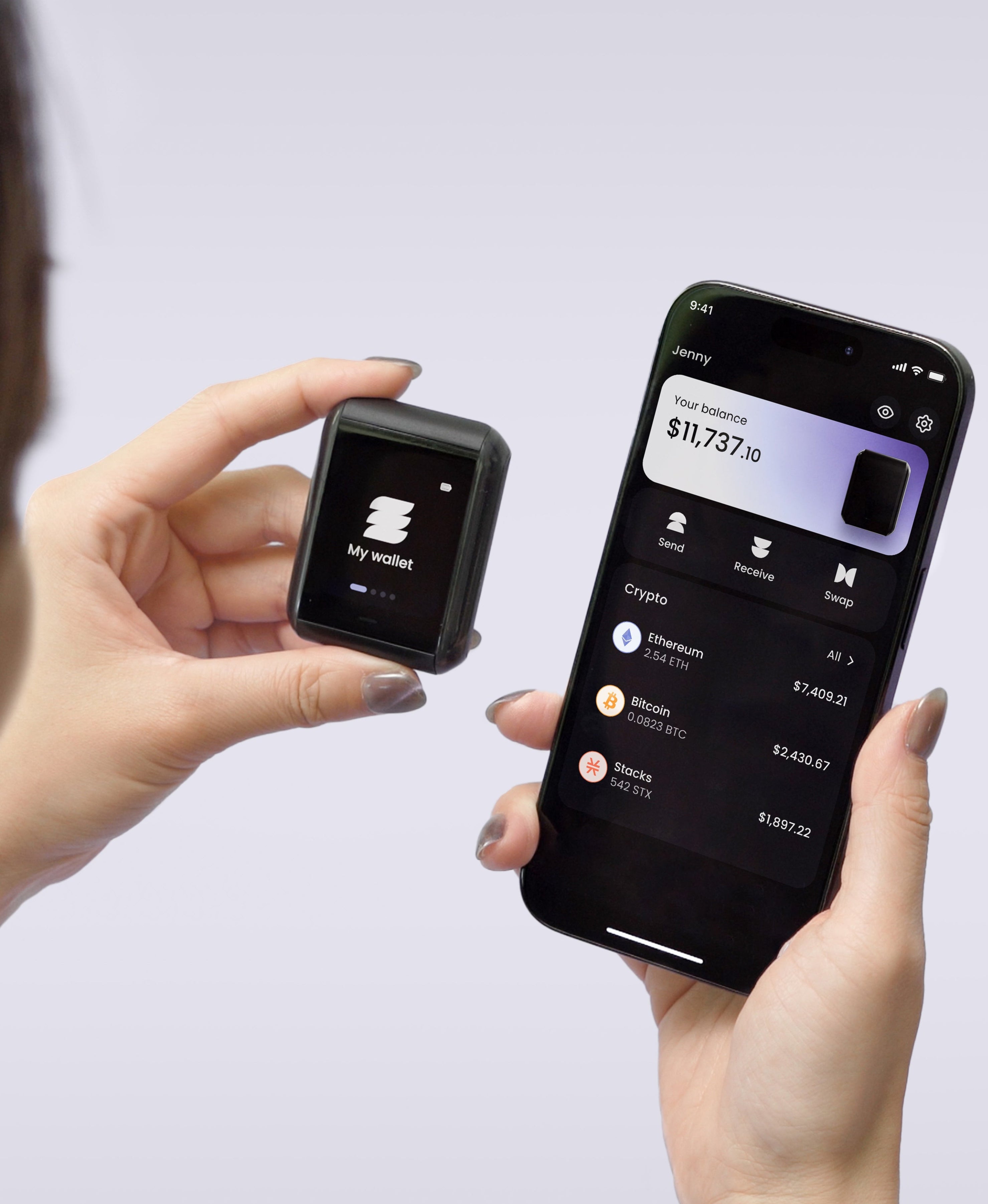
| Ryder One, Starter Combo | 149 USD | 1.6-inch AMOLED touchscreen | NFC only |
| Ryder One, Super Safe Combo | 179 USD | Same device, with three Recovery Tags | NFC only |
| Ledger Nano Gen5 | 179 USD | 2.8-inch monochrome E Ink touchscreen | Cable, Bluetooth, NFC |
| Ledger Flex | 249 USD | 2.8-inch grayscale E Ink touchscreen | Cable, Bluetooth, NFC |
| Trezor Safe 7 | 249 USD | 2.5-inch color touchscreen | Cable, Bluetooth |
| Ledger Stax | 399 USD | 3.7-inch curved E Ink touchscreen | Cable, Bluetooth, NFC |
What the extra money buys
Trezor's comparison page makes the pattern easy to see. The Safe 3, Safe 5 and Safe 7 each carry an EAL6+ certified secure element, the chip that holds your keys and resists tampering, and all three use the same PIN protection; the 190 USD between the Safe 3 and the Safe 7 goes on the display, a touchscreen, Bluetooth, a battery with Qi2 wireless charging, glass on the front and back, and on the Safe 7 a second security chip that Trezor calls TROPIC01. Ledger's range has the same shape, with every model listing a certified secure element and the price rising with screen size, E Ink touch and wireless links, from a Nano S Plus that runs on a cable with no battery to a Stax with a 3.7-inch curved screen and Qi charging.
The screen matters for one practical reason: it's where you check what you're approving. Before you send anything, the device should show the full destination address and the amount, and malware on your phone or computer can't change what the device itself displays. A small screen does that job if you're patient enough to scroll through a long address, and Ledger describes its two entry models as having a "small screen, multi-step process", while a larger touchscreen shows the same address in one view. A card with no screen hands that check to your phone, which is the trade-off behind Tangem's price, and our Tangem comparison covers what that means day to day.
What a backup adds to the bill
Every cold wallet needs a backup, because a device can break, get lost or be stolen, and this is where totals start to drift apart. Most devices ship with a paper card for writing down your seed phrase, which costs nothing more but won't survive a fire or a flood. A steel plate will, and Trezor sells its Keep Metal for 99 USD, which puts the Safe 3 backup bundle at 142 USD on sale or 158 USD at list price, more than double the wallet on its own.
Ledger's optional backup is a subscription. Ledger Recover encrypts a spare copy of your key inside the device, splits it into three pieces held by separate companies, and ties each piece to an identity document you upload; US users can verify with a passport, a national ID card or a driver's license. Ledger sells Recover in bundles, and each bundle lists one year of it at 119.88 USD above the device's own price (a Flex alone is 249 USD, or 368.88 USD with a year of Recover), which works out to 9.99 USD a month at list price before the two free months the bundles include. The terms on the same page say renewals are charged in euros and that a payment more than 7 days late stops you restoring through Recover until you pay, so if you'd rather avoid the running cost, a seed phrase backup does the same job without a bill.
Tangem builds its backup into the box price. The additional cards in each set are copies of the same wallet, and the Tangem pricing page says that if you lose one card from a three-card set, the other two keep your access, with no subscription and no maintenance fee on top.
Ryder One also includes its recovery hardware. TapSafe restores your wallet from a Recovery Tag together with an encrypted backup in your phone's iCloud or Google Drive, and the seed phrase stays available on the device as a last resort. The Starter Combo comes with one Recovery Tag and the Super Safe Combo with three, so the 30 USD between them buys two more tags; a 2-pack of Recovery Tags costs 38 USD if you add them later.
Tax, shipping and where you buy
The prices in our table are before sales tax, and Tangem's page states plainly that its prices exclude taxes and duties. Shipping varies by maker: Tangem ships free on orders above 100 USD, Trezor's US store offers free shipping on orders over 160 USD until 13 November 2026, and we ship Ryder One free worldwide.
A lower price on a marketplace listing can look like a saving, although a device from a seller you don't know may have been opened, set up or swapped before it reaches you, and that risk costs far more than the discount. Our guide on where to buy a hardware wallet safely explains what to check if you buy anywhere other than the maker's store.
Is a cold wallet worth it at your balance?
A cold wallet is a one-time purchase you'll use for years, so the useful comparison is its price against what you plan to keep on it. The table below is our own arithmetic, the device price divided by the amount you hold, for three price points from the list above.
| What you hold | 59 USD device | 149 USD device | 249 USD device |
|---|---|---|---|
| 500 USD | 11.8% | 29.8% | 49.8% |
| 2,000 USD | 3.0% | 7.5% | 12.5% |
| 10,000 USD | 0.6% | 1.5% | 2.5% |
| 50,000 USD | 0.12% | 0.30% | 0.50% |
If you hold a few hundred dollars and trade most weeks, any device is a big slice of your balance, and keeping that money on a well-run crypto exchange or in a hot wallet for now is a reasonable choice. Once the balance is an amount you couldn't shrug off losing to an exchange failure or a hacked account, the sums change quickly: at 10,000 USD even a 249 USD device is a one-time 2.5%, and the cheapest models come in under 1%. Our guide on how many crypto wallets to keep shows how to split spending money from savings once you get there.
Where Ryder One fits
Ryder One costs 149 USD as the Starter Combo, which includes one Recovery Tag, a Qi wireless charger and a travel pouch, and 179 USD as the Super Safe Combo with three Recovery Tags, both checked on ryder.id on 14 October 2026. The device shows every transaction in readable detail on a 1.6-inch AMOLED touchscreen before you approve it, talks to your phone over NFC only, and keeps keys inside an EAL6+ certified Infineon SLC38 chip, with firmware that Halborn audited and a report anyone can read.
If the lowest price matters most, the Trezor Safe 3 and the Tangem two-card set do the core job for under 60 USD, each with its own trade-off in screen size and recovery, and our Trezor vs Ledger comparison goes deeper on those two brands. If you want a clear touchscreen and a backup that comes in the box, run the checks in our first hardware wallet guide and then compare Ryder One against your shortlist.


Share: