

Trezor vs Ledger is the first question most people ask when they decide to take their crypto off an exchange, and it has been the same two names for a decade. Both companies build hardware that keeps a private key inside a chip instead of on a laptop, both have sold millions of units, and both had a rough August in 2026. The comparison below is written by a company that builds a competing wallet, so we have tried to be exact about what each one does well and where the shared blind spot sits.
The one difference that shapes everything else
Trezor publishes its firmware. Anyone can read the code that runs on a Safe 3, propose a change, or build it themselves, and SatoshiLabs has treated that openness as the product's founding argument since 2013.
Ledger keeps the operating system on its secure element proprietary. The company's position is that a chip certified for banking and passport use comes with contractual secrecy attached, and that certification is worth more to a buyer than published source. Every other difference between these two, screen size, price, chain support, tends to follow from that split.
Neither approach is a guarantee. Coldcard publishes its firmware too, and a build configuration mistake made in March 2021 quietly weakened the randomness behind newly created wallets, letting attackers rebuild seeds offline and take more than 115 million USD in confirmed losses through mid-August 2026. Open code helps when somebody reads it, and for four years nobody had.
Side by side
| Trezor | Ledger | Ryder One | |
|---|---|---|---|
| Firmware | Open source | Proprietary secure element OS | Audited by Halborn, report public |
| Secure element | EAL6+ on Safe 3 and Safe 5, TROPIC01 dual-chip on Safe 7 | CC EAL6+ across the line, EAL5+ on the older Nano X | EAL6+ Infineon SLC38 |
| Screen | 0.96in mono to 2.5in colour | 1.1in OLED to 3.7in E Ink | 1.6in AMOLED touchscreen |
| Connectivity | Wired USB, Bluetooth on Safe 7 | Wired USB, Bluetooth and NFC on newer models | NFC only |
| Backup | Seed phrase, multi-share option | Seed phrase, optional paid Recover service | TapSafe split across tag, phone and contacts |
| 2026 incident | Shipping partner breach, 13,689 customers | Payments partner breach, plus an Ethereum app signing bug | None disclosed |
| Entry price | 59 USD Safe 3 | Listed in euros, from 40.83 for Nano S Plus | 149 USD Starter Combo |
Trezor lists the Safe 3 at 59 USD and the Safe 5 at 129 USD on its own store, with the Safe 7 at the top of the range. Ledger renders its prices after the page loads, so the figures above come from Coin Bureau's 2026 comparison, which lists the line in euros from 40.83 for the Nano S Plus up to 332.50 for the Stax. Check either store before you buy, since regional tax and bundles move these numbers around.
Trezor: what you get
The Safe 3 is the cheapest credible hardware wallet from a company with a long track record, and at 59 USD it removes the price excuse for anyone still holding coins on an exchange. Moving up the line buys you a colour touchscreen on the Safe 5 and, on the Safe 7, a larger display, a rechargeable cell with wireless charging, and a new dual-chip security design built around the TROPIC01, which SatoshiLabs designed to be auditable rather than sealed behind a certification agreement.
Trezor's multi-share backup deserves attention. Rather than one 12-word phrase, you can split recovery into several shares and require a threshold of them to restore, which is the same underlying idea as our own recovery system and a considerable improvement on a single card in a drawer.
Best for: buyers who want to read the code, or want the lowest entry price from an established name.
Worth knowing: in August 2026 Trezor disclosed that ShipMonk, one of its shipping providers, had been breached through a vulnerability in a third-party analytics tool. Order data for 13,689 customers was exposed, 11,742 of them with full name, email, phone number and shipping address. Wallets and keys were untouched, and the leaked list is still a directory of households known to own crypto hardware.
Ledger: what you get
Ledger supports more chains and integrates with more applications than anyone else, which matters if you hold assets outside the top few networks or spend time in decentralized finance. The touchscreen Flex and Stax are the nicest screens on the market, and Ledger Live is the most polished desktop software in the category by a wide margin. Certification is checkable rather than decorative, because the secure elements carry Common Criteria ratings you can look up instead of taking on faith.
Best for: holders of a wide range of assets, and anyone who wants desktop software that behaves like a finished product.
Worth knowing: Ledger has had a harder run on trust than on engineering. A 2020 e-commerce breach put customer names and addresses in public hands, the Recover subscription launch in 2023 convinced many owners that keys could leave the device after all, and on 5 January 2026 the company confirmed that its payments partner Global-e had been hacked, exposing customer names and contact details again. Then in August 2026 a bug in the Ethereum app made it possible for a malicious site to swap a transaction while the device still showed the original. Ledger's own security lab found it and shipped version 1.22.2 on 12 August, ten days before an outside firm published the details, and no thefts have been tied to it.
What the head to head misses
Read fifty Trezor vs Ledger comparisons and they will argue about screens, coin counts and price. Almost none of them ask the question that decides whether you still hold your crypto in ten years, which is what happens to your recovery when the device is gone.
Both companies give the same answer. You write down a phrase, you keep it somewhere, and that piece of paper or metal restores everything to whoever holds it. Trezor's multi-share option softens this if you use it, and most owners never turn it on. So the failure mode that costs people their coins is rarely the chip: it is a house fire, a flooded basement, a support call from someone convincing, or a relative who finds the card in a filing cabinet and does not know what it is.
The 2026 breaches sharpen this. Both companies leaked lists of customers with home addresses through third parties they did not control, and Chainalysis has tracked home invasions rising from 26 percent of violent crypto incidents in 2023 to 37 percent through mid-2026. If one object in your home restores everything, somebody standing in that home has one question to ask.
How we answer the recovery question
We built TapSafe Recovery so that no single item carries a complete answer. Your Recovery Tag holds 50 percent, your paired phone holds the other 50 percent stored encrypted in your own iCloud or Google Drive rather than on the handset, and optional Recovery Contacts hold 25 percent each without learning anything about your holdings. Tag and phone together restore the wallet; either alone restores nothing. Your seed phrase stays available on the device as a last resort under the BIP-39 standard, so leaving us later is always possible.
That design is the reason we exist, and it is the one thing neither Trezor nor Ledger offers as a default.
So which should you buy
If you want open code and the lowest entry price, buy the Trezor Safe 3 and turn on multi-share backup on the day you set it up. If you hold a long tail of assets and live in desktop software, buy a Ledger and keep every app updated. Either of those beats leaving coins on an exchange by a distance that no comparison table can close.
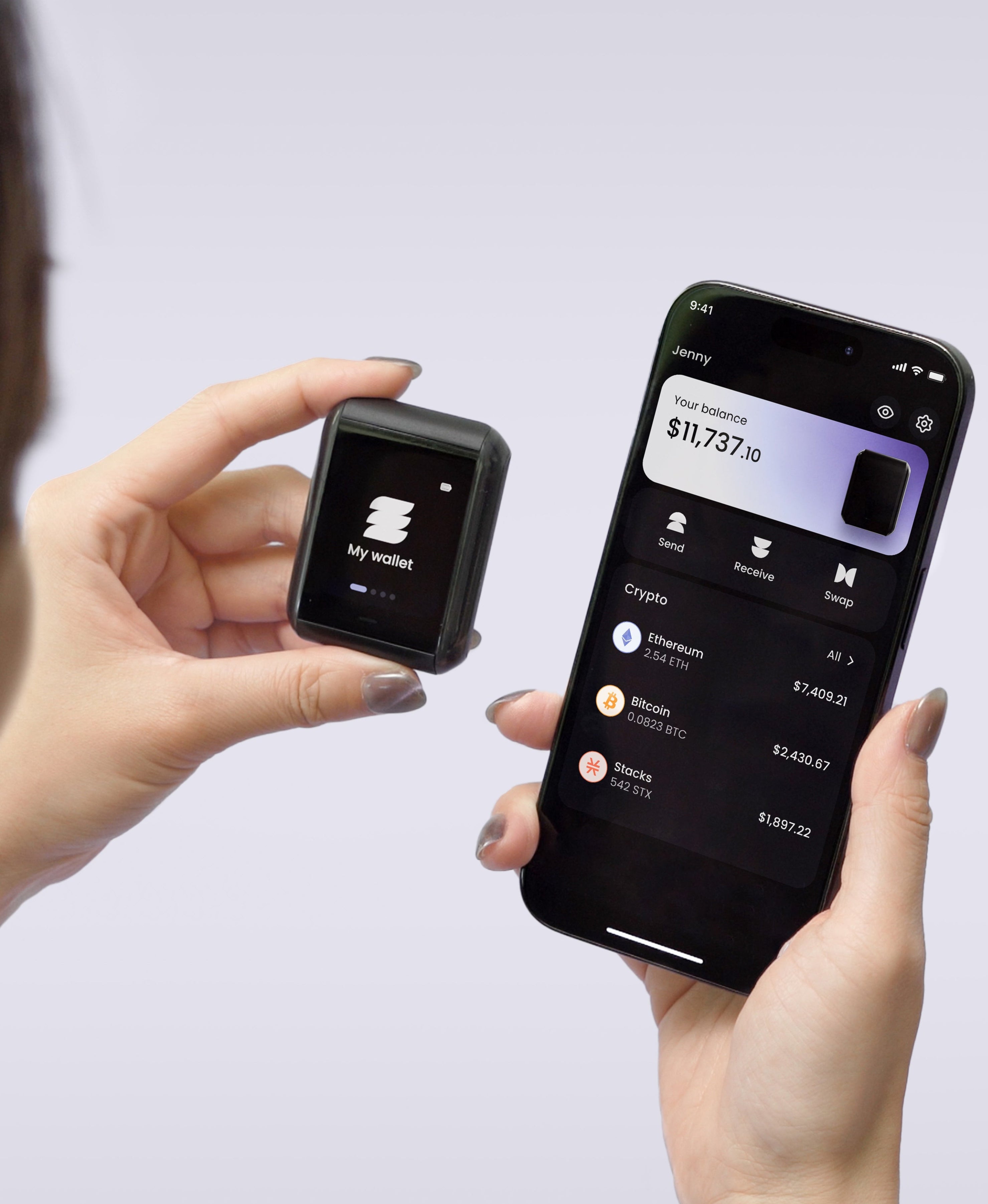
If the part that worries you is the backup rather than the chip, look at the Ryder One. Keys are generated inside an EAL6+ certified Infineon SLC38 secure element and never leave it, the firmware was independently audited by Halborn with the full report published, and every transaction renders on the 1.6-inch AMOLED screen before you approve it. Communication runs over NFC and nothing else, so there is no wired data channel and no Bluetooth radio. Setup takes about 60 seconds, the box includes the Recovery Tag, a Qi wireless charger and a pouch, and the Starter Combo is 149 USD.
We wrote a longer piece on how the Ryder One compares to Ledger specifically, and a fuller breakdown across all three brands sits on our why Ryder page. Whichever way you go, get the keys off the exchange this month. See the Ryder One.
Meta description: Trezor vs Ledger in 2026: open code against certification, prices, screens, and the 2026 breaches on both sides. Plus the recovery question neither one answers.


Share: