

If you're weighing the Tangem wallet against the Ryder One, you've already settled the hard question: your crypto belongs in cold storage, away from exchanges and browser extensions. Both are hardware wallets that talk to your phone over NFC, both carry an EAL6+ secure element, and neither forces you to copy a seed phrase onto paper during setup. From there the two products split. Tangem is a flat card with no screen and no battery inside. Ryder One is a compact aluminium device with a touchscreen, a rechargeable battery, and a recovery system designed to survive the loss of the device itself. Which one fits depends on how much you hold, how often you transact, and what you want to happen on the day something goes missing.
The comparison at a glance
| Tangem Wallet | Ryder One | |
|---|---|---|
| Form factor | Flat card, fits in a cardholder | 41 x 55 x 14.5 mm aluminium device, 38 g |
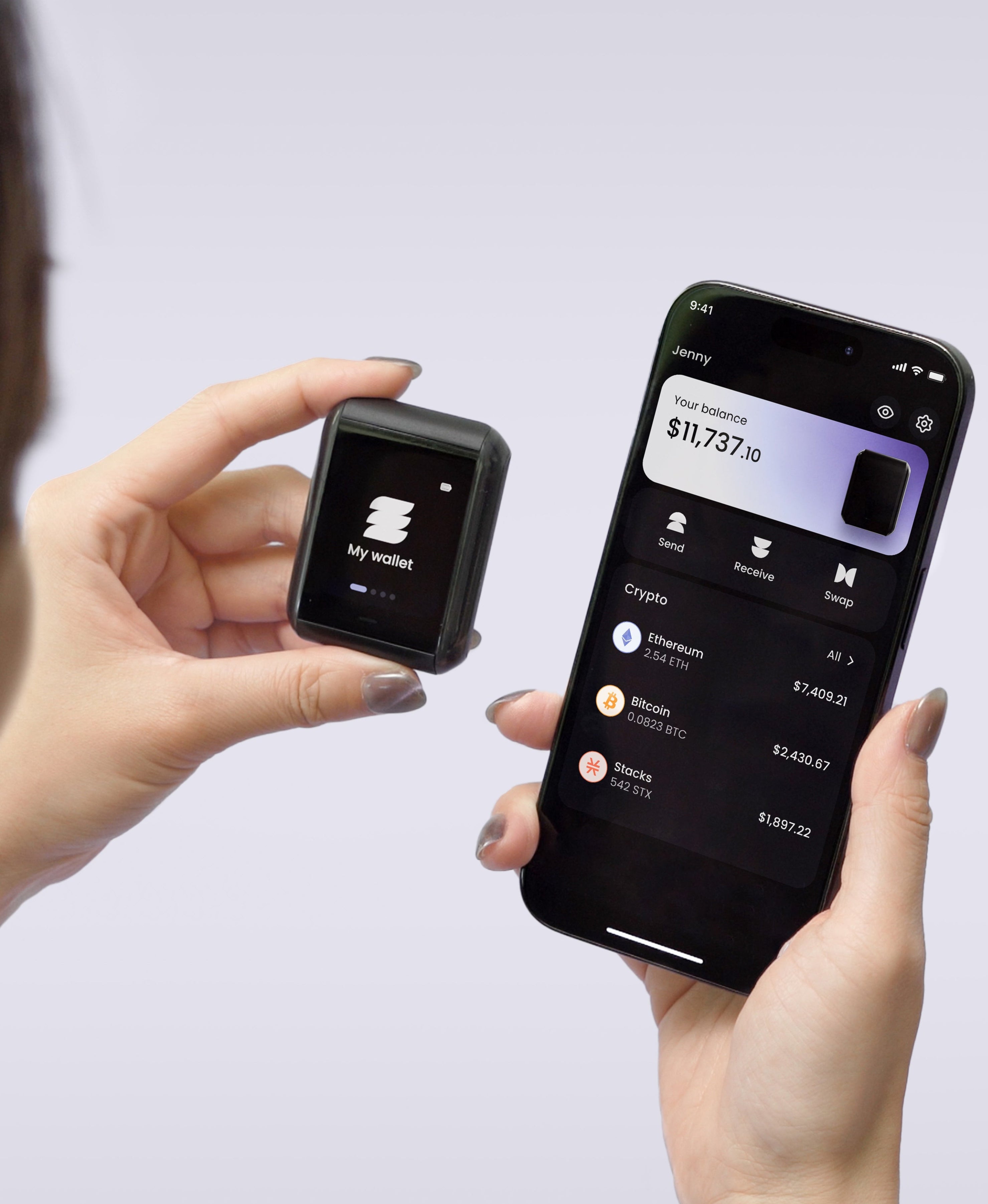
| Display | None; details appear in the phone app | 1.6-inch AMOLED touchscreen, 301 PPI |
| Power | Drawn from your phone's NFC field | 200 mAh battery, Qi wireless charging |
| Connectivity | NFC | NFC only (no USB, Bluetooth, or Wi-Fi) |
| Secure element | Samsung chip, EAL6+ | Infineon SLC38, EAL6+ |
| Backup model | Spare cards hold copies of the key | TapSafe: Recovery Tag, encrypted phone backup, optional Recovery Contacts |
| Recovery after total loss | Optional seed phrase only | Seed phrase always accessible on device (BIP-39) |
| Transaction check | On the phone screen | On the device screen |
| Assets | 14,100+ tokens across 90 blockchains | Bitcoin, Ethereum, Solana, plus top ERC-20 and SPL tokens |
| Durability | IP69K, 25-year warranty | IP67, aluminium and tempered glass |
| Price | $54.90 to $180 | $149 Starter Combo, $179 Super Safe Combo |
Where the Tangem wallet earns its reputation
Tangem's pitch is subtraction. Each card holds an EAL6+ Samsung secure chip and an antenna, draws power from your phone's NFC field the moment you tap, and carries an IP69K rating with a 25-year warranty. There's nothing to charge, nothing to break in a drawer, and nothing for an attacker to reach over Bluetooth or USB, because the card has neither. Asset coverage is wide too: Tangem's app supports more than 14,100 tokens across 90 blockchains, which matters if your portfolio lives on chains beyond the majors.
The price makes the case even stronger. A 2-card set costs $54.90 and a 3-card set $69.90, with the Tangem Ring at $160 and the Pro Kit at $180. For under $70 you get cold storage that survives a washing machine.
Best for: long-term holders who want the lowest-cost durable cold storage, hold across many chains, and trust themselves to keep spare cards in separate places for years.
Worth knowing: in late December 2024, Tangem disclosed that a bug in its mobile app had logged private keys when users created or imported a seed phrase, and those logs could reach the support team if a user filed a ticket from the app. Tangem says fewer than 0.1% of users were affected, shipped fixed app versions within days, and permanently erased the stored logs. No fund losses were reported, and the cards themselves were never at fault. The episode still carries a lesson: when a wallet has no screen of its own, its security includes every line of code in the companion app.
How backup and recovery work on each
With Tangem, your spare cards are the backup. During setup the cards link to each other through encrypted communication, each one can then approve transactions on its own, and you spread them out: one in a safe, one in a drawer, one with someone you trust. The model is clean right up to the edge case. Tangem's private keys are generated on the card and never leave the chip, and the seed phrase is optional, so if every card is lost or destroyed and you skipped that option, there is no path back to the funds. The cards are the wallet.
We designed TapSafe to remove that kind of edge case. TapSafe Recovery splits recovery across layers using our own build of Shamir's Secret Sharing: a Recovery Tag holds 50%, your paired phone holds 50% (stored encrypted in your iCloud or Google Drive rather than on the phone itself), and optional Recovery Contacts hold 25% each. No single piece grants access alone, so a stolen Tag or a lost phone reveals nothing by itself. Lose the Ryder One and the Tag plus your phone backup restore everything. On top of that, the seed phrase stays accessible on the device as a last resort, meets the BIP-39 standard, and works in other wallets, so you're never locked to our hardware. You can also import an existing 12 or 24-word seed phrase from another wallet and layer TapSafe on top of it.
What you see before you approve
A Tangem card has no display, so every transaction detail you confirm appears on your phone. That works fine when the phone is healthy. The weakness shows up with address-substitution malware, which displays the destination you expect while sending your funds somewhere else, and a screenless wallet gives you no second place to look.
Ryder One puts the check on the device. The full transaction appears on the 1.6-inch AMOLED screen with readable detail, receive addresses are verified on the device as well, and a button wired directly to the secure element means no software path can sign anything without your press. What you see on the device is what you sign. The PIN keypad even shuffles its digits on every unlock, so someone watching over your shoulder learns nothing from your finger movements.
Halborn audited our firmware and secure element integration and found zero critical and zero high-severity issues; the full report is public.
Price and what lands in the box
Tangem is the cheaper buy, and if budget is the deciding factor it wins this section outright. The Ryder One Starter Combo is $149 and includes the device, a Recovery Tag, a Qi wireless charger, and a travel pouch; the Super Safe Combo is $179. The gap between $69.90 and $149 buys the screen, the secure-element-wired button, and a recovery setup that doesn't depend on you managing spare cards for a decade.
Think about which failure you're paying to prevent. With Tangem you're betting that at least one card survives every move, flood, and house clean-out over the years you hold. With Ryder One the bet is spread across a Tag, an encrypted cloud backup, and people you choose, and TapSafe reassembles the wallet even after the device itself is gone.
Which wallet fits how you hold crypto
Pick Tangem if you want the least expensive durable cold storage, your portfolio spans many chains, and you're confident in your own system for storing backup cards long term. It does what it promises at a price nothing with a screen can match.
Pick Ryder One if you want to verify transactions on the wallet's own display, and if self-custody has always felt like a test you could fail. Setup takes under 60 seconds, recovery keeps working after the device is lost, and there's no single object whose destruction takes your funds with it. That last point is the one we'd want a family member to have covered, and it's the same reason we built the device this way. For how this stacks up against the biggest name in the category, read our Ryder One vs Ledger comparison.
Ready to hold crypto without betting everything on one object? Get your Ryder One, starting at $149 with free global shipping and a Recovery Tag in the box.


Share: