

# TRON (TRX) in 2026: The USDT Rail Every Holder Should Know
TRON gets covered in crypto media as a Justin Sun profile, an SEC docket, or a Chinese-market rumor mill, but the number that matters is the stablecoin float on-chain. As of mid-2026, more than half of every USDT in existence sits inside a TRC-20 wallet on TRON, and the chain routinely settles more USDT transfers per day than Ethereum does. Remittance flows through Nigeria, Argentina, Turkey, and Vietnam clear on this network because a $500 transfer costs a fraction of a cent and lands in under ten seconds.
Below we cover what TRON and TRX are, how DPoS with 27 Super Representatives works, why USDT-on-TRON became the world's dominant dollar wire, the ecosystem today, the SEC case, the self-custody read, and where Ryder One fits.
What TRON and TRX are
TRON was launched in 2017 by Justin Sun as an ERC-20 token on Ethereum, then migrated to its own mainnet in June 2018 in an event the project called Independence Day. The native asset TRX pays for compute, fuels the resource-credit system, and gets staked in exchange for voting power over governance. According to the official TRON site, the chain clears billions of dollars in daily on-chain volume and sits inside the top ten crypto assets by market capitalization.
Under the hood, TRON runs the TRON Virtual Machine, which is compatible with Ethereum's EVM, so Solidity contracts port over with minor changes and much of the Ethereum tooling points at TRON RPC endpoints. TRC-20 is TRON's flavor of ERC-20 and is the standard used by Tether, Circle (via bridged USDC), and every major project on the chain. TRC-10 is a lighter spec from before smart contracts went live, though nearly all projects of note use TRC-20 today.
DPoS and the 27 Super Representatives
TRON does not use proof-of-work or straight proof-of-stake. Consensus runs on Delegated Proof of Stake, where TRX holders vote for 27 Super Representatives who take turns producing blocks in three-second rounds. Voting power comes from freezing TRX in a resource contract, which grants both bandwidth allowance and voting weight; the more you freeze, the more votes you can cast across candidates.
Block production rotates through the 27 SRs on a fixed 81-second schedule, which is why TRON can sustain around 2000 transactions per second in practice while keeping finality inside a handful of blocks. The TRON developer documentation walks through the rotation and reward rules, and tronscan.org shows the current SR rankings live. Critics point out that 27 producers is a small validator set next to Ethereum's tens of thousands, and the top slots have historically been held by exchange-affiliated entities including Binance, Poloniex, and Justin Sun's own HTX cluster. That is the tradeoff: throughput and low fees against a concentrated validator base.
How USDT-on-TRON became the informal dollar rail
Tether's own transparency page shows why TRON matters more than any TRX price chart. As of mid-2026, Tether's transparency dashboard reports that more than $80B of USDT sits on TRON as TRC-20, well over half of the total USDT float and larger than the USDT supply on Ethereum by a wide margin. Ethereum still dominates DeFi and settles most institutional flows, but for the everyday dollar transfer that the world's crypto users make, TRON is the default.
The reason is fee mechanics. A USDT transfer on Ethereum costs a few dollars on a calm day and can spike into the tens; on TRON, if you hold enough energy from frozen TRX, the same transfer costs zero. Without staked energy, you pay a small TRX fee that still lands well under a cent equivalent. That pricing collapse is what let TRON win the informal remittance market: Nigerian traders wiring value out of Lagos, Argentine freelancers taking a US payout, Turkish businesses hedging lira exposure, Vietnamese exporters clearing invoices, and Chinese users routing around capital controls default to USDT on TRON because moving a dollar there is close to free. For picking between the two dominant stablecoins on this chain, our USDC vs USDT breakdown covers the trade-offs, and our crypto remittances piece compares fees across chains.
The TRON ecosystem in 2026
TRON's own DeFi stack is smaller than Ethereum's or Solana's, and the biggest apps on-chain cluster around stablecoin flow. JustLend, the flagship lending market run by the JUST DAO, holds several billion in TVL and lets users borrow against USDT, USDC, and TRX collateral. SunSwap is the largest DEX on the network, an EVM-style AMM that handles most of the on-chain swap volume between TRC-20 assets. USDD, the algorithmic stablecoin from the same DAO stack, sits at a smaller float and has been through several redesigns since its 2022 launch.
Beyond DeFi, TRON acquired BitTorrent in 2018 and launched the BTT token, which still trades. Recent milestones tracked on DefiLlama and CoinGecko include TRON crossing one billion cumulative on-chain accounts in 2025 and TRX rejoining BTC, ETH, and USDT among the most transacted crypto assets by daily transfer count.
Justin Sun and the SEC case
In March 2023, the US SEC charged Justin Sun and three of his companies with fraud and unregistered securities offerings tied to TRX and BitTorrent's BTT token. The complaint accused Sun of orchestrating wash trading and paying eight celebrities to promote TRX without disclosing the payments; Lindsay Lohan, Jake Paul, and Soulja Boy were among the names listed. Sun has contested the charges, most celebrity defendants settled for small fines, and Reuters has tracked the docket through several procedural rounds since.
The case is still open at the time of writing and matters for anyone holding TRX because a US court finding that the asset is a security would reshape how US exchanges list it. Delistings on Coinbase, Kraken, and other regulated venues would follow, though the impact on offshore volume and USDT-on-TRON flow would likely be muted. Sun himself has spent much of 2024 and 2025 outside the US, running his portfolio from Hong Kong and elsewhere.
Self-custody read on TRC-20 and TRX
TRON uses secp256k1 elliptic-curve cryptography, the same primitive behind Bitcoin and Ethereum, so the underlying key math is familiar. Where TRON differs is the address format: TRON addresses start with "T" (base58-encoded) and derive along a chain-specific path, so wallet software has to know it is producing TRON addresses rather than BTC or ETH ones. Native tokens are TRC-10 or TRC-20, with TRC-20 the dominant standard; USDT, USDC, and every major project on the chain ship as TRC-20 contracts.
TRON accounts also carry a native permissions system that allows multi-sig at the account level, a feature the TRON docs describe in detail. Owner permission holds the highest authority, active permissions can be scoped down to specific contract calls, and a threshold of signers can be set for any operation. That lets sophisticated holders run a shared treasury without a third-party contract, and it means self-custody on TRON can extend past a single private key to a signer group. For retail holders, the threat model is the same as on any EVM chain: phishing sites, clipboard hijackers that swap a copied TRON address at paste time, and exchange counterparty risk if the balance lives on a custodian.
Where Ryder One fits
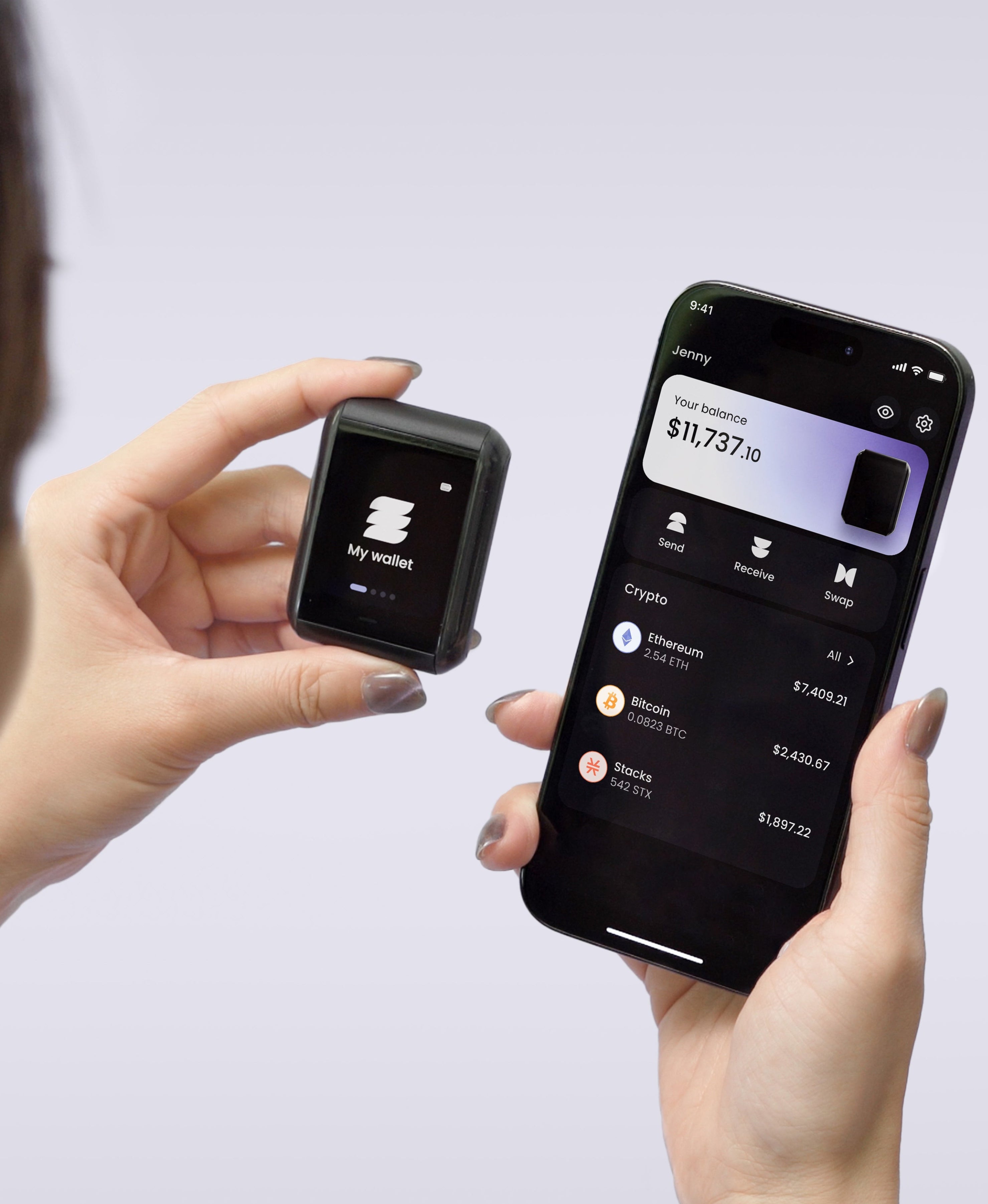
TRON is not on the current Ryder One coin list, which sits at Bitcoin, Ethereum, Solana, and a growing set of top ERC-20 and SPL tokens. If your dollars are living as USDT on TRON, keep that balance either on a reputable venue with strong operational security or in a TRON-native software wallet with cautious signing habits, while your BTC, ETH, and Solana balances live behind hardware. For every asset Ryder One does support, the guardrails are the same: an EAL6+ Infineon SLC38 secure element that generates keys on the chip and never releases them, a 1.6-inch AMOLED touchscreen that displays every transaction detail before you sign, and NFC-only communication with no USB port, no Bluetooth radio, and no Wi-Fi to widen the attack surface.
Backup takes a different route from the paper-and-metal playbook. Paper seed phrases tear or burn, and metal plates survive fire while still concentrating a whole recovery on one object having to survive everything. TapSafe Recovery splits the secret across a Recovery Tag rated to IP69K, your paired phone (backed up encrypted to iCloud or Google Drive rather than to the handset itself), and up to two optional Recovery Contacts. The BIP-39 seed stays on-device as a last resort, so a Ryder One holder is never locked to our hardware. The device ships at $229 with the Recovery Tag, a Qi wireless charger, and a travel pouch in the box.
The bottom line
TRON's story in 2026 is less about TRX the token and more about the chain becoming the world's dominant dollar wire. More than $80B of USDT lives on TRON as TRC-20, fees for a stablecoin transfer sit close to zero when energy is staked, and remittance corridors from Lagos to Buenos Aires to Istanbul to Hanoi clear through this network every day. If you hold USDT on TRON, apply the same self-custody discipline you would on any hardware wallet balance: verify addresses on-device where you can, keep long-term dollars off custodians you do not control, and think of TRON as a payment rail first. For the assets Ryder One supports today, the wallet keeps keys inside a certified chip, shows every signing detail on screen, and backs everything up without any single object having to survive alone.
SEO
Target keyword: tron crypto / trx crypto
SEO title: TRON (TRX) in 2026: The USDT Rail Every Holder Should Know
Meta description: TRON hosts more than half of all USDT in 2026 as the world's dominant dollar rail. DPoS, fees, JustLend, SEC case, and self-custody with Ryder One.
Hero alt text: TRON TRX USDT rail 2026 — Ryder self-custody hardware wallet


Share: