

The two largest stablecoins in crypto both promise the same thing: one token, one dollar, redeemable forever. They don't get there the same way. USDC and USDT have different backing models, different transparency practices, different regulatory positions, and different track records in moments of stress. The choice between them matters, though regardless of which you hold, where you hold it matters more.
This piece walks through USDC vs USDT carefully, then turns to the more important question of how to hold either one without adding extra counterparties on top of the one you've already accepted by holding a stablecoin at all.
What each one is
USDC is issued by Circle, a US-based financial services firm that went public on the NYSE as CRCL in mid-2025. Every USDC is backed 1:1 by cash and short-duration US Treasuries, with monthly reserve attestations from Deloitte & Touche. The bulk of those reserves sit in the BlackRock-managed Circle Reserve Fund, a registered 2a-7 government money market fund custodied at BNY Mellon, with the remaining cash held at large US banks. Circle operates under US regulatory frameworks, files with state regulators, and is required to maintain 1:1 backing in segregated reserve accounts.
USDT is issued by Tether Holdings, headquartered in the British Virgin Islands. Per Tether's most recent BDO Italia attestation, reserves are roughly 82% US Treasuries with the rest split across money market funds, overnight repo, cash, around 8 billion USD in gold, and around 7 billion USD in Bitcoin. Tether operates outside US banking regulation and has settled with the New York Attorney General and the CFTC in past years over historic reserve claims.
Both are pegged to the US dollar and can in principle be redeemed for dollars at par by qualified institutional users, with retail users typically redeeming indirectly through exchanges. The two tokens trade at or very near 1.00 USD most of the time.
What the backing looks like up close
USDC's reserve composition skews heavily toward US Treasuries and cash held at regulated US banks. The Circle Reserve Fund (a registered SEC fund) holds the bulk of these assets, with the remainder in segregated bank accounts.
USDT's reserve composition is broader. Treasuries make up a majority, but Tether also holds secured loans, corporate bonds, precious metals, and other assets. The mix has shifted over the years toward higher-quality liquid assets, but it isn't the pure cash-and-Treasuries model USDC runs.
For a holder, the practical difference comes down to transparency versus liquidity profile. USDC reserves are more transparent and conservatively composed. USDT is the larger stablecoin in 2026, with market cap near 190 billion USD, and its reserve mix includes gold and Bitcoin positions that can't be liquidated instantly the way cash and short-duration Treasuries can.
How each one behaves under stress
The most informative moments for any stablecoin are the depegs.
USDC depegged in March 2023 when Circle disclosed that 3.3 billion USD of its reserves were stuck at Silicon Valley Bank during the bank run. USDC dropped to roughly 0.87 USD for a weekend before the Federal Reserve guaranteed SVB depositors and the peg recovered. Holders who didn't panic got their full dollar back within days. Holders who sold into the dip at 0.90 took the loss.
USDT has had its own moments: a brief depeg to around 0.85 USD in 2018 during a banking-relationship scare, a smaller wobble in 2022 during the Terra collapse, and persistent (though never realized) market skepticism about reserve quality. USDT has always recovered its peg, but the recovery curves have sometimes been slower than USDC's.
Both are stable in normal markets and can wobble in extreme ones. The difference shows up in the failure mode: USDC's main risk is banking-system exposure (the SVB pattern), while USDT's main risk is reserve-composition opacity (the persistent transparency questions).
Where each one is used
USDC dominates regulated US contexts: institutional DeFi, on-chain payments by US companies, Circle's own enterprise rails. USDT dominates emerging markets, peer-to-peer trading, exchange-to-exchange settlement, and most non-US trading pairs.
If you're trading on a US-regulated exchange, you'll see deeper USDC liquidity. If you're trading on an offshore exchange or in a high-inflation country using crypto as a dollar substitute, USDT is usually the default.
Chain availability differs too. Both are on Ethereum and Solana, but USDT has broader chain coverage including Tron, which carries the majority of USDT volume. USDC has been more selective about which chains it deploys natively to.
The bigger question: where to hold either one
USDC vs USDT is a small choice next to the choice of where to custody them. Stablecoins on an exchange come with two counterparties stacked together: the issuer (Circle or Tether) plus the exchange itself. Hold them on a hot wallet on your phone and the stack becomes the issuer plus your phone's security model. Self-custody on a hardware wallet leaves only the issuer to think about.
This matters most during the moments when stablecoins matter most. When USDC depegged in March 2023, exchanges paused USDC withdrawals on the worst days. Holders in self-custody could move their position immediately if they wanted to. Holders on exchanges waited for the platform to decide it was safe to allow withdrawals again.
Self-custody doesn't remove issuer risk. Circle and Tether can both freeze any address holding their tokens, and have done so under court orders. What self-custody removes is the second layer: the custodian who might pause withdrawals, declare insolvency, or get hacked.
How to hold stablecoins on Ryder One
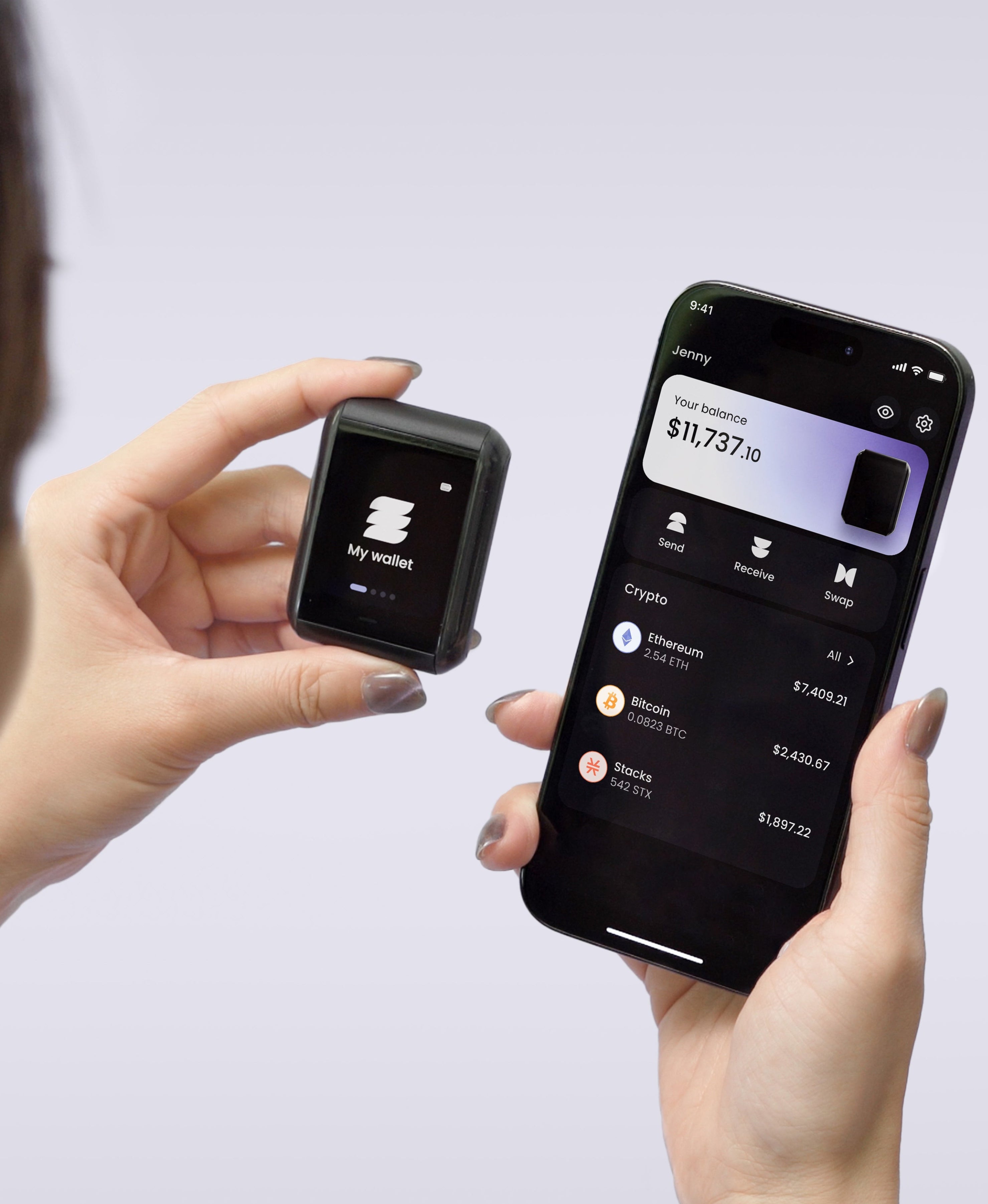
Ryder One supports USDC and USDT as ERC-20 tokens on Ethereum and as SPL tokens on Solana, alongside Bitcoin, Ethereum, Solana, and a growing list of major tokens. The flow is the same as for any other asset: receive to your wallet address, verify the address on the device's 1.6-inch AMOLED touchscreen, and the tokens are in cold storage until you sign to send them out.
For stablecoin holders specifically, the upside has more to do with positioning than with speed; you're not running USDC-to-ETH trades from a hardware wallet every five minutes. The position sits outside any custodian's books, so if the next March 2023 happens you can act on your own timeline.
So which one?
A reasonable rule of thumb for most holders: USDC if you're US-based, want maximum transparency, and don't need access to Tron-based liquidity. USDT if you're trading globally, need the deeper liquidity USDT has on most exchanges, or you live somewhere USDT is the de facto dollar substitute.
Split the position if you're not sure and hold some of each. The thing that matters most is whether either one is sitting on an exchange you no longer want exposure to when the next stress moment arrives.
The bottom line
USDC and USDT are both reasonable choices for the use case they were built for: a dollar-pegged token you can move on-chain. They differ on transparency, reserve composition, and which markets they dominate, and either one can wobble in extreme conditions. Holding either on an exchange adds a counterparty stack you don't need, while self-custody on a hardware wallet leaves you with only the issuer to think about.
Own the stablecoin yourself, end to end. Ryder One keeps your USDC and USDT in cold storage on an EAL6+ secure element with TapSafe Recovery as the backup. See how it works.


Share: