

Anyone searching for a list of fake crypto exchanges is hoping for a lookup table: type in a name, get a yes or a no, move on with the afternoon. No such table exists in a form you can trust on its own, and the reason is worth understanding before you hand money to a platform you found through a search result or a message from someone friendly.
Why a list of fake crypto exchanges is always behind
Fraudulent platforms are cheap to build and cheaper to abandon. A convincing site, a fake order book that ticks upward, a support chat staffed by the same people running the scheme: none of that takes long to assemble, and when regulators or journalists name it, the operators register a new domain and start again. The list you are reading was compiled from complaints that arrived after people lost money, which means every entry on it represents damage already done.
Scale gives you a sense of the churn. The FBI's Internet Crime Complaint Center recorded 181,565 cryptocurrency fraud complaints in 2025 with reported losses above 11 billion USD, and the average loss per complaint came to 62,604 USD. Those figures cover a wide range of schemes, though a large share of them route through a platform the victim believed was an exchange. You cannot name your way through a population that size one domain at a time.
So the question to carry into this is not which names appear on somebody's list. It is which checks you can run yourself, in about ten minutes, on a platform nobody has written about yet.
The checks worth running before you deposit
Start with registration, because the useful lists are the regulatory ones. The Commodity Futures Trading Commission publishes a Registration Deficient List, known as the RED List, naming foreign entities that appear to be doing business requiring CFTC registration without holding it. Your state securities regulator keeps warnings of its own, and a platform soliciting US customers while appearing on neither any registry nor any regulator's site is telling you something.
Then look at how the money is allowed to move. A pattern that shows up again and again is a platform where deposits clear instantly and withdrawals develop problems: a verification step that was never mentioned, a tax that has to be paid up front before funds release, an account frozen for review the week you tried to leave. Test this early with an amount you can afford to lose, before your balance is large enough that walking away hurts.
Look at the age of the domain and the depth of the record behind it. Companies that have handled customer money for years leave traces: audits, incident write-ups, employees with histories, coverage that predates the current marketing push. A site that appeared four months ago with a polished interface and testimonials you cannot trace to anybody is worth treating as unproven until it earns otherwise.
Watch for the approach itself. Where the introduction came from a stranger in a messaging app, a dating profile, or a group that welcomed you warmly before mentioning returns, the platform is a prop in a longer story, and no amount of checking its website will tell you that. The tell lives in how you arrived, not in what you found when you got there.
The second category nobody searches for
Here is the part that the fake-exchange framing hides. Platforms that were never fraudulent also stop holding your coins, and they do it on a schedule you do not control.
CoinEx announced on 15 September 2026 that it is winding down after nine years, and the timetable is already running. New registrations closed that day, on-chain deposits and every service beyond spot trading end on 22 September, spot trading stops on 29 September, and the withdrawal window shuts at 02:00 UTC on 22 December 2026, at which point the platform ceases operations. Decrypt reported founder Haipo Yang attributing the decision to prolonged market weakness alongside compliance and security demands that had become hard to contain. CoinEx says its reserves exceed 100 percent of user balances and that everyone can withdraw in full, which is the good version of this outcome.
The bad version is FTX, where roughly 8 billion USD of customer funds went missing in 2022 from a business that had stadium naming rights and a Super Bowl advertisement. Nobody's list of fake exchanges included FTX in October 2022, because by the standards any such list applies, it was not one.
Both endings share a mechanic. An exchange balance is a claim against a company, and the strength of that claim depends on the company's solvency, its jurisdiction, its compliance posture and its management, none of which you can audit from outside. Vetting a platform well tells you it is unlikely to be running a confidence trick today. It cannot tell you what it will be in three years.
Where your coins go once you stop trusting a platform
Moving coins to a wallet you control removes the counterparty question, and it hands you a different one: your backup becomes the thing that keeps you solvent. That trade is a good one, and it deserves to be made with open eyes rather than as a reflex.
Writing a seed phrase on the card in the box is where most people stop, which leaves the whole position resting on a piece of paper surviving water, fire, moving house and curiosity. Metal plates are the standard upgrade and they do solve the paper problem, though what they leave in place is one object that grants full access to anyone who reads it and total loss to you if it goes missing.
TapSafe Recovery removes that single point of failure by splitting your backup so no one item carries it. The Recovery Tag holds half, your paired phone holds the other half encrypted in your own iCloud or Google Drive rather than on the handset, and the two together restore the wallet. Optional Recovery Contacts each hold a quarter share while seeing nothing about your balances. Your seed phrase stays available on the device as a last resort under the BIP-39 standard, so you are never locked to our hardware if you want to leave.
What to take away
The search that brought you here has a better version: rather than asking whether a platform is on a list, ask what you are relying on and who has to stay honest for you to keep your money. On an exchange, the answer is a company. In self-custody, the answer is a device and a backup you can inspect.
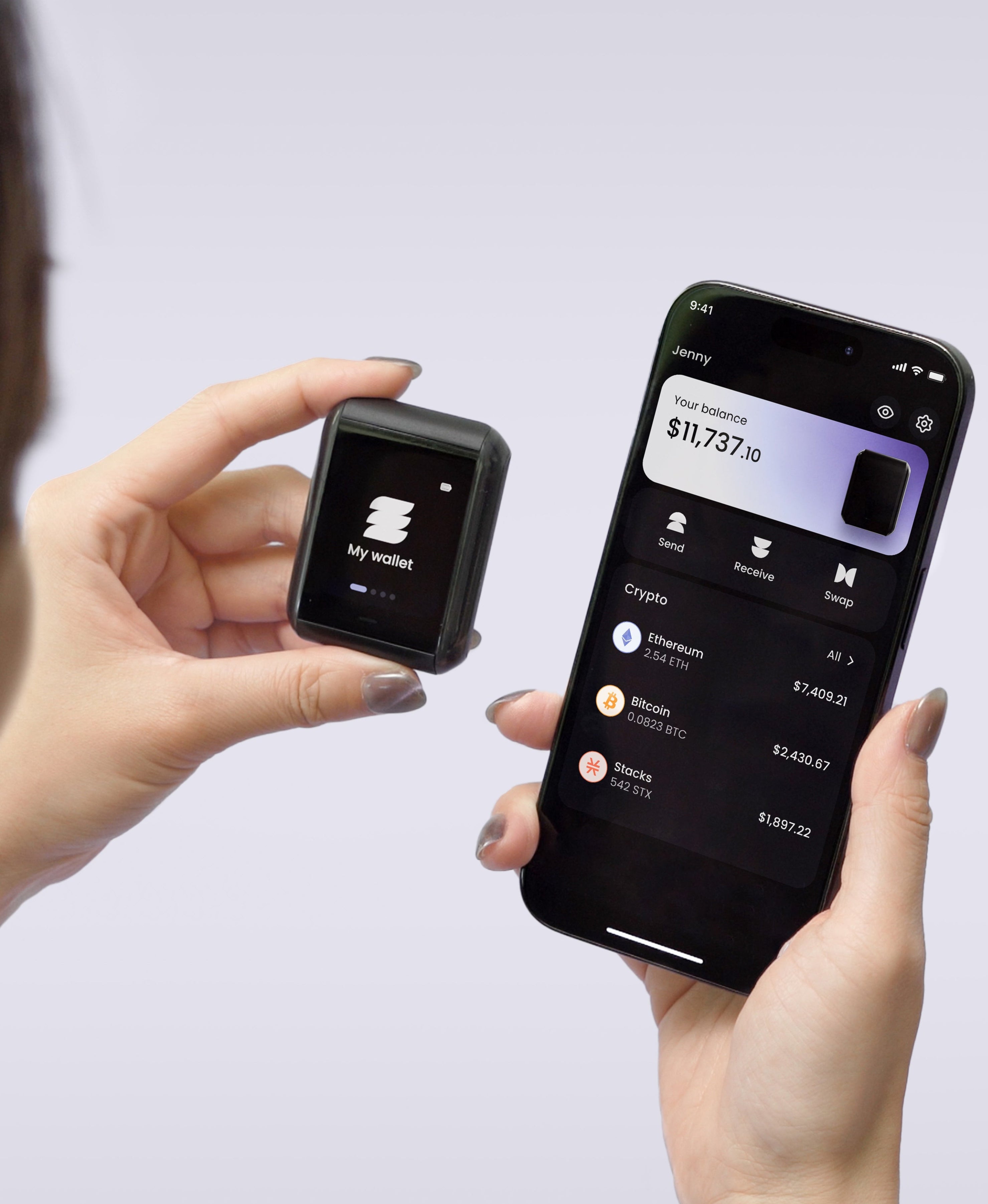
Ryder One is 149 USD for the Starter Combo. Private keys are generated inside an EAL6+ Infineon secure element and never leave the chip, the device communicates over NFC only with no Bluetooth, USB or Wi-Fi, and every transaction appears in readable detail on the 1.6 inch AMOLED touchscreen before you approve it. The firmware has been audited by Halborn with the full report published. Setup takes about sixty seconds, and there is no account for anyone to freeze, wind down or lose.
Meta description: No list of fake crypto exchanges stays current. The checks that work, the FBI and CFTC sources worth using, and why real exchanges fail too.


Share: