

Sending 500 USD from New York to Manila through Western Union costs around 25 USD in fees and takes a day or two to settle. Sending the same 500 USD as Bitcoin over Lightning, or as USDC over Solana, costs under a dollar and settles in seconds. The savings compound for the families who send remittances every month. The catch is that the workflow needs both ends to be set up correctly, and the sender's side is the part most people get wrong. This piece walks through what a crypto remittance actually is, the corridors where the savings are largest, the workflows that work, and why the sender's hardware wallet matters more than most people realize.
The cost gap, in concrete terms
The World Bank's Remittance Prices Worldwide dataset puts the global average cost of sending remittances at 6.36% of the amount sent. Still a large haircut before the money even reaches home. Some corridors are much worse. The most-used remittance corridors have these rough cost profiles: - US to Mexico: traditional rails (Western Union, MoneyGram, bank wire) charge 3 to 5 percent. Crypto rails (Bitcoin Lightning, USDC on Solana) charge under 1 percent. - US to Philippines: traditional 4 to 6 percent. Crypto rails through services like Pouch.ph: under 1 percent. - EU to Nigeria/Kenya: traditional 7 to 10 percent. Crypto rails through Bitnob or similar: under 2 percent. - GCC to South Asia: traditional 3 to 5 percent. Crypto rails: under 1 percent. For families sending 200 to 500 USD per month, the annual savings are real money. For larger transfers, the savings are larger in absolute terms but the relative gap stays similar.
What a crypto remittance looks like
The workflow has three pieces: the sender side, the on-chain leg, and the receiver side. Sender side: The sender holds crypto they want to send. Ideally in a hardware wallet if the amount is large. They send to the receiver's address. The transaction is signed on the hardware wallet, broadcast to the chain, and confirmed. On-chain leg: The Bitcoin or USDC or other asset moves on-chain, Lightning Network transfers settle in seconds. On-chain Bitcoin or Ethereum settles in minutes whereas Solana settles in seconds. The choice of network affects the speed and the on-chain fee. Receiver side: The receiver either holds their own wallet (cold or hot) or uses a custodial app that converts the crypto to local currency for them. The custodial apps vary by country: Strike in the US and parts of Latin America, Pouch.ph in the Philippines, Bitnob in Nigeria, Yellow Card across several African markets. The receiver pulls local currency from the app to their bank or mobile money account. The friction is usually in the receiver-side conversion, not the on-chain leg. Where the local custodial app works well, the whole flow is cheaper and faster than traditional rails.
Why the sender's hardware wallet matters
The failure mode that costs remittance senders the most isn't on-chain fees. It's address-substitution. When the sender types or pastes the receiver's address into their wallet app, malware on the sender's phone or laptop can substitute a different address. The transaction goes through, but the funds go to the attacker, and the receiver gets nothing. The sender's family member is short the rent that month. Avast researchers found one simple "HackBoss" clipboard-hijacker operation earned over \$560,000 in crypto. Remittance flows are particularly exposed because senders often use the same phone for messaging, banking, social media, and crypto. The attack surface is broad. A hardware wallet that shows the destination address on its own screen before signing is the structural defense. The malware on the sender's phone can swap the address in the wallet app's UI; the hardware wallet shows the real address that's about to be signed. The sender catches the discrepancy and rejects the transaction. For small remittance amounts (under 100 USD), the risk is small and a software wallet with careful copy-paste is reasonable. For monthly transfers in the hundreds, or larger one-off sends, the hardware wallet is the cheapest insurance available.
When the savings are worth the setup
Small, infrequent sends (under 100 USD, once or twice a year): Use traditional rails. The setup cost of crypto isn't worth the savings on a few transfers, unless you're already deeply embedded in crypto. Recurring sends (any amount, monthly or more often): Use crypto rails. The cumulative savings are meaningful even at small per-transfer amounts. Set up the hardware wallet on the sender's side; receiver can use a custodial app. Large infrequent sends (over 1,000 USD, any frequency): Use crypto rails. The percentage savings are large enough to matter on a single transfer. Hardware wallet on both ends if possible, or at minimum on the sender's side. Consider doing a small test transfer first to confirm the receiver's address is right before sending the full amount.
The trade-offs to know
Volatility on the on-chain leg: Bitcoin's price can move 2 to 5% on a fast day. If the sender's transfer takes 30 minutes to confirm and Bitcoin drops 3 percent in that window, the receiver gets fewer dollars than expected. Stablecoins eliminate this risk. For corridors where the receiver wants speed and dollar-stability, USDC over Solana or Lightning over Bitcoin (with conversion at the receiver's app) is usually the better path. Receiver-side app availability: Crypto remittance only works where the receiver has a way to off-ramp. The major apps cover most of the largest corridors. Smaller corridors may still require the receiver to manage crypto themselves or to use a less-known local provider. Regulatory variability: Different countries treat crypto remittances differently. Some treat them as standard remittances under existing money-transmitter rules, others have specific crypto frameworks. Of course, a few restrict the activity as well. For example, the Philippines regulates Virtual Asset Service Providers under BSP Circular No. 1108 (2021). Meanwhile, traditional remittances remain expensive in aggregate: the World Bank's Remittance Prices Worldwide tracker puts the global average cost at 6.36% of the amount sent. Fee structure across services: Lightning Network fees are usually under a cent, Solana fees are usually a fraction of a cent and Ethereum mainnet fees can be 1 to 10 USD depending on congestion, so pick the chain that matches the corridor's needs.
How Ryder One fits
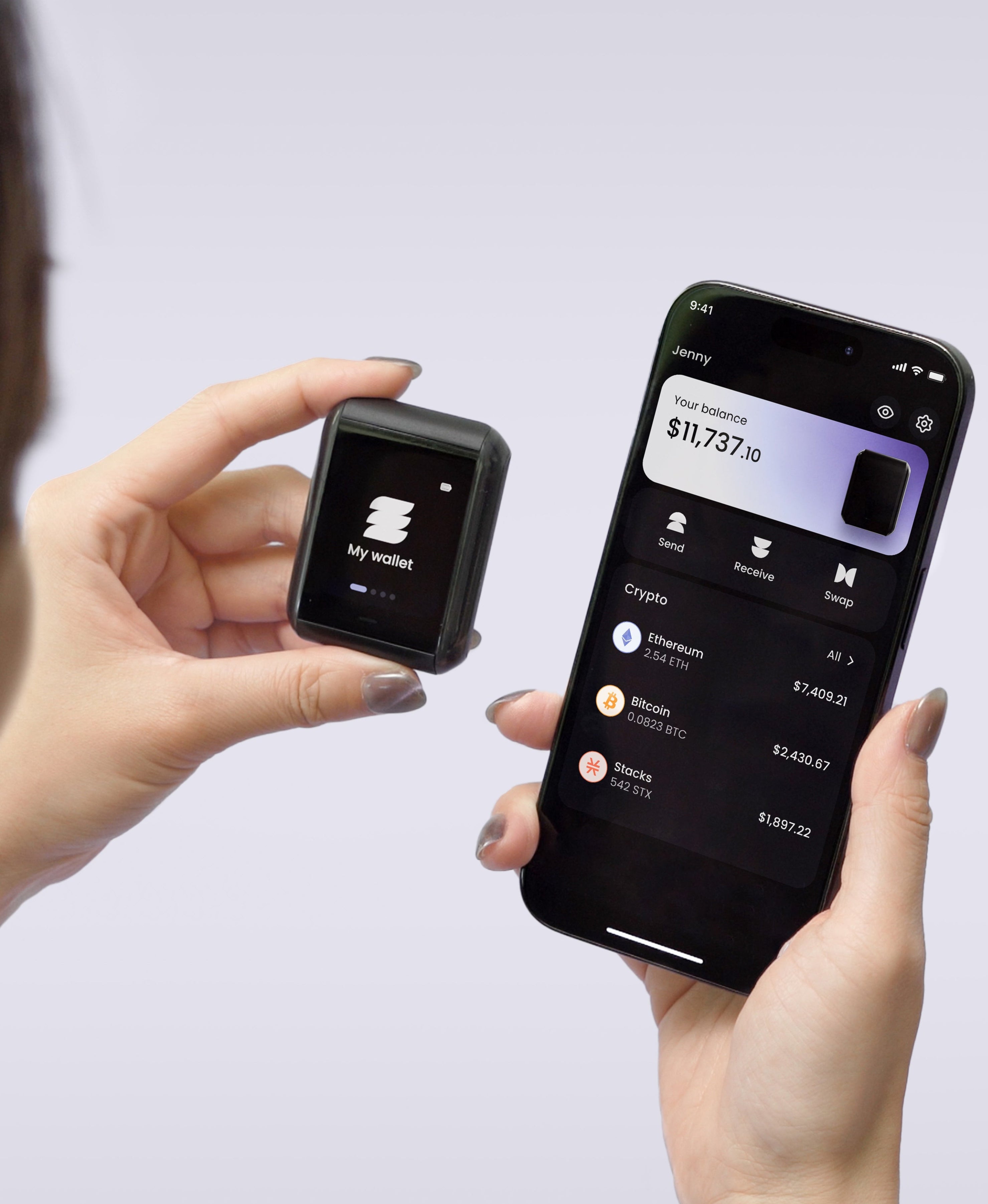
Ryder One holds Bitcoin, Ethereum, Solana, USDC, USDT, and other major assets on an EAL6+ Infineon SLC38 secure element. Every transaction is verified on the device's 1.6-inch AMOLED touchscreen before signing. For remittance senders, the touchscreen is the structural defense against address-substitution: you see the destination address on the device, not just in the app, and you reject the transaction if the address has been swapped. For the receiver side, the right tool depends on the corridor. Most receivers using crypto remittances will use a custodial app for the local conversion; the hardware wallet matters most for the sender who's repeatedly moving meaningful amounts.
The bottom line
Crypto remittances cost a fraction of what traditional remittances cost on the corridors where the tooling exists. The savings are real and the setup is worth doing for any sender making recurring transfers. The piece most senders skip is hardware-wallet signing on the sending side, which is the only practical defense against the address-substitution attacks that drain remittance flows. Get the setup right once. Then the savings compound for years.
Ryder One verifies every destination address on its own screen before signing, so the funds reach the family member you meant to send them to. See how it works.


Share: