


# Ondo Finance in 2026: OUSG, USDY, and Tokenized T-Bills
Ondo Finance spent 2024 as the "wrapper on top of BUIDL" story and 2026 as the issuer that overtook it. Ondo's suite of tokenized Treasury products has climbed past $1.5 billion in AUM by mid-2026, edging ahead of BlackRock's BUIDL for the top slot per public dashboards, while the broader tokenized US Treasury market crossed roughly $14.8 billion on-chain and Ondo Chain (the group's own Layer 1) opened to institutional partners in 2025. If you searched "ondo crypto" hoping to figure out what OUSG, USDY, and the chain each do, this is the ground floor.
In this piece, we walk through what Ondo Finance is, how OUSG and USDY differ under the hood, what Ondo Chain adds, how the category compares to BlackRock BUIDL and Franklin BENJI, what freezable ERC-20 controls mean for a self-custody holder, and where Ryder One fits.
What Ondo Finance is
Ondo Finance is a US-based issuer that specializes in bringing regulated financial products onto public blockchains. Founded in 2021 by two Goldman Sachs alums, Nathan Allman and Pinku Surana, the company shipped its first tokenized Treasury product, OUSG, in January 2023. Over the following three years, Ondo added USDY for non-US retail, launched Ondo Global Markets for tokenized US equities, and stood up Ondo Chain as a purpose-built Layer 1 for real-world assets.
Rather than wrap a single asset and call it a product, the team has been assembling the plumbing an institutional RWA market needs: a compliance-aware token standard, a settlement layer whose validators are known entities, and a bridge layer that moves tokenized shares between public chains under supervision. That approach put Ondo in the middle of nearly every meaningful RWA integration through 2025 and 2026, from Ethena backing USDe with OUSG to major derivatives venues accepting Ondo tokens as collateral.
OUSG and USDY: two tokens, two audiences
OUSG and USDY are Ondo's two flagship tokens, and the split between them explains most of what confuses first-time readers.
OUSG is Ondo's Short-Term US Government Treasuries fund token, structured as a private-placement security under Rule 3(c)(7), which limits ownership to qualified purchasers ($5 million in investments for individuals) and comparable institutional accreditations elsewhere. In late 2024 Ondo restructured OUSG to hold BlackRock's BUIDL as the primary underlying, alongside a smaller sleeve in bank deposits and cash for same-day liquidity. Yield accrues into the token price via a rebasing mechanism, and holders can redeem 24/7 through the Ondo app or via authorized participants. Because ownership is gated at the smart-contract level, OUSG transfers between non-whitelisted wallets revert on-chain by design.
USDY is the retail-facing yield-bearing stablecoin. It's issued out of Ondo USDY LLC, a bankruptcy-remote SPV, backed by short-duration US Treasuries and demand deposits at insured US banks, and available to any non-US holder after passing KYC through Ondo's onboarding flow. Where OUSG rebases in price, USDY holds a slowly appreciating value: one USDY starts at $1.00 at issuance and climbs as reserve income accrues, tracking short-end rates around 4% by mid-2026. USDY runs as an ERC-20 on Ethereum with mirrored deployments on Solana, Aptos, Sui, Mantle, and a growing list of chains via Ondo Bridge and LayerZero.
The contract-level difference between the two is subtle but load-bearing. OUSG's whitelist is a hard-coded permission list at the token level. USDY's compliance layer is a lighter-touch KYC gate at issuance and redemption, with transfers between third parties open on-chain but issuer controls (freeze, blacklist, force-redeem) written into the contract in case of court order or sanctions action. Both tokens are freezable ERC-20s with administrative powers reserved for the issuer, sitting closer to USDC's design pattern than to a bearer asset like Bitcoin or ETH.
Ondo Chain and the 2026 milestones
Ondo announced Ondo Chain in February 2025 alongside Ondo Global Markets, its tokenized US securities platform, and the chain went live for institutional partners later that year before opening to broader issuers through 2026. Its design brief reads more like a settlement layer than a general-purpose blockchain: validators are permissioned institutions (Franklin Templeton, WisdomTree, Wellington, ABN AMRO, and Google Cloud were among the initial set), block times target sub-second finality, and the chain natively supports fiat and Treasury asset issuance without a separate token-standard workaround.
Public chains like Ethereum are open by design, which means tokenized securities on those chains have to enforce every compliance restriction inside the smart contract itself. On Ondo Chain, the validator set is the compliance perimeter, so issuers can ship tokenized products with less contract-level plumbing and more predictable behavior under stress. Ondo Global Markets, live on the chain since 2025, lets non-US investors buy tokenized US stocks and ETFs directly and settle T+0 rather than T+1, using OUSG or USDY as the settlement asset. Ondo also runs bridging into Ethereum, Solana, and other public chains for holders who want to keep exposure on the venue they already use.
The tokenized Treasury landscape: Ondo, BUIDL, and BENJI
Zoom out to the whole category and three names carry the story. BlackRock's BUIDL sits near $2.85 billion in AUM and dominates institutional treasury balance sheets. Ondo's OUSG holds a large slice of BUIDL as its underlying, then adds an accessible retail sibling in USDY. Franklin Templeton's BENJI, the tokenized version of the FOBXX money market fund, remains the largest option a US retail investor can hold directly from a phone, with combined balances above $1 billion.
Where Ondo pulls ahead of both is scope. BUIDL is one fund with one wrapper and a qualified-purchaser gate, and BENJI is one money market fund with a US-retail wrapper. Ondo's suite covers institutional (OUSG), non-US retail (USDY), tokenized equities (Global Markets), and its own settlement chain, which is why RWA.xyz has Ondo's combined AUM sitting ahead of BlackRock BUIDL by mid-2026 for the first time. The comparison isn't apples to apples, given that OUSG uses BUIDL as its underlying, so a large share of Ondo's growth flows through BlackRock's fund anyway. The picture is one of stacked wrappers rather than pure competition.
Regulation catches up with the category through the GENIUS Act, signed into law in July 2025, which set the first federal framework for payment stablecoins. The GENIUS Act bans yield distribution on payment stablecoins, which sharpens the line between USDC-style payment tokens and yield-bearing tokens like USDY. USDY is registered as a security offering outside the United States and structured to sit inside that separate bucket, so the law affirmed rather than upended Ondo's product design.
The self-custody read on freezable RWA tokens
Here is the piece a lot of retail coverage misses. OUSG and USDY are freezable ERC-20s with issuer-level administrative powers written into the contract. That's the same design as USDC and USDT, and it changes what self-custody means in this category. Your private key still authorizes every outbound transfer, and no one at Ondo can move a token from a wallet whose keys they don't hold. What the issuer can do is freeze a specific address in response to a sanctions listing or a court order, block transfers to non-whitelisted destinations in the case of OUSG, and force-redeem tokens under the terms disclosed in the offering documents.
That trade is written into the underlying regulation. A tokenized Treasury or a yield-bearing dollar is a regulated security or an e-money instrument, so the issuer has to keep compliance handles on the token, the same way the manager of a money market fund keeps administrative powers a bearer instrument doesn't have. What self-custody buys you here is control over the signing key, not immunity from issuer action. Holding OUSG or USDY on your own hardware still beats parking them at a custodian by a wide margin, because you avoid platform-level custodial risk of the FTX and Celsius pattern and keep the on-chain optionality of the token itself.
Where Ryder One fits
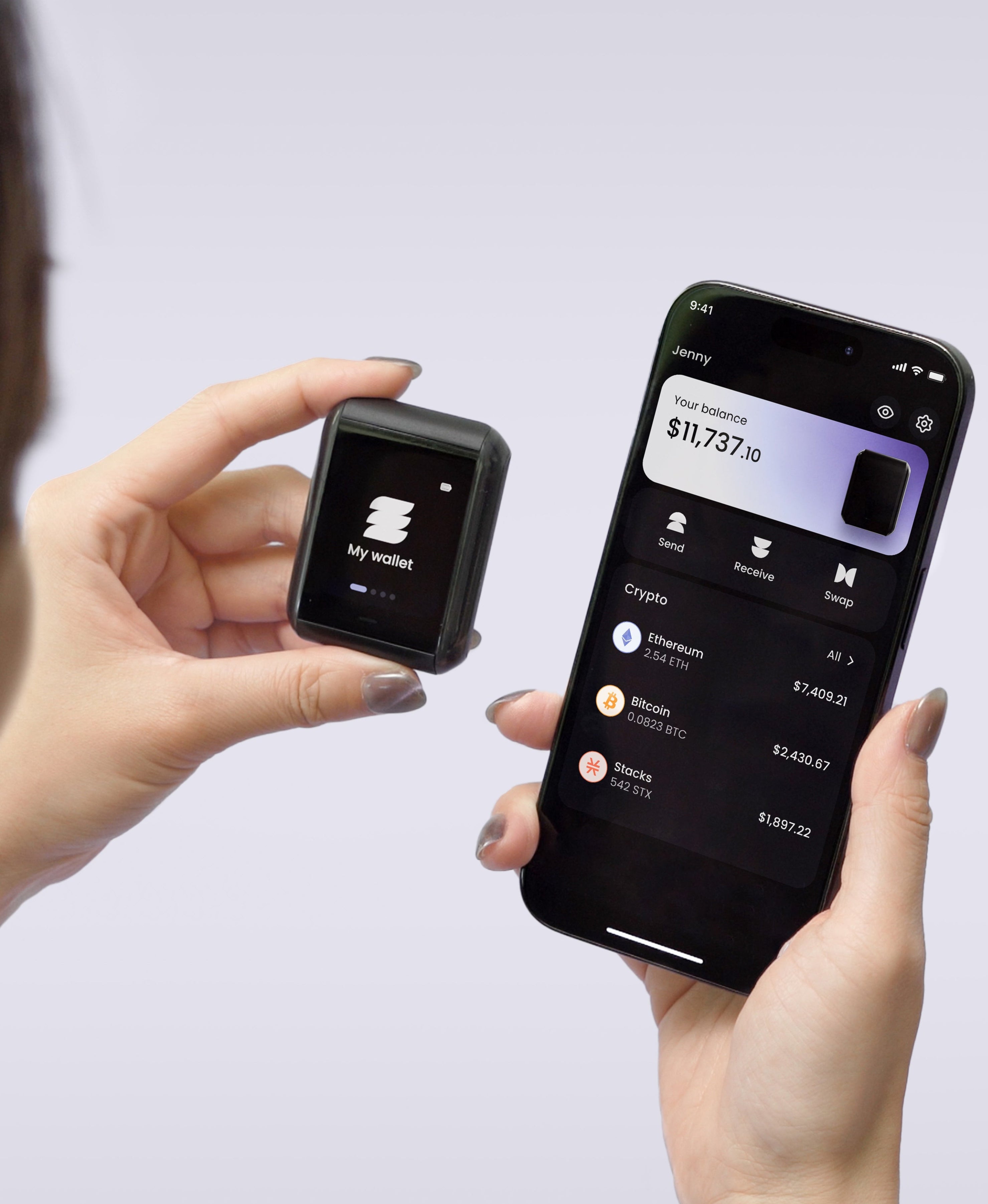
Treat OUSG and USDY like any ERC-20 or stablecoin you'd hold in self-custody. Ryder One generates and stores private keys inside an EAL6+ certified Infineon SLC38 secure element audited by Halborn, and no software path can extract those keys. When you approve a USDY transfer or an OUSG redemption, the destination address and the amount render on the 1.6-inch AMOLED touchscreen in readable form before a button wired directly to the secure element becomes active, so the signing step happens on hardware rather than inside an app that could be spoofed by a malicious browser.
Communication is NFC-only, with no USB port and no Bluetooth radio a remote attacker could pivot through, and the device charges over Qi so power doesn't open a data path either. TapSafe Recovery splits your wallet's recovery secret across a Recovery Tag (IP69K rated, 50% of the share), the paired phone with the share encrypted into iCloud or Google Drive rather than sitting on the handset (50%), and up to two optional Recovery Contacts (25% each). The BIP-39 seed phrase stays accessible on-device as a last resort, so a holder is never locked into Ryder hardware. Ryder One ships at $229 with the Recovery Tag, Qi wireless charger, and travel pouch, measures 41 x 55 x 14.5 mm at 38 grams, and carries an IP67 rating on the device with IP69K on the Recovery Tag. Practicing self-custody on OUSG or USDY works the same way it does on Bitcoin: keys inside the secure element, backup spread across TapSafe.
Bottom line
Ondo Finance turned itself into the category leader of tokenized US Treasuries in 2026 by stacking two products that solve for two audiences and adding a settlement chain underneath both. OUSG gives qualified institutions a wrapper around BlackRock BUIDL with same-day redemption, USDY gives non-US retail a yield-bearing dollar backed by short Treasuries and bank deposits, and Ondo Chain gives the whole stack a permissioned settlement venue with named institutional validators. For a self-custody holder, both tokens read as freezable ERC-20s with issuer controls, so the playbook is the same one you already run on USDC and USDT: your hardware wallet holds the signing key, and the offering documents tell you which administrative handles the issuer can pull.
Hold your tokenized Treasury exposure with keys you control. Ryder One keeps OUSG, USDY, and every other ERC-20 offline on an EAL6+ secure element, with TapSafe Recovery as the backup.
SEO
- Target keyword: ondo crypto
- SEO title: Ondo Finance in 2026: OUSG, USDY, and Tokenized T-Bills (55 chars)
- Meta description: Ondo Finance overtook BlackRock BUIDL in tokenized Treasury AUM by mid-2026. Here is what OUSG, USDY, and Ondo Chain do for holders. (131 chars)
- Hero alt text: Ondo Finance OUSG USDY tokenized Treasuries — Ryder self-custody hardware wallet


Share: