

Most hardware wallets hand you twelve or twenty-four words at setup and wish you luck. The Bitkey wallet from Block and the Ryder One both reject that arrangement, which makes them unusual, and it makes the comparison more interesting than the usual spec-sheet standoff. Both devices decided the single written backup was the weak link. They then solved it in ways that differ on one question worth understanding before you buy: who holds the piece that saves you.
We build one of these two. We've described Bitkey from its own documentation and from independent teardowns, and where the record is unflattering to us we've said so.
What Bitkey gets right
Block shipped a device with a clear thesis, and the 2026 revision sharpened it. Bitkey runs a 2-of-3 multisig setup: one key sits in the device's secure enclave, one is generated on your phone during setup, and a third lives on Block's servers, encrypted and unusable without your involvement. Any spend needs two of the three. Normal daily spending uses your device plus your phone, so Block sits out of the transaction entirely.
That structure buys something the standard model can't offer. Lose the hardware and you're not finished, because there's an optional "transfer without hardware" mode where your phone and the server key co-sign up to a limit you set. No single lost object ends your access.
The 2026 device costs $250 and measures 66 x 60 x 13.6 mm at 79 grams. It added a touchscreen for on-device transaction verification, correcting the most-criticised gap in the original model, which shipped without a display. A fingerprint sensor unlocks the device and approves actions. It handles Bitcoin.
Best for: Bitcoin-only holders who want recovery that survives losing the device, and who are comfortable with a company holding one key in the arrangement.
Worth knowing: Two things. The firmware is published on GitHub under the MIT licence, but it can't be reproducibly built, because the fingerprint sensor depends on a third-party matching library Block is contractually barred from releasing. WalletScrutiny records this as a "nosource" verdict, meaning you can read the code and still can't confirm the device is running it. Separately, your recovery path includes a key held by a company, so it depends on Block continuing to operate and cooperate. That's a reasonable bet for many people. It's still a dependency the standard model doesn't have.
What Ryder One gets right
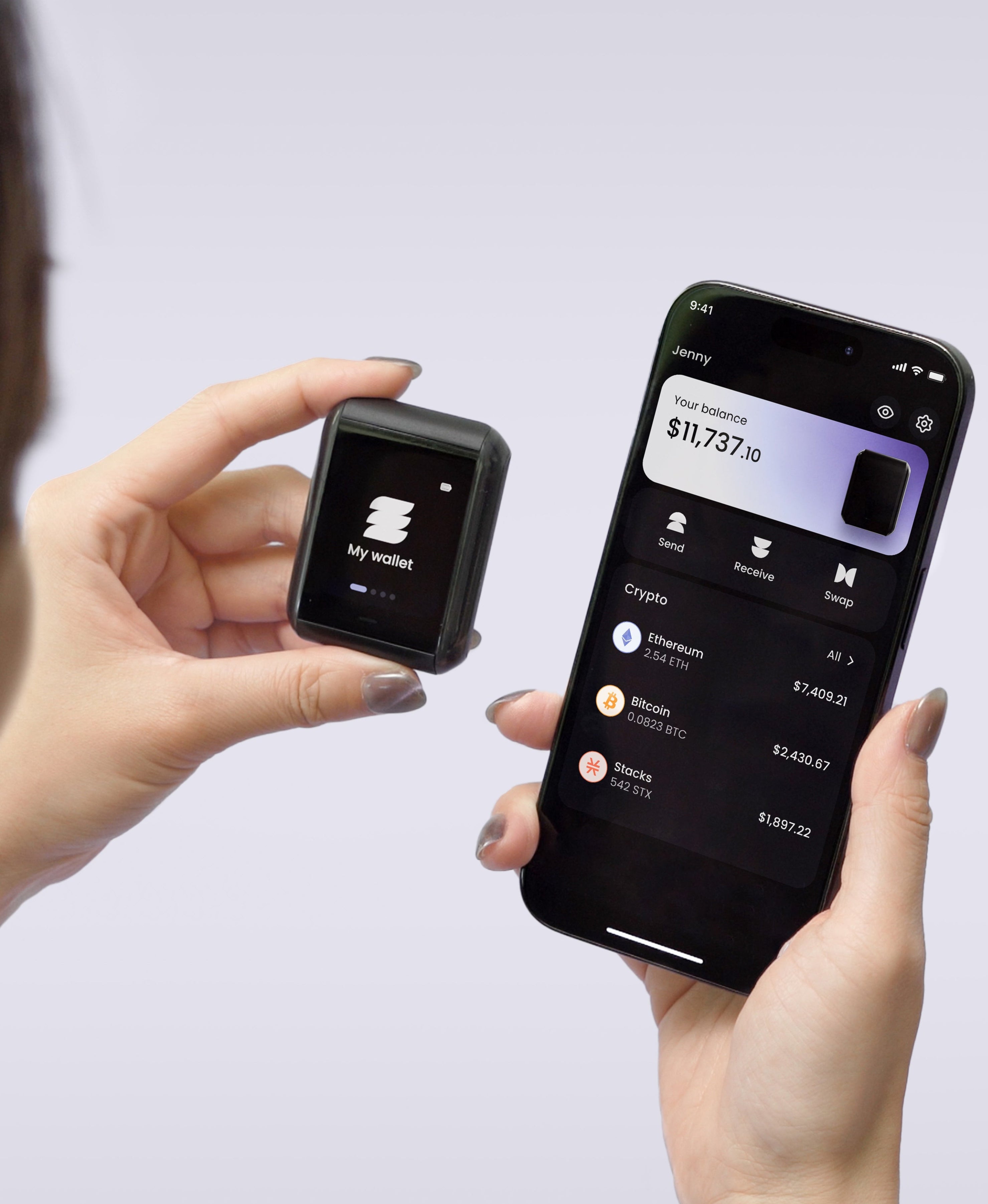
The Ryder One is $149.00 for the Starter Combo and $179.00 for the Super Safe Combo, which adds two extra Recovery Tags. It measures 41 x 55 x 14.5 mm at 38 grams, runs a 1.6-inch AMOLED touchscreen, and wireless-charges over Qi from the charger in the box.
Keys are generated inside an EAL6+ certified Infineon SLC38 secure element and never leave it. Firmware was independently audited by Halborn with the full report public. Like Bitkey, it talks to your phone over NFC, and it has no other radio: no Bluetooth, no Wi-Fi, no wired data path. Transactions render in readable detail on screen before approval, and the confirmation button is wired straight to the secure element.
Best for: People holding Bitcoin, Ethereum, Solana and major ERC-20 or SPL tokens who want split recovery with no company in the loop.
Worth knowing: There's a battery to charge, and the supported coin list is narrower than a general-purpose wallet chasing long-tail altcoins.
Side by side
| Bitkey (2026) | Ryder One | |
|---|---|---|
| Price | $250 | $149.00 (Starter), $179.00 (Super Safe) |
| Size and weight | 66 x 60 x 13.6 mm, 79 g | 41 x 55 x 14.5 mm, 38 g |
| Screen | Touchscreen, on-device verification | 1.6" AMOLED touch, 320x360 |
| Connectivity | NFC | NFC only |
| Unlock | Fingerprint sensor | Randomised passcode keypad |
| Key storage | Secure enclave | EAL6+ Infineon SLC38, keys generated in-chip |
| Firmware transparency | MIT on GitHub, not reproducibly buildable | Halborn audit published in full |
| Assets | Bitcoin | Bitcoin, Ethereum, Solana, major ERC-20 and SPL tokens |
| Recovery model | 2-of-3 multisig, third key held by Block | TapSafe Recovery, shares held by you |
| Seed phrase | Not exposed in normal use | Available on-device as a last resort, BIP-39 |
The question that separates them: who holds the piece that saves you
Both wallets agree the single written phrase is a bad foundation. Where they part company is what replaces it.
Bitkey replaces it with multisig and puts the third key on Block's servers. Your two keys do the daily work, and the company's key exists for the day something goes wrong. The design is sound and the encryption means Block can't move your Bitcoin on a whim, since one key alone authorises nothing. What you're accepting is that your recovery route runs through a corporate service. Companies get acquired, change terms, exit markets, and occasionally shut products down.
TapSafe Recovery splits the backup without adding a company to it. Your Recovery Tag holds 50%, your paired phone holds the other 50% encrypted in your own iCloud or Google Drive rather than on the handset, and bringing the two together restores the wallet. Recovery Contacts are optional: people you choose, holding 25% each, able to see nothing about your wallet, set up in person with an NFC tap. It runs on a custom implementation of Shamir's Secret Sharing rather than multisig, and the two approaches carry different properties worth understanding on their own, which we've covered separately.
The seed phrase doesn't vanish on either device, and we'd distrust any wallet claiming it had. On the Ryder One it stays reachable on-device as a last resort and follows the BIP-39 standard, so you can walk your keys to another wallet whenever you like. What changes is that nothing in normal use forces you to depend on it.
Which one should you buy
Pick Bitkey if you hold Bitcoin and nothing else, if a fingerprint unlock suits how you'd use a wallet, and if a company holding one recovery key reads to you as a safety net rather than a string attached. At $250 it's the more expensive device, and for a single-asset holder who wants a spending path that survives losing the hardware, it earns that.
Pick the Ryder One if your holdings run past Bitcoin, if you want the key generated inside certified silicon with an audit you can read, and if you'd rather every share of your backup sat with you and people you chose. It's also the lighter device by half, which matters more than spec sheets suggest for something you'll handle for years.
The honest summary: these are the two wallets treating the backup problem as a design question rather than a disclaimer, and the choice comes down to whether you'd rather trust a company's uptime or your own distribution of shares. Both beat writing words on a card and hoping.
Want split recovery with nobody else holding a piece? Get your Ryder One.
Meta description: Bitkey wallet vs Ryder One compared: price, secure element, firmware transparency, supported coins, and who holds the recovery key when things go wrong.


Share: