


Circle Internet Group listed on the New York Stock Exchange on June 5, 2025 under the ticker CRCL, pricing its IPO at $31 per share above the initial $27 to $28 range and raising roughly $1.1 billion in the offering. On day one the stock closed at $82.84, a 167% gain that made Circle's IPO one of the most explosive debuts for any US company raising more than $500 million since 1980. The reason this listing matters to anyone holding USDC has less to do with the pop and more to do with what it forced into the open: Circle now files quarterly with the SEC, and the accounting behind the second-largest dollar stablecoin sits under public disclosure rules for the first time.
In this piece, we walk through what the IPO changed about USDC's disclosure profile, how the GENIUS Act intersects with Circle's business model, where CRCL has traded since listing, how USDC compares against Tether, and what a self-custody holder should take from a stablecoin issuer becoming a public company.
What Circle's IPO put on the table
The offering priced 34 million shares at $31 and gave Circle a market value near $6.8 billion at pricing. That value expanded on the open. Circle's own pricing announcement confirmed the upsize from the original range, and the shares moved into the mid-$90s during the first trading session before drifting to close at $82.84. By July 2026, CRCL trades near $64 with a market capitalization around $18.6 billion, still well above the IPO valuation but a long way below the summer 2025 peak that briefly pushed the company past $70 billion.
What the IPO added is disclosure. Before June 2025, Circle published monthly reserve attestations from Deloitte and voluntary transparency reports, and that was the extent of what a USDC holder could rely on. Since the listing, the company files a 10-Q every quarter and a 10-K annually with the SEC. Reserve composition, revenue concentration, counterparty risk at Coinbase, and the fine print of interest-sharing arrangements all sit inside filings that carry criminal liability for material misstatements. For a stablecoin holder, that shift in disclosure regime matters more than the share price.
The business model the S-1 exposed
Circle's S-1 filing laid out a business built on one revenue line: interest income earned on the reserves backing USDC. Total 2024 revenue landed at $1.68 billion, with 99% of that figure coming from reserve income on short-term US Treasury holdings and overnight repos. The reserve pool, roughly $32 billion at the time of filing, sits 85% in BlackRock's Circle Reserve Fund (overnight reverse repos) and 15% at systemically important banks including Bank of New York Mellon.
The concentration cuts both ways. A stablecoin issuer whose reserves live in T-bills and overnight repos is easier to audit than one that owns commercial paper, gold, or Bitcoin. That's the direction Circle chose after the March 2023 Silicon Valley Bank incident exposed 3.3 billion USD of USDC reserves stuck at a failed bank and briefly pushed USDC to $0.87 on Coinbase before recovering. The rebuild moved reserves further into government paper. It also produced a business whose income line is a bet on where the Federal Reserve keeps rates. Circle disclosed in the S-1 that a one percentage-point drop in interest rates would remove approximately $441 million from annual revenue. If short rates return toward zero, the model compresses hard.
The other item the S-1 forced into daylight is the Coinbase arrangement. Circle pays Coinbase a share of reserve income tied to the amount of USDC held on Coinbase's custodial platform. The more USDC lives at Coinbase, the more of the reserve income flows there. Legal scholars have since argued that this arrangement sits uncomfortably against the GENIUS Act's prohibition on paying yield to stablecoin holders, though the parties frame the payments as a commercial partnership rather than a yield distribution.
How the GENIUS Act reshaped the setup
President Trump signed the GENIUS Act into law on July 18, 2025, six weeks after Circle's IPO. The law created the first federal framework for payment stablecoins in the United States and set out reserve, disclosure, and licensing requirements for issuers. Circle achieved full compliance before any other global issuer and now markets USDC as the regulated dollar stablecoin for institutional use.
The GENIUS Act bars payment-stablecoin issuers from paying interest, yield, or rewards to holders. That provision reshaped the competitive picture in two ways. First, it pushed the yield-bearing "stablecoin" category (tokens paying holders a share of reserve income) into a separate regulatory bucket and away from payment rails. Second, it locked in the reserve-income business model for compliant issuers: Circle keeps the T-bill yield, holders get a dollar-pegged token, and any yield distribution has to route through a distinct product with a distinct wrapper.
For USDC holders, the practical effect is that the token you hold looks more like a bank-adjacent dollar liability than a share of a Treasury fund. That's the trade the law codified. The token is easier to use as payment, harder to use as savings, and the interest sits with Circle rather than the holder.
USDC versus Tether after the IPO
USDC circulation reached roughly $78 billion by early 2026, growing faster than Tether's USDT for the second consecutive year. USDT still leads by a wide margin at approximately $183 billion, with a peak near $188 billion in April 2026 before token burns brought supply down. Tether keeps the larger stack; Circle wins the compliance narrative.
That split reflects the two ends of the stablecoin market. USDT dominates trading pairs, offshore exchanges, and emerging-market dollar demand, sitting largely outside US bank rails. USDC dominates US institutional use and any flow where a fund or a regulated broker needs a clean audit trail. The GENIUS Act pushed institutional demand toward the compliant end, which is why USDC has been the faster grower even as USDT holds the larger absolute lead. For a retail holder, both share the same underlying counterparty question: you own a claim on the issuer's reserve pool, and the security of your dollars depends on how those reserves hold up under stress.
What holders should still watch after the listing
Public-company status doesn't remove the risks that mattered before the IPO; it makes them auditable.
Reserve composition is the first watch item. Circle now discloses reserve holdings monthly and files a full breakdown quarterly. The composition today sits heavy on overnight repos and T-bills, which is the safer end of the spectrum. If that composition shifts, the disclosure trail will show it before the price action does.
Interest-rate exposure is the second. The reserve-income model wins on the way up and compresses on the way down. If the Federal Reserve cuts hard through 2026 or 2027, Circle's revenue line takes the hit, which pressures margins and eventually pressures the reserve fee model itself. That's a business-model risk on a longer horizon, not a peg risk in the near term.
The counterparty question is the third. USDC lives on banks for the cash portion and on BlackRock's fund for the repo portion. The 2023 SVB incident showed how a bank counterparty can move USDC's peg by 13 cents in a weekend. The current split reduces that specific exposure, but the general point stands: holding USDC means holding a claim, and claims wobble when their counterparties do.
Where Ryder One fits
None of the above changes the base fact that a stablecoin is an issuer claim. If you hold USDC in your own wallet, you own the token but not the dollars: the dollars sit at Circle's counterparties, and the token's value depends on Circle honoring redemption. If you hold USDC on an exchange, you don't even own the token: the exchange does, and you own a claim against the exchange. Ryder One sits at the first layer of that question: it holds the private keys that control your on-chain USDC, so at least the token side of the claim lives with you rather than a custodian.
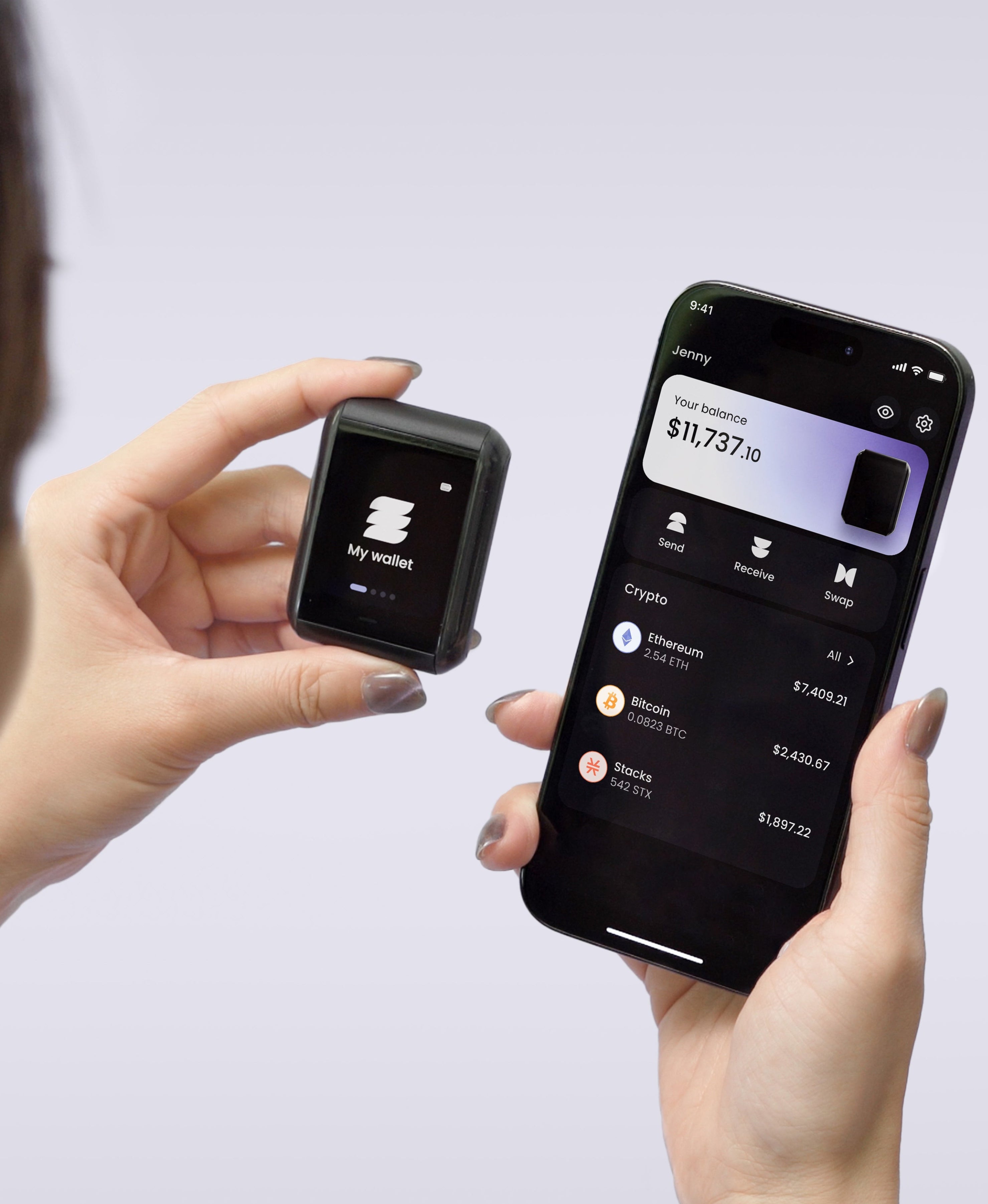
We built Ryder One around an EAL6+ Infineon SLC38 secure element with a 1.6-inch AMOLED touchscreen. Every USDC transaction (send, swap, approve) is verified on the device before signing. NFC-only communication keeps wireless data paths out of the picture, and Qi wireless charging handles power without exposing a data port. Ryder One ships at $229 with a Recovery Tag, Qi wireless charger, and travel pouch.
Backup lives inside TapSafe Recovery, our answer to the seed-phrase-on-paper problem. The Recovery Tag holds 50% of the recovery share; your paired phone holds the other 50% encrypted in iCloud (iOS) or Google Drive (Android) rather than on the phone itself. You can add up to four Recovery Contacts, each holding 25%, for further redundancy. The BIP-39 seed phrase remains accessible on-device as a last resort, so the wallet never locks you to our hardware. For readers newer to the topic, our self-custody explainer walks through what the model does and doesn't cover.
For a USDC holder specifically, the pitch is simple. Circle going public makes the issuer more transparent; it doesn't move the token from an exchange balance to your control. That last step is what a hardware wallet does.
The bottom line
Circle's June 2025 IPO priced at $31, raised about $1.1 billion, and put the second-largest dollar stablecoin issuer inside SEC quarterly disclosure for the first time. CRCL now trades near $64 with a market cap around $18.6 billion, a long way below its 2025 peak but well above the IPO valuation. The GENIUS Act, signed six weeks after the listing, locked in the reserve-income business model and pushed institutional demand toward compliant issuers, helping USDC grow faster than USDT even as USDT keeps a wide absolute lead. For holders, the useful takeaway is that Circle's disclosure has improved, the business-model risks are now auditable, and the token remains an issuer claim regardless. Whether you keep dollars on-chain or fiat, the layer you control is the wallet holding the keys.
Own the keys that hold your USDC. Ryder One keeps your private keys offline on an EAL6+ secure element, with TapSafe Recovery as the backup.
SEO
- Target keyword: circle ipo
- SEO title: Circle IPO Explained: What It Means for USDC Holders (52 chars)
- Meta description: Circle's June 2025 NYSE IPO raised $1.1B under ticker CRCL. Here is what public-company status changes for USDC holders in 2026. (128 chars)



Share: