

Moving your coins into cold wallet crypto storage is the single biggest security upgrade most people ever make, and it's worth doing. It also gets sold as a finish line, which it isn't. A cold wallet closes off one category of risk cleanly and leaves several others exactly where they were, so knowing which is which is the difference between being protected and feeling protected.
Here's the honest map of both sides.
What a cold wallet does
A cold wallet keeps your private keys on a device that has no live connection to the internet. Signing happens on the device, and only the signed transaction travels out. The key itself never touches a machine that a stranger can reach over a network.
That one property does a lot of work.
It removes the counterparty. When your coins sit on an exchange, you hold a claim rather than the asset. FTX made the distinction concrete in 2022 when roughly 8 billion USD of customer funds went missing, and 2026 has kept the lesson current with a run of venue closures. Keys in your own hands can't be frozen by a withdrawal halt or absorbed into someone else's bankruptcy estate.
It closes the remote-drain path. Malware that reads your clipboard, a compromised browser extension, an infected laptop: these are how hot wallets get emptied, and every one of them depends on reaching a key that's sitting on a connected machine. Move the key offline and that whole family of attacks runs out of road.
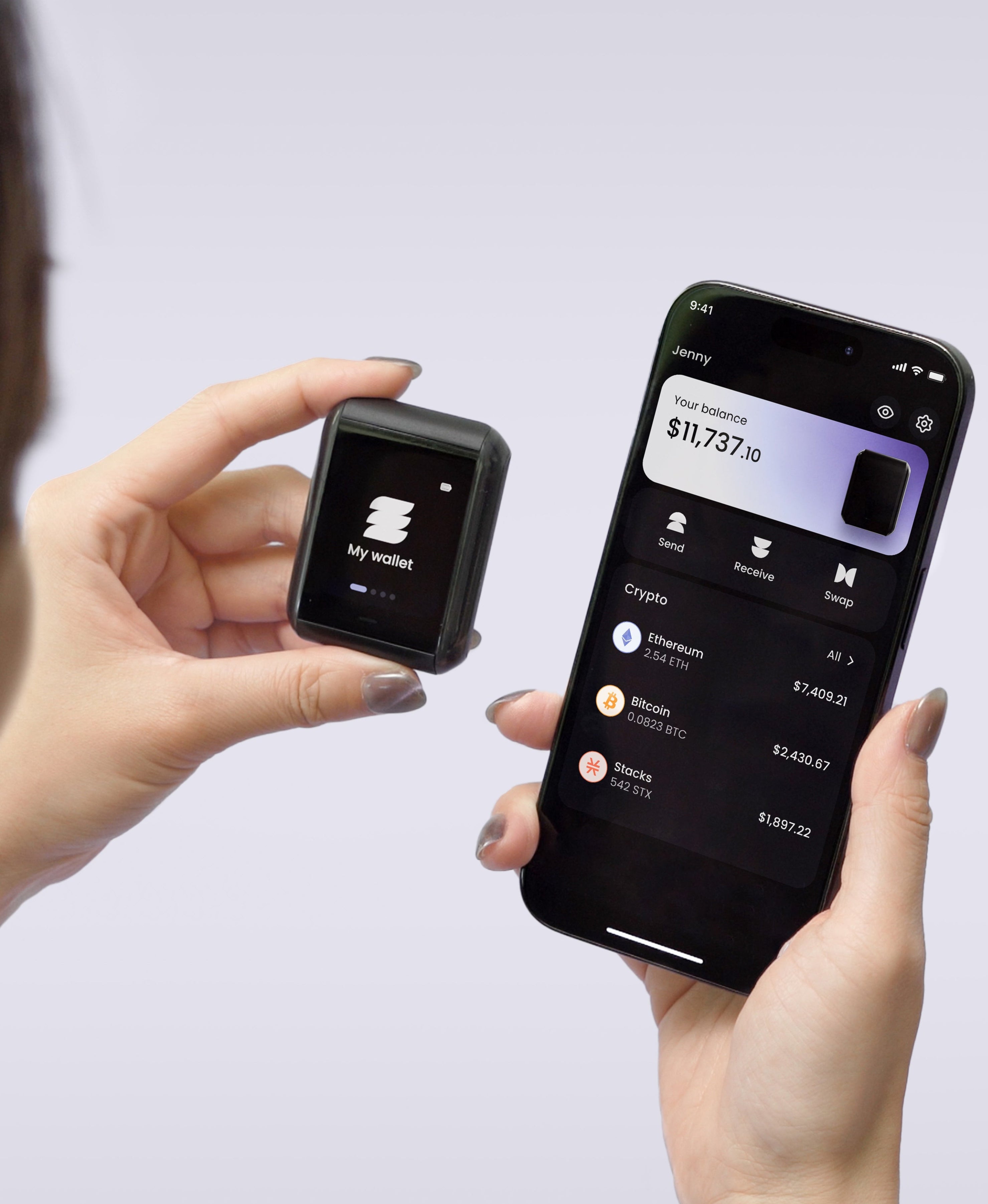
It puts a screen between you and a mistake. Any decent cold device shows you the transaction before you approve it. On the Ryder One, each transaction renders in readable detail on the 1.6-inch AMOLED display, and the confirmation button is wired directly to the secure element, so nothing signs without a deliberate press from you.
What a cold wallet doesn't do
Now the other column, which gets far less airtime.
It doesn't guarantee your key was well made. This is the failure mode of 2026. Starting 30 July, an attacker drained roughly 1,816 BTC, around 116 million USD, from more than 5,200 addresses by exploiting a build error in Coldcard firmware from March 2021 that had quietly weakened key generation from 128 bits down to as little as 40. TRM Labs documented the waves and treats the totals as preliminary. Every one of those devices was cold the entire time. Being offline protects a key from the network; it does nothing about a key that was weak the moment it was born.
It doesn't protect you from losing your backup. Cold storage moves the risk from "someone reaches my key" to "I have to keep this recoverable for decades." Paper degrades and burns. Steel survives more, though your recovery still hangs on one object being findable when you need it. House moves, floods, divorces, and plain forgetting have cost people more coins than remote attackers have.
It doesn't stop you approving something you didn't read. A screen only helps if you use it. Approving a transaction you haven't checked hands over the same authority a stolen key would, and no amount of offline storage intervenes.
It doesn't cover coercion or a co-located backup. If your recovery phrase lives in the same drawer as the device, a burglar who finds one finds both. Cold storage is a defence against remote attackers, and it was never a defence against someone standing in your house.
The backup problem is the one people underestimate
Look at that second gap again, because it's where most self-custody losses come from. The standard model asks you to write twelve or twenty-four words on something during setup and then keep that object safe and findable for as long as you hold crypto. One object. Fire, theft, water, and memory all get a vote.
Metal plates are the usual upgrade, and they're a fair improvement over paper: they survive heat and water that would destroy a card. The trade-off stays in place though, because you've made the single point of failure more durable without removing it. Everything still depends on one item existing when you need it.
TapSafe Recovery takes the split-it approach instead. Your backup divides across a Recovery Tag holding 50% and your paired phone holding the other 50%, with the phone's share encrypted in your iCloud or Google Drive rather than on the handset, so losing the phone doesn't cost you the share. Together they restore the wallet. Recovery Contacts are optional and hold 25% each, see nothing about your wallet, and get set up in person with an NFC tap. Underneath it runs a custom implementation of Shamir's Secret Sharing. Your seed phrase remains available on the device as a last resort and follows the BIP-39 standard, so you keep the freedom to move to any other wallet.
The point isn't that seed phrases are bad. It's that a backup surviving the loss of any single piece beats a backup that has to survive everything.
Buying cold storage that closes both gaps
If you're shopping, the questions worth asking go past "is it offline."
Find out where keys get generated, and whether that happens inside a certified secure element such as the EAL6+ Infineon SLC38 in the Ryder One, where the key is created in the chip and never leaves it. Check whether the firmware has been independently reviewed and whether you can read the report; ours was audited by Halborn and published in full. Look at what the device can talk to while idle, since fewer radios means fewer openings, and the Ryder One communicates over NFC only with no Bluetooth or Wi-Fi. Then look hard at recovery, because that's the gap cold storage opens rather than closes: ask whether losing one item costs you the wallet, which is the question TapSafe Recovery was built to answer.
Cold storage is worth doing. Treat it as the first decision rather than the last one, and the rest of your setup will hold up better than most.
Ready for cold storage that doesn't hand you a new single point of failure? Get your Ryder One.
Meta description: A cold wallet blocks exchange failure and remote malware, then leaves key generation and backup wide open. What cold crypto storage covers, and what it misses.


Share: