


# BlackRock BUIDL Hit $2.85B. Here's What Tokenized Treasuries Do.
BlackRock's USD Institutional Digital Liquidity Fund, ticker BUIDL, went live on Ethereum on March 20, 2024 with Securitize as the tokenization provider and transfer agent. It crossed $1 billion in AUM by March 2025 and sat near $2.85 billion by Q2 2026, placing it at the top of the tokenized US Treasury market. The fund is also live on Aptos, Arbitrum, Avalanche, Optimism, Polygon, and Solana, alongside its home on Ethereum. Every share is tokenized. Yields get paid out as freshly minted tokens straight to the wallet on the holder's whitelist.
In this piece, we walk through what BUIDL is, how the growth curve looks, the qualified purchaser gate that blocks retail from holding it directly, how everyday holders get tokenized Treasury exposure through Ondo USDY and Franklin BENJI, and where a hardware wallet like Ryder One sits in the stack.
What BUIDL is
BUIDL is a tokenized money market fund. Under the hood, the portfolio holds cash, short-dated US Treasury bills, and repurchase agreements collateralised by Treasuries, which is the same shape as a traditional prime money market fund. Each token is designed to keep a stable $1 net asset value, and the yield gets distributed daily as new tokens minted directly into holder wallets. On a 2026 basis that's been tracking around 4% APY, which lines up with front-end Treasury rates.
Where BUIDL breaks from a normal money market fund is the wrapper. Instead of shares living inside a fund administrator's ledger and settling through the DTC, each share is an ERC-20 (or the SPL, Move, or equivalent on other chains) that a holder can transfer peer-to-peer, use as collateral inside DeFi, or plug into a smart contract that expects a yield-bearing dollar. Securitize handles the compliance layer: every wallet holding BUIDL is whitelisted, transfers between non-whitelisted addresses are blocked at the token contract, and the fund can freeze or redeem holdings if the regulator requires it. The chain gives you programmability. The whitelist keeps the fund inside the securities law it's registered under.
The growth curve from $1B to $2.85B
Tokenized Treasuries had been kicking around since Franklin Templeton launched BENJI on Stellar in 2021, but BlackRock's brand pulled the category into a different orbit. Twelve months after launch, BUIDL was the first product in the space to cross $1 billion in AUM. Six months after that, it had roughly doubled again.
Part of that lift came from BlackRock and Securitize expanding the chain footprint. The fund launched on Ethereum, then added share classes on Aptos, Arbitrum, Avalanche, Optimism, and Polygon in November 2024, then Solana in March 2025, and BNB Chain later that year via Wormhole's cross-chain messaging. Each new chain opened a new set of institutional integrations: Ondo Finance restructured its OUSG fund to hold BUIDL as the underlying, Ethena moved reserves into BUIDL to back USDe, and several derivatives venues began accepting BUIDL as collateral.
The category as a whole grew with it. Tokenized US Treasury products crossed roughly $14.8 billion in on-chain value by mid-2026 across BUIDL, Ondo's suite, Franklin BENJI, Circle's USYC, WisdomTree's WTGXX, and a handful of smaller issuers. BUIDL sits at the top by a wide margin, and Ondo's OUSG (which uses BUIDL as its underlying) accounts for a large share of BUIDL's holder concentration.
The qualified purchaser gate
Here's the piece most retail coverage skips. BUIDL is a private placement under Rule 3(c)(7) of the Investment Company Act, which means the fund is closed to anyone who isn't a "qualified purchaser" under US securities law. A qualified purchaser is an individual with at least $5 million in investments or an entity with at least $25 million in investments, and the minimum initial ticket size that Securitize is willing to onboard has been $5 million since launch.
If you're an ordinary crypto holder wondering how to buy BUIDL from your phone, the answer is that you can't. The token contract itself will refuse the transfer, because your wallet isn't on the whitelist Securitize maintains for the fund. It's not a KYC form and a click-through disclosure. It's a hard-coded permission list at the smart-contract level, checked on every transfer. The token has all the programmability of an ERC-20 and none of the free composability, because free composability would be securities law violation.
That's the trade the fund made to get to $2.85 billion in a year and a half. Institutional money will only touch tokenized assets that sit inside a compliance perimeter it recognises. Making the whitelist enforceable at the token level is what let treasurers, DAOs with institutional entities, and derivatives venues put real balance sheet into BUIDL. It also means BUIDL is the plumbing under the tokenized-Treasury story rather than a product a retail holder buys directly.
How retail gets tokenized Treasury exposure
There are two ways ordinary holders end up with tokenized T-bill yield, and they both wrap around funds like BUIDL rather than replacing them.
The first is Ondo Finance's USDY, a yield-bearing dollar token designed for non-US retail. USDY is backed by short-term Treasuries and bank deposits, distributes yield through a rebasing mechanism (the redemption value climbs over time), and by April 2026 had grown past $700 million outstanding. Anyone outside the United States can hold USDY after passing KYC through Ondo's onboarding. It's the closest thing to a "retail BUIDL" that exists on public chains, and it runs on the same custody assumptions: a whitelisted wallet holds the token, transfers are gated at the contract level, and the private key on the holder's device is the object that proves ownership.
The second is Franklin Templeton's BENJI, the tokenized version of the FOBXX money market fund. BENJI is available to US retail through the Franklin Templeton app, and it records ownership on Stellar (plus Base, Polygon, Ethereum, Aptos, Arbitrum, Avalanche, and Solana). It's the largest tokenized Treasury product a US retail investor can hold from a phone today, sitting at roughly $1 billion in AUM. Superstate's USTB targets accredited US investors, and Circle's USYC (from the Hashnote acquisition) sits above $2.7 billion serving institutional counterparties.
The pattern is the same across all four. Regulated fund, tokenized wrapper, whitelisted addresses, on-chain distribution of yield. If you're the holder, the object that carries your claim is the private key that controls the whitelisted wallet. Lose that key and the fund's compliance layer can help you recover if you can prove identity, but the recovery process runs through the issuer's back office, not through the chain. The chain doesn't undo signatures.
Where Ryder One fits
Tokenized Treasuries move the "where does the money sit" question onto public chains without changing the answer to "what proves you own it." Whether the wrapper is BUIDL, USDY, BENJI, or something that ships next year, the claim is carried by a signed transaction from a wallet the issuer whitelisted. If that signing key is compromised, the position moves. If the backup sits in one place and that place is destroyed, the position ends up stuck in a permissioned wallet that only the issuer can help you recover over weeks of case-by-case review.
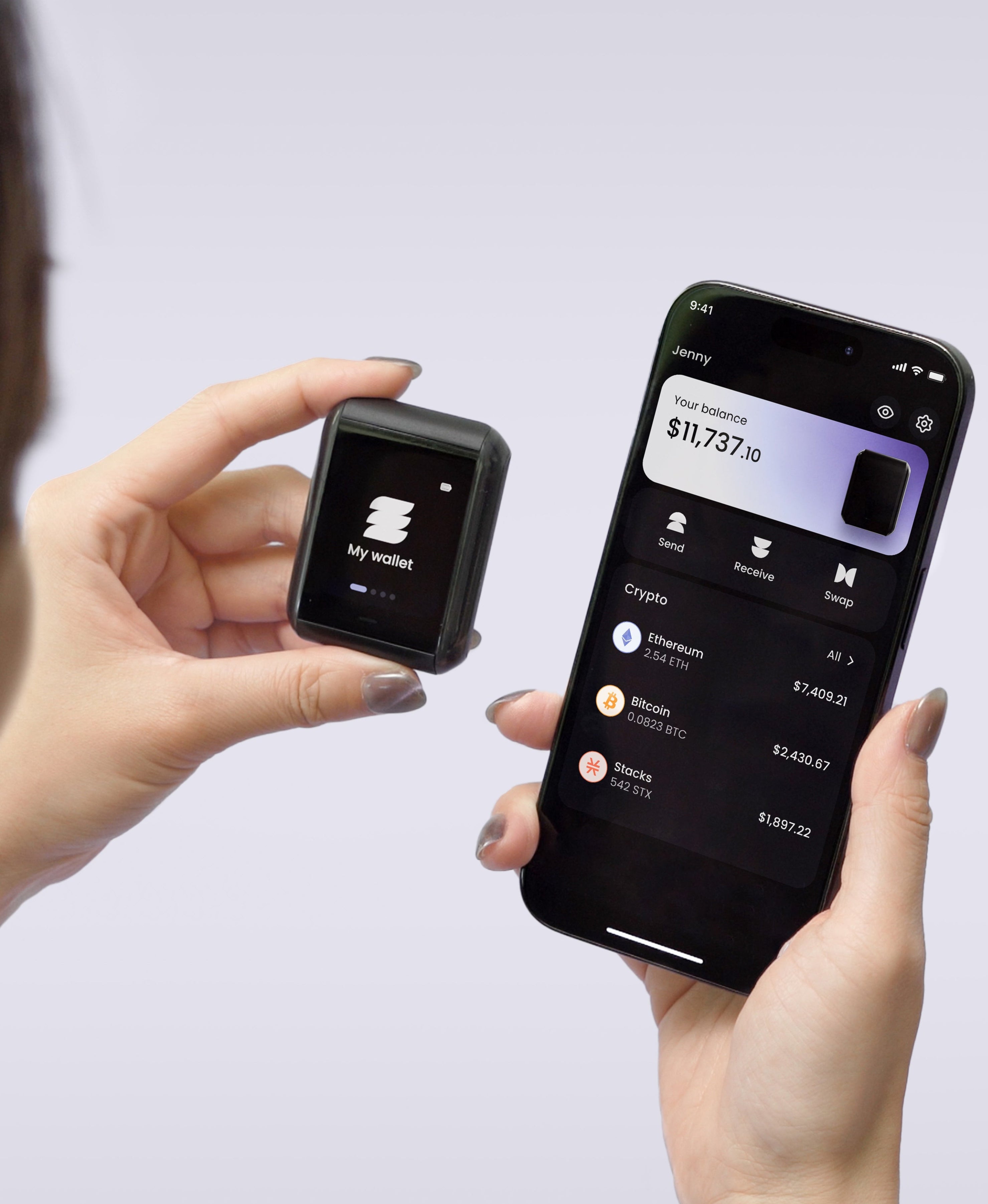
Ryder One was built for exactly this signing surface. Keys are generated inside an EAL6+ certified Infineon SLC38 secure element, audited by Halborn, and never leave the chip. When you approve a BUIDL redemption, a USDY transfer, or an Ondo Bridge routing, the destination address and amount render on a 1.6-inch AMOLED touchscreen in readable form before the button becomes active, and that button is wired directly to the secure element. Communication is NFC-only, with no USB port, no Bluetooth radio, and no wireless data channel that a remote attacker can pivot through.
Backup is where the standard playbook breaks. Paper seed phrases fail to fire, water, and misplacement. Metal seed plates upgrade the durability of the storage medium, but the security posture still rests on a single object surviving everything. TapSafe Recovery breaks the wallet's recovery secret across a Recovery Tag (IP69K rated, 50% of the share), the paired phone (encrypted into iCloud or Google Drive rather than stored on the handset, 50%), and up to two optional Recovery Contacts, none of whom ever see the wallet contents. The BIP-39 seed phrase stays accessible on-device as a last resort, so no holder is locked into Ryder hardware. Ryder One ships at $229 with the Recovery Tag, a Qi wireless charging pad, and a travel pouch in the box, weighs 38 grams, and measures 41 x 55 x 14.5 mm at IP67. Practicing self-custody on a tokenized Treasury product means both the signing hygiene and the backup posture have to hold, and TapSafe was designed so a lost tag or a lost phone alone doesn't end the story.
Bottom line
BUIDL is what happens when the biggest asset manager in the world decides to run a money market fund on Ethereum. Two and a half years in, the fund has grown to about $2.85 billion, the wrapper has proven itself as usable collateral inside DeFi, and the tokenized US Treasury category has crossed $14.8 billion in on-chain value across a handful of issuers. That's meaningful traction for a product category that barely existed in 2023.
For a retail holder, the read is more nuanced. Buying BUIDL directly requires qualifying under securities law that most individuals don't meet. Getting tokenized Treasury yield from a phone means using Ondo's USDY, Franklin's BENJI, or a similar wrapper, all of which inherit the same permissioned custody model that BUIDL introduced. Whichever wrapper you end up holding, the layer you own is defined by the private key that signs transfers, which is why the wallet that holds that key is the piece worth thinking hardest about.
Whichever tokenized Treasury wrapper you hold, the layer you own is defined by the key. Ryder One keeps that key inside an EAL6+ secure element, renders every transfer on a readable screen, and backs it up with TapSafe so no single object holds your position hostage.
SEO
- Target keyword: blackrock buidl
- SEO title: BlackRock BUIDL Hit $2.85B. What Tokenized T-Bills Do. (55 chars)
- Meta description: BlackRock BUIDL grew to $2.85B in tokenized US Treasuries by mid-2026. Here's the qualified purchaser catch, and how retail gets exposure via USDY or BENJI. (156 chars)


Share: