

A non-custodial crypto wallet is one where you hold the private keys yourself, which means no company can move your coins, freeze your balance, or restore your access if your backup is gone. That last part gets left out of most explanations, and it is the part that changes what you have to do differently. Custody answers one question: who is able to act on your coins without asking you first. Whether those coins are hard to steal is a separate question, and the two get blended together often enough that people buy the wrong thing.
The one question that sorts your wallet into the right category
The clearest test we have found comes from a company whose main business is holding crypto for other people. In its own help documentation, Coinbase writes that if you can recover access by contacting the platform or resetting your credentials, it's an exchange, and if you received a recovery phrase during setup and control your own private keys, it's a self-custody wallet. Apply that to whatever is holding your crypto today and you will have an answer in about five seconds.
The test works because it points at the thing that matters rather than at branding. Plenty of products carry the word wallet and hold your keys for you. A password reset is the tell: a company that can let you back in is a company that can also be compelled to act, or breached, or wound up.
Custodial and non-custodial, side by side
With a custodial wallet, you sign up with an email address and a password, verify your identity, and the platform manages the keys behind the scenes. Coinbase's documentation puts Coinbase itself, Binance, Kraken, Bitget and OKX in this group. You get support, account recovery, and a familiar login, and in exchange the coins sit on a balance sheet that is not yours.
A non-custodial wallet removes the company from that loop and hands you the keys. Coinbase's own list of self-custody wallets runs across mobile apps such as MetaMask, Phantom, Exodus and Trust Wallet, browser extensions, and hardware devices from Tangem, Ledger and Trezor. Nobody can freeze your balance, because nobody else can reach it. Nobody can restore it either.
One naming trap worth knowing: a brand can sell both. Coinbase the exchange holds your keys, while Coinbase Wallet is a separate self-custody app with its own recovery phrase. Same logo, opposite arrangement.
What a non-custodial crypto wallet protects you from
The whole category exists to remove one failure point, and it does that well. When a platform suspends withdrawals during an incident, when a company enters restructuring and your balance turns into a creditor claim, when an account gets frozen while a compliance review runs, none of it reaches coins held behind keys you generated. The company cannot lose what it never held.
That is a narrow benefit, and it is worth being precise about how narrow, because the phrase gets used as though it settles the security question too. Removing the custodian removes the custodian's problems and nothing else; every other way of losing crypto stays exactly where it was.
What it doesn't protect you from
Holding your own keys hands you two jobs that the exchange used to do badly but did do: approving only the transactions you understand, and keeping a backup that survives.
The scale of the first job is visible in the numbers. The FBI's 2025 Internet Crime Report, published in April 2026, logged 181,565 complaints involving cryptocurrency with reported losses above 11 billion USD, and the Bureau noted that investment fraud accounted for nearly 49 percent of all scam-related losses while Americans over 60 reported roughly 7.7 billion USD in losses, up 37 percent on the year before. Almost none of that was a broken wallet. Those were people authorizing transfers they had been talked into, and self-custody makes that outcome final rather than disputable.
The second job is quieter and catches more careful people. A non-custodial wallet with no working backup is a countdown, because the phone will eventually break, get wiped, or get upgraded.
Where the keys live, which is the question underneath
Non-custodial tells you who controls the keys. It says nothing about the environment those keys sit in, and that is where the category splits in two.
A non-custodial app keeps your keys on a phone or inside a browser profile, next to a messaging app, an email client, and whatever else you installed last month. The keys are yours, and they share an operating system with everything that might go wrong on that device. A non-custodial hardware wallet moves them into a chip that does nothing else, so a compromised phone can ask for a signature but cannot read what it is asking about.
Both are non-custodial. Only one of them takes your phone out of the trusted path, which is why the distinction is worth more than the label.
The backup problem you inherit
Most non-custodial wallets hand you a seed phrase and leave the rest to you. It is a single object holding everything, and it has to survive fire, flood, theft, house moves, and your own memory of where you put it. Some people manage that well for decades. Others find the gap on the day they need it.
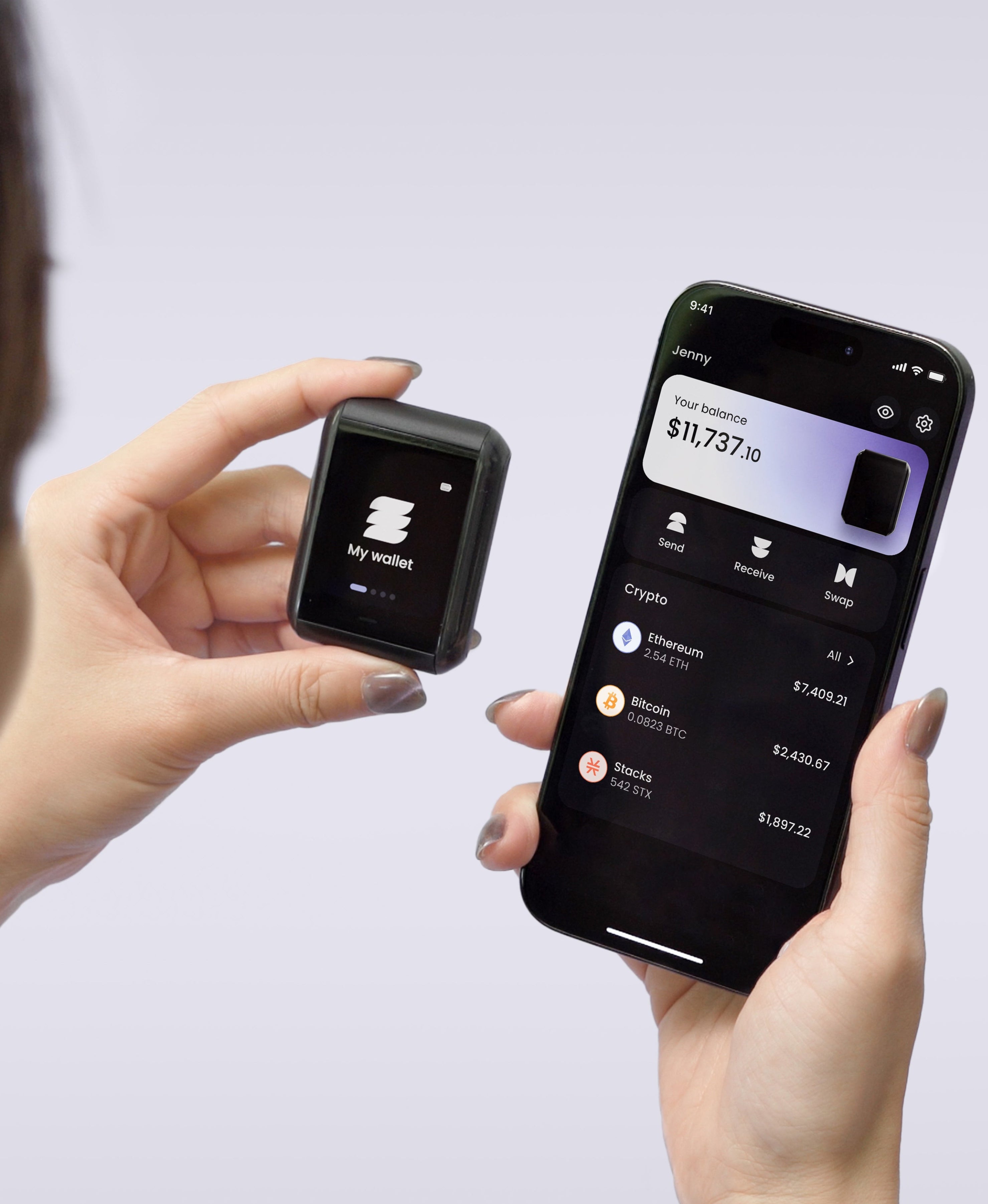
We built the Ryder One around that specific problem. TapSafe Recovery splits your backup so that a Recovery Tag holds half and your paired phone holds the other half, with the phone's share stored encrypted in your iCloud or Google Drive rather than on the handset, so losing the phone does not lose the share. Bringing the tag and the phone together gets you to a full recovery, and you can optionally add Recovery Contacts who each hold a quarter and can see nothing about your wallet. Any combination that reaches the full amount works, so two tags alone will do it, as will the phone plus two contacts. The seed phrase stays available on the device as a last resort and follows the BIP-39 standard, so your keys travel to another wallet whenever you want them to.
Choosing one without overbuying
Match the wallet to the amount and the activity rather than to the strongest option available. For a balance you are actively trading and would be annoyed rather than hurt to lose, a non-custodial app is a reasonable place to sit, and the honest advice is to keep that balance small. Once the number reaches the point where losing it would change your year, the keys belong somewhere your phone cannot reach them.
If you are still deciding whether to leave an exchange at all, start with the custody test above and work out what you are holding today. When you get to comparing devices, we wrote up what to check before you buy your first hardware wallet, which covers the specifications that change the answer.


Share: