

No. On 15 September 2026 the Senate held a cloture vote on the motion to proceed to H.R. 3633, the Digital Asset Market Clarity Act, and it fell short. The tally came in at 49 to 50, eleven votes below the sixty needed to break a filibuster and one vote below a simple majority. If you've been waiting to hear whether the CLARITY Act passed before deciding how to hold your crypto, that wait is over, and the answer changes less about your position than the headlines suggest.
We wrote about what the bill covered the week before the vote. This is what happened, and what it leaves standing.
How the vote broke down
Not a single Democrat voted yes, which is what ended it. Four Republicans also voted against the motion: Collins, Hawley and Moran opposed it on the merits, with community-bank objections to stablecoin yield reportedly driving part of that, while Tillis voted no as a procedural move so that a motion to reconsider stayed available. Seven Democrats who had spent months negotiating the text, among them Gillibrand, Warner, Booker, Warnock, Gallego, Alsobrooks and Cortez Masto, voted against the bill they had helped shape.
Warner explained his position by pointing at unresolved conflict-of-interest questions, saying that failure to address them made it impossible for him to support moving forward. Senator Lummis, one of the bill's sponsors, put it more bluntly before the vote: "I think we're done. It's over."
The self-custody language that went down with it
Here is the part worth understanding if you hold your own keys. The final substitute text carried amendments to the Blockchain Regulatory Certainty Act that would have created a civil safe harbor for developers of non-custodial software and relieved them of money-transmitter registration requirements. In plain terms, someone who writes wallet code that never touches your coins would have had a statutory answer to the question of whether they are running a money transmission business.
That mattered because the question has been live in court rather than settled in law, and prosecutions touching non-custodial software have made developers nervous enough to geofence Americans out of products. A safe harbor written into statute would have put a floor under that. The floor didn't get built.
For you as a holder, the practical effect is narrower than it sounds. Nothing in the failed vote restricts your right to run a wallet, hold a private key, or move coins between addresses you control. What you lost was a promise of stability, so the rules covering the tools you use stay a matter of agency interpretation and case law for now.
What governs your crypto tomorrow morning
With the legislation stalled, the SEC and CFTC keep writing rules through their own processes, and those processes move without a floor vote. The bill stays on the Senate calendar, Tillis's motion to reconsider preserves a path back, and Senator Kennedy has suggested any renewed attempt may wait for the lame-duck session. Floor time before the midterms is scarce, which is a polite way of saying nobody should plan around this passing in 2026.
That leaves the arrangement most self-custody holders were already operating under. Your claim on your coins is enforced by whether you can produce a signature, and no vote in Washington adds to or subtracts from that. Exchange balances are different, because those are claims against a company, and companies are exactly what regulation reaches first.
Why a stalled bill is an argument for holding your own keys
Every time a market structure bill stalls, the same thought goes through a lot of people's heads: maybe it's safer to wait and leave everything on a platform until the rules firm up. The logic runs backwards. Regulatory uncertainty is a risk that lands on intermediaries, because an intermediary is the thing that can be licensed, restricted, frozen, or ordered to hand over records. A key sitting in a chip in your drawer has no compliance department and no counterparty.
Bitcoin's history has a decade of examples. Mt. Gox, FTX with eight billion dollars of customer funds in 2022, Binance's 4.3 billion dollar settlement with the Department of Justice in 2023: none of those losses came from someone signing their own transactions. They came from balances held by other people.
Where the responsibility lands instead, and the backup question
Holding your own keys moves the failure point from a company to your own arrangements, and that is a trade most people are glad to make once they've set it up properly. The part they underestimate is recovery. A seed phrase on paper is one object away from total loss, and steel plates, while a sensible upgrade in durability, keep the same shape of problem: everything depends on one item surviving, staying private, and staying findable.
TapSafe Recovery splits that dependency. A Recovery Tag holds half of what's required, your paired phone holds the other half encrypted into your own iCloud or Google Drive rather than on the handset, and optional Recovery Contacts hold a quarter each while seeing nothing about your balances. It runs on a custom implementation of Shamir's Secret Sharing, and the seed phrase stays available on-device as a last resort under BIP-39, so your recovery never becomes a single object anyone can burn, read, or lose.
The takeaway
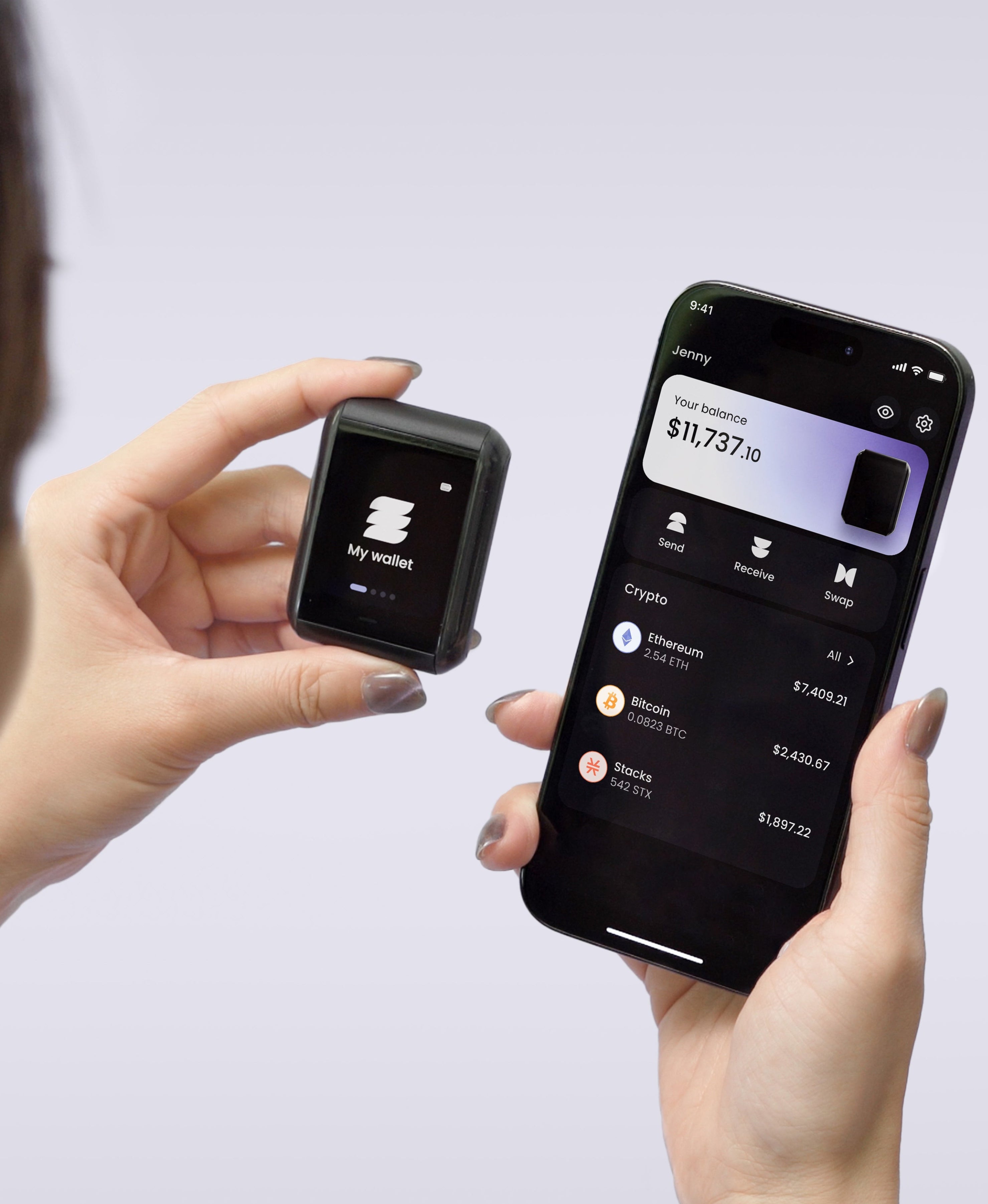
The CLARITY Act didn't pass, the self-custody safe harbor went with it, and the legal picture for American holders in 2026 stays roughly where it was in August. What you can control is where your keys live. The Ryder One keeps them inside an EAL6+ certified secure element that communicates over NFC alone, with every transaction drawn in full on a 1.6-inch AMOLED screen before you approve it. Setup takes three taps and under a minute, and the Starter Combo is 149 USD with the Recovery Tag, wireless charger, and pouch included. Get your Ryder One.
Meta description: Did the CLARITY Act pass? The Senate cloture vote failed 49 to 50 on September 15, 2026. What the lost self-custody safe harbor means for American crypto holders.


Share: