

The argument about seed phrases usually happens at the wrong moment. People compare the two models while everything is working, when the seedless option looks obviously easier and the twelve words look obviously old. The comparison that matters is the one you run on the day the device is gone, and that day rewards different things.
A seedless wallet is also four or five different products wearing one label, which is where most of the confusion starts. Worth separating them before asking what recovery looks like.
What "seedless" covers
Split or sharded backups take one secret and divide it into pieces, usually with Shamir's Secret Sharing, so that some threshold of pieces reconstructs it. There is still a master secret underneath; you are no longer carrying it as a single written object.
MPC and keyless wallets never assemble a whole key anywhere. Shares live across your device and a provider's servers, and signing happens collaboratively. Recovery usually runs through the provider's account system, which is why these feel familiar to anyone who has reset a password.
Passkey wallets lean on your phone's secure hardware and your platform account, so recovery follows Apple's or Google's rules rather than the wallet's.
Smart-contract and social recovery wallets put the rules on-chain: nominated guardians can vote to reassign control. Recovery depends on those people being reachable and on the contract behaving as written.
These share a marketing phrase and almost nothing else. The thing they have in common is that the recovery event is a process rather than an act of transcription.
What recovery looks like with a seed phrase
You buy a new device, choose restore, and type the words in order. If they are right, your wallet reappears and nobody needed to approve anything.
Three things go wrong in practice, and none of them involve cryptography. The words can be transcribed incorrectly, which is why a word or two in the wrong place produces a valid but empty wallet rather than an error message. The backup can be unreachable at the moment you need it, in a safe deposit box on a bank holiday or a drawer in a house you no longer live in. And the wallet can restore to the wrong derivation path, showing a zero balance that sends people into a panic over an account that is fine.
What the model gets right is independence. There is no company whose survival you depend on, no account to be locked out of, no support queue, and no third party who can be compelled to act. The words will work in ten years against any wallet that implements the same standard.
What it asks in return is that you keep one secret both secret and intact for as long as you hold crypto, with no margin for a single accident.
What recovery looks like without one
It depends entirely on which of the four things you bought, so the only useful move is to read your own vendor's process before you need it.
With a split backup, recovery means gathering enough shares to meet the threshold. The upside is obvious: any single lost piece is survivable. The cost is that you now have a small logistics problem instead of a storage problem, and you need to know where each share is and how many you need.
With MPC or a keyless wallet, recovery usually means proving who you are to a provider. That is easier on a bad day, and it introduces a dependency the seed-phrase model does not have: if the provider changes its terms, suffers an outage, or stops operating, your recovery path is affected by a decision you did not make. Ask what happens to your funds if that company disappears, and accept only a specific answer.
With passkeys, you have inherited a platform's account-recovery rules, which are outside the wallet vendor's control and can change.
With social recovery, you depend on your guardians still being contactable, still holding their keys, and still willing. That works well for people with a stable circle and poorly for people without one.
None of this makes seedless worse. It makes the failure modes different: seed phrases fail through loss and transcription, and seedless models tend to fail through dependency.
The question to ask instead
"Seed or seedless" is the wrong frame, because the thing that decides your outcome is how many separate items have to survive and who else is involved. Phrase it this way and ask it of any wallet you are considering:
- If one item in my home is destroyed tomorrow, do I still have my crypto?
- If one item is found by someone else, do they have it?
- Does my recovery need any company to exist, answer, or approve?
- Can I leave this product and restore somewhere else using a public standard?
A wallet that answers well on all four is rare, and the four together describe the arrangement you want far better than which camp it belongs to.
How TapSafe answers those four, including the part people miss
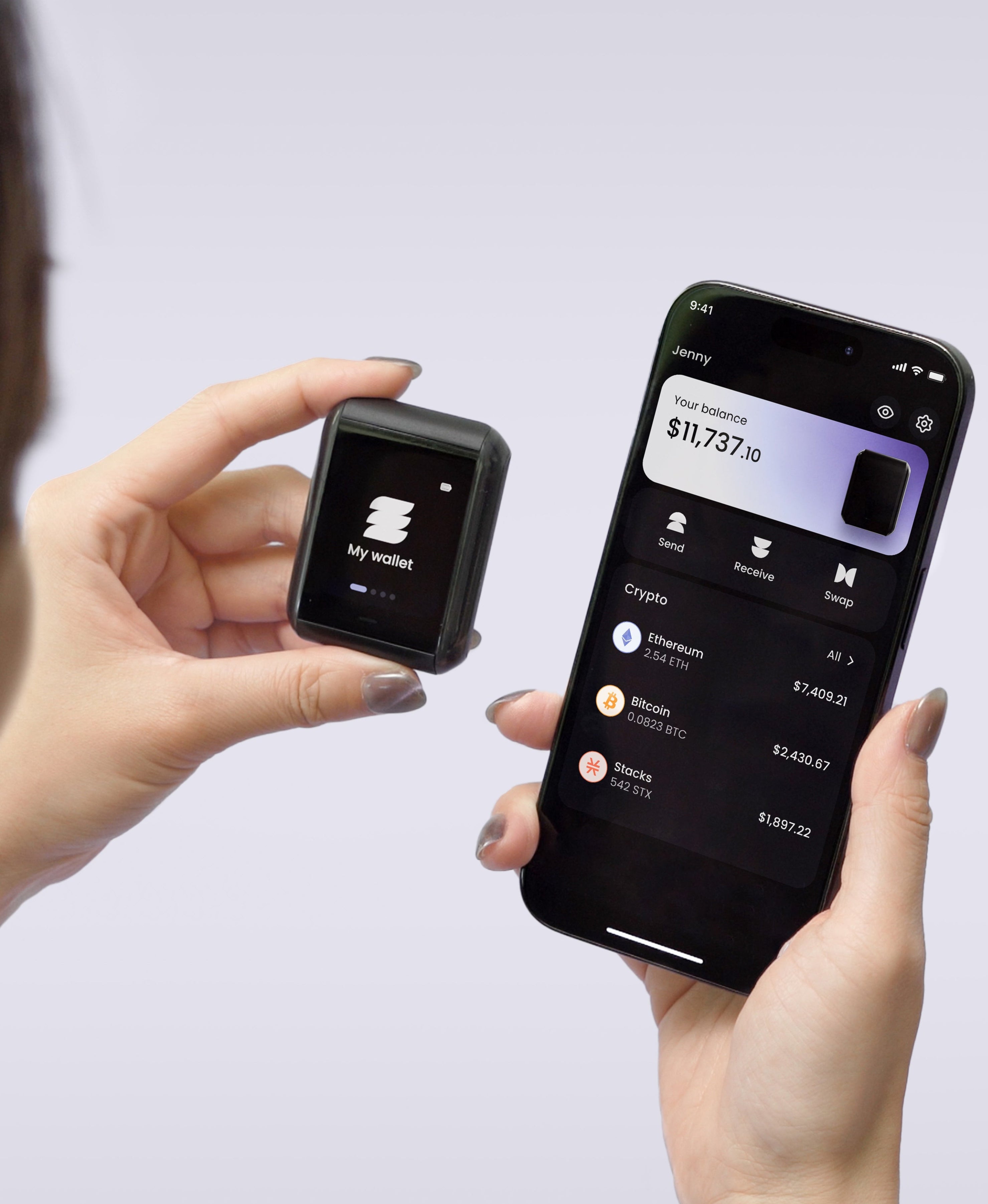
We built TapSafe Recovery around that first question. Recovery is split using a Shamir's Secret Sharing implementation we wrote: your Recovery Tag holds half, your paired phone holds the other half encrypted into your own iCloud or Google Drive rather than on the handset, and optional Recovery Contacts hold a quarter each while learning nothing about your holdings. No single share opens the wallet, so a destroyed Tag or a lost phone is something you repair.
The part that gets missed, and the reason we do not describe Ryder One as a seedless wallet: your seed phrase is always available on the device as a last resort, and it follows the BIP-39 standard. You are not required to depend on it in normal use, and it is there when you want it. That answers question four, because you can restore to other hardware and walk away from us whenever you like.
On question three, no part of recovery routes through Ryder. We do not hold a share, cannot approve a restore, and cannot block one. If we stopped operating tomorrow your Tag, your phone backup and your seed phrase would all keep working.
Choosing between them
If you value independence above convenience, can be disciplined about storage, and want a backup that outlives every company involved, a well-stored seed phrase is still a sound answer and always has been.
If what worries you is the single point of failure rather than the dependency, look for a split model and check whether a master secret remains available to you underneath it. That combination gives you the resilience without giving up the exit.
If convenience is the priority and you hold an amount you could absorb losing, a keyless or passkey wallet is a reasonable choice as long as you have read the provider's recovery terms rather than assumed them.
The Ryder One is 149 USD for the Starter Combo and 179 USD for the Super Safe Combo, with the Recovery Tag and wireless charger included. Keys are generated inside an EAL6+ certified Infineon SLC38 secure element and never leave the chip, and Halborn audited the firmware independently with the report published in full. Whichever model you pick, read its recovery process before you need it rather than during. Get your Ryder One.


Share: