


# DePIN in 2026: A Guide to Decentralized Infrastructure Networks
Most crypto is bits: on-chain records, ledger entries, contracts that touch nothing outside the network. DePIN pushes in the opposite direction. Operators buy hardware, plug it in somewhere in the world, and get paid in tokens when the network uses their kit. Helium hotspots blanket cities with LoRaWAN coverage, Filecoin nodes hold petabytes of customer data, Akash GPUs train models, and Hivemapper dashcams stream street footage. When the sector works, the token is a claim on services that a paying customer already wants; when it doesn't, the token subsidises hardware nobody uses.
This piece covers what DePIN means, the sub-categories inside it, the top names in each bucket, where the sector sits in mid-2026, and how holding any of these tokens should sit alongside your custody setup.
What DePIN is
DePIN stands for Decentralized Physical Infrastructure Networks. Messari analyst Sami Kassab coined the term in a 2023 report that surveyed hundreds of projects using crypto incentives to build hardware networks in the wild. The pattern repeats across projects: a protocol issues a token, operators buy hardware and provide a service, users pay for the service in tokens or fiat that routes back to token buys, and the network rewards operators with more tokens for uptime, coverage, or throughput.
The appeal is that a small protocol can bootstrap a global network without owning any capital equipment. Helium's hotspot count crossed several hundred thousand devices at its 2022 peak, all bought and installed by people who wanted the tokens; T-Mobile ran nowhere near that many cell sites when it started as a challenger carrier. The trade-off is that networks live and die on whether the token still holds value once the initial subsidy tapers off.
The four DePIN sub-categories
Messari's original taxonomy split DePIN into four buckets by what kind of infrastructure the network provides.
Wireless networks cover hotspots and small cells that carry data or voice. Helium is the biggest name, running two flavours: Helium's LoRaWAN coverage for IoT devices and Helium Mobile's 5G buildout that partners with T-Mobile for roaming fill-in. Nodle uses smartphones as ambient Bluetooth relays for asset tracking.
Storage networks offer distributed cold and warm storage for files, backups, and archives. Filecoin holds tens of exbibytes of paid data across a global miner base, Arweave sells one-time-payment archives designed to outlive their buyers, and Sia and Storj run S3-compatible object stores at fractions of AWS's price.
Compute networks run GPU and CPU marketplaces where operators rent idle silicon. Akash rents any Docker workload; io.net aggregates spare GPUs into training clusters; Nosana focuses on inference; Render sells GPU cycles for 3D rendering and AI inference, and we covered it in the AI Crypto Tokens piece.
Sensor and mapping networks turn cameras, sensors, and connected cars into data pipes. Hivemapper builds a competitor to Google Street View from dashcams. DIMO reads car OBD-II ports to sell anonymised drive data. Grass routes web-scraping traffic through spare residential bandwidth so AI companies can hit sites they would otherwise get blocked from.
Two adjacent categories have grown enough to warrant their own labels. Energy DePINs like Powerledger and Daylight Energy tokenise rooftop-solar and grid-flexibility rewards. Peaq positions itself as an L1 built for DePIN dApps, tying multiple sensor and IoT networks under one settlement layer.
Wireless: Helium, Helium Mobile, and DIMO
Helium is the DePIN case study everyone points to. Founded in 2013 as a wireless startup, it pivoted to a token model in 2019 and reached several hundred thousand hotspots at peak. LoRaWAN coverage is patchy in places because operators pulled hardware when HNT rewards dropped, but the network still carries paying IoT traffic for Salesforce, Victor pest control, and municipal water utilities. HNT trades around $3 with a market cap near $600 million in mid-2026.
Helium Mobile is the bigger 2026 story. The service resells T-Mobile's 5G at $20 a month with unlimited data, offloading traffic to community-owned CBRS radios wherever coverage exists. Subscribers earn MOBILE tokens for sharing anonymised location and coverage data that the network sells to carriers and mapping firms. It became the first DePIN network where a Fortune 500 carrier signed a paid interconnect deal.
DIMO carries the same idea into vehicles. Owners plug a small dongle into the OBD-II port, and the car streams anonymised telemetry to the DIMO network. Automakers, insurers, and mapping firms buy the data; drivers earn DIMO tokens for participating. Around 150,000 vehicles are connected in mid-2026.
Storage and compute: Filecoin, Akash, and io.net
Filecoin is the largest storage DePIN by a wide margin, holding more paid data than most enterprise clouds outside the top three. Providers compete on price and reliability, buyers pay in FIL, and cryptographic proofs verify that data still sits on disk. FIL trades around $3 in mid-2026 with a market cap near $2.5 billion, and customers range from Internet Archive backups to genomics research at UC Berkeley.
Arweave takes a different angle: pay once, get archival storage backed by an endowment that funds ongoing replication for as long as the network survives, and Solana projects use it heavily for NFT metadata.
Akash is the largest general-purpose compute DePIN. Providers rent CPUs, GPUs, RAM, and disk; buyers spin up Docker containers with the same YAML they would use on Kubernetes. Prices run 60 to 80% below AWS for equivalent instances. AKT trades near $1.20 in mid-2026 with a market cap around $350 million, and network usage climbed sharply once AI training workloads found their way in.
io.net stacks a different bet. It aggregates fragmented GPU supply from mining rigs, Filecoin storage nodes, and independent operators into unified training clusters that AI teams can rent by the hour. IO trades around $0.60 in mid-2026 with a market cap near $150 million after a rocky first year that included founder turnover and a token airdrop that saw heavy selling.
Data and mapping: Grass and Hivemapper
Grass monetises spare home internet bandwidth. A browser extension routes AI-company web-scraping requests through participating users' connections, avoiding IP-based blocks that hit datacentre traffic. Contributors earn GRASS tokens; buyers get scraping infrastructure. The network crossed two million active nodes by the end of 2025, and GRASS trades near $1 with a market cap around $250 million in mid-2026.
Hivemapper is a decentralised Street View. Drivers install a dashcam that streams street footage; the network stitches together fresh map tiles and sells the data to logistics firms, ride-hailing platforms, and mapping providers. HONEY rewards flow to drivers based on kilometres captured and image quality. Around 100,000 dashcams are active in mid-2026, at freshness levels Google's fleet can't match on side streets.
Where the category sits in mid-2026
Messari's DePIN research pegs the aggregate category market cap at around $20 billion in the first half of 2026, split roughly between storage (Filecoin dominates), wireless (Helium and Nodle), and compute (Akash, Render on the AI side, io.net). Growth has been uneven: storage revenue exists and stays boring, wireless has plateaued, and compute keeps swinging with the AI narrative.
Regulatory questions haven't gone away. The SEC hasn't taken direct action against a major DePIN token in 2026, though the framework question sits open: is a token that rewards work performed a security, a commodity, or neither? Legal opinions differ by network and jurisdiction, and the answers will likely arrive one lawsuit at a time.
The comparison to purely on-chain networks is worth a pause. Bitcoin's mining economy is arguably the original DePIN, with miners providing security in exchange for token issuance and warehouses of ASICs doing measurable work. What Messari framed as new is that the "work" is now visible outside the blockchain: coverage, bandwidth, storage, mapping data.
Self-custody read on DePIN tokens
Almost every DePIN token is either an ERC-20 on Ethereum, an SPL token on Solana, or a token on an EVM sidechain like Base or Polygon. HNT and MOBILE live on Solana. FIL runs on its own chain but bridges to EVM. AKT, RENDER, GRASS, DIMO, and HONEY are standard-issue Solana or EVM tokens. From a self-custody standpoint, the read is the same as any Ethereum or Solana asset: the address holds the tokens, the private key signs the transactions, and a compromised key means a drained balance.
The extra wrinkle with DePIN tokens is that many operators keep hardware wallets far from their earning address, then sweep tokens periodically to cap hot-wallet exposure. If you run Helium hotspots or a Hivemapper dashcam and earnings pile up in a mobile wallet, a phone compromise means the whole pot goes with the phone. Sweeping to cold storage weekly caps that loss.
Where Ryder One fits
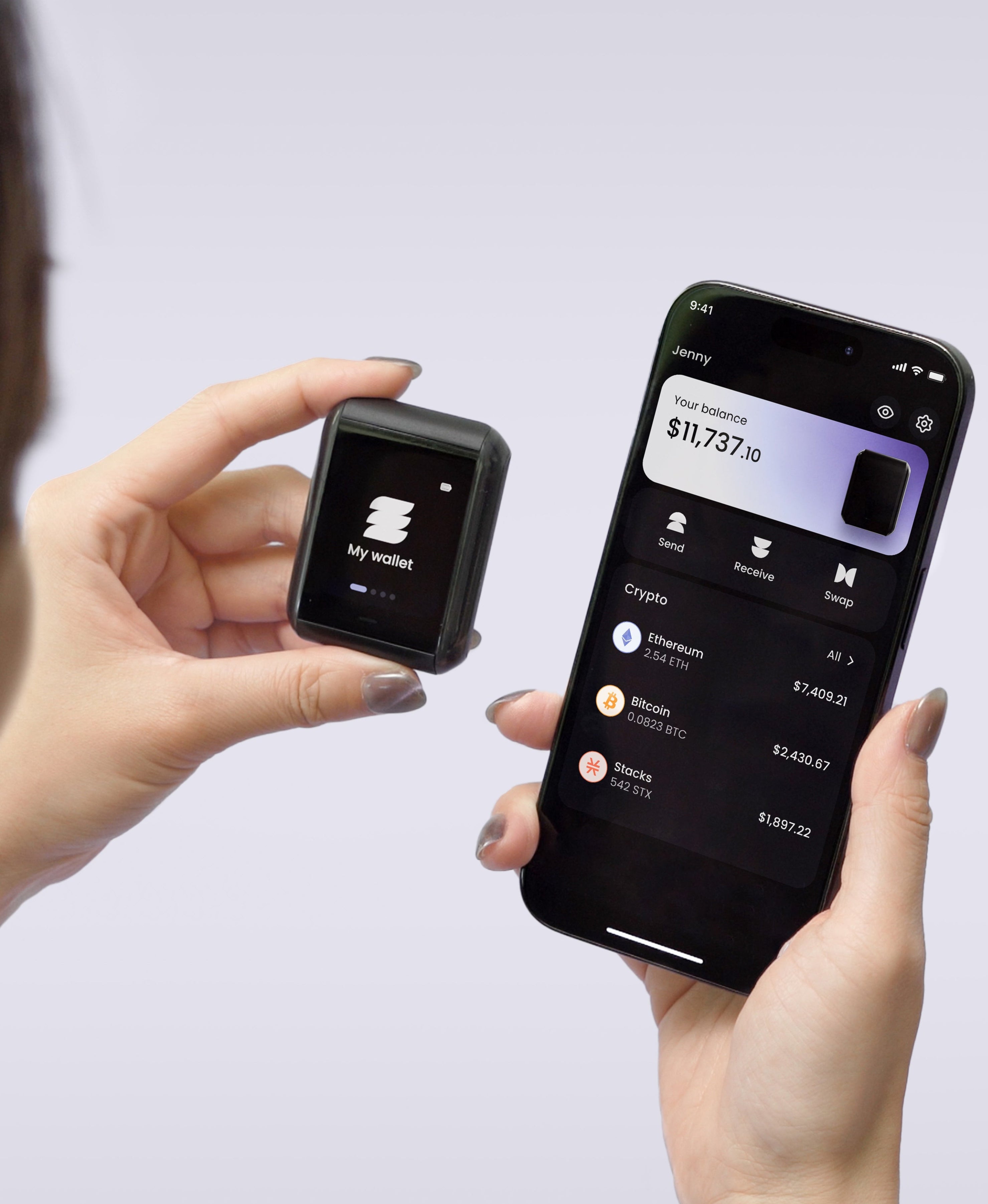
Ryder One is $229 and holds the private key inside an Infineon SLC38 secure element with EAL6+ certification and a Halborn audit on the firmware. Communication is NFC-only, so there is no USB port, no Bluetooth radio, and no Wi-Fi surface for a remote attacker to reach. Every transaction shows on the 1.6-inch AMOLED touchscreen before you tap to approve, so a compromised phone can't quietly swap a destination address behind the scenes.
Coverage matches DePIN's chain mix. Ryder One handles Ethereum and its ERC-20 tokens, Solana and its SPL tokens, plus Bitcoin and a growing list of assets on other supported networks. Backup runs on TapSafe Recovery, a Shamir-based split across the IP69K-rated Recovery Tag, an encrypted iCloud or Google Drive blob paired to your phone, and optional Recovery Contacts. Losing any single piece doesn't lose the wallet.
Bottom line
DePIN is the corner of crypto where tokens attach to hardware doing observable work. Helium hotspots carry paid traffic, Filecoin nodes hold customer data, and Akash GPUs run training jobs while Hivemapper dashcams map streets. The sector doesn't need a fresh narrative to survive because the services underneath it keep running whether or not the token narrative rotates elsewhere.
If you hold DePIN tokens, the custody read is the same as for any ERC-20 or SPL asset. Hold the keys yourself, sweep earnings off hot wallets, and keep a backup plan that doesn't hinge on one object surviving everything.
Get Ryder One for $229 and keep your DePIN bag behind keys only you can sign with.
--- SEO
Target keyword: depin
SEO title: DePIN in 2026: Decentralized Physical Infrastructure Explained
Meta description: DePIN uses crypto tokens to bootstrap real-world hardware networks. Category sits near $20B in 2026. Helium, Filecoin, Akash, Grass explained.
Hero alt text: DePIN decentralized physical infrastructure 2026 — Ryder self-custody hardware wallet



Share: