


# AI Crypto Tokens in 2026: What FET, TAO, and RENDER Do
The AI crypto sector has been the loudest corner of the market since late 2024. As of mid-2026 the CoinGecko AI category tracks a combined market cap near $22 billion, down from a spike above $26 billion in late May. The category groups a mix of very different bets: decentralized GPU marketplaces, on-chain agent frameworks, subnet-based ML networks, and the memecoin fringe that rides the same narrative.
In this piece we cover what "AI crypto tokens" means, walk through the top names, look at what the tokens do versus what buyers are speculating on, place the sector in its mid-2026 context, and where a hardware wallet sits if you hold any.
What AI crypto tokens are
The label is loose. At its broadest it covers any token whose protocol touches artificial intelligence, from decentralized compute providers renting GPUs to memecoins minted by a Twitter-bot LLM. Inside that spread live four sub-categories:
- Compute networks. RENDER and IO.NET rent GPU cycles from a distributed operator base. Buyers pay for rendering, model training, or inference; the token pays operators and, in some designs, is burned as fees clear.
- Machine-learning marketplaces. Bittensor's TAO sits here. Contributors run models inside subnets; emissions reward whichever outputs pass on-chain scoring.
- Agent platforms and frameworks. Fetch.ai (now the ASI Alliance), Virtuals Protocol, and ElizaOS let developers deploy autonomous agents that hold wallets, transact, and coordinate.
- Data collection and oracles. GRASS, OCEAN (before its Alliance exit), and NEAR AI collect training data or pipe it into on-chain models.
The buy case is different for each bucket. A compute-network token is a claim on GPU-market revenue. A subnet token is closer to a productive asset once subnets ship. An agent-platform token sits closer to a launchpad fee token: it captures value when agents launch and trade, which is a memetic economy today.
The top names, one by one
### FET / ASI Alliance
Fetch.ai, SingularityNET, and Ocean Protocol merged into the Artificial Superintelligence Alliance in early 2024, unifying AGIX and OCEAN into FET at fixed conversion rates. Phase 2 planned a rebrand to a new "ASI" ticker; Coinbase and Kraken opted out of the contract migration, so the unified token still trades as FET on most venues. Ocean Protocol withdrew in October 2025 to control its own tokenomics. FET traded near $0.16 with a market cap around $360 million by mid-July 2026, well off its early-2024 highs. The Alliance shipped an agent launchpad testnet on May 30, 2026 and a large autonomous-agent network on April 12, 2026, so protocol activity is moving even while the token price hasn't.
### TAO (Bittensor)
Bittensor is a decentralized machine-learning network built around subnets. Each subnet is a mini-market where miners compete to produce outputs (text embeddings, video segmentation, price forecasts) that on-chain validators score, with TAO emissions flowing to whichever miner sits at the top of the curve. The Robin τ upgrade in May 2026 lifted the total from 128 to 256 subnets, opening slots for new AI teams. Bittensor ran its first halving on December 12, 2025, cutting daily emissions from 7,200 TAO to 3,600 TAO against a fixed 21 million supply cap that mirrors Bitcoin's schedule. TAO trades around $250 in mid-2026 with a market cap near $3 billion, ranked around #27. This is one of the few tokens in the sector that pays for measurable AI work happening on-chain.
### RENDER
Render Network is a decentralized GPU marketplace with roots in film-grade rendering. Buyers pay operators to render 3D scenes, train models, or run inference, and RENDER settles the market. The network migrated from Ethereum to Solana in November 2023, swapping RNDR (ERC-20) for RENDER (SPL) at 1:1. Burns accelerated after that: RENDER burned 530,171 tokens between January and September 2025, up 278% year-over-year, and the pace kept climbing into 2026. Analysts project GPU compute to grow from $83 billion in 2025 to $353 billion by 2030 on AI demand, and Render is one of the few networks with a working buyer-seller loop already running.
### VIRTUAL (Virtuals Protocol)
Virtuals is an agent-launch platform on Base. Builders spin up autonomous agents, mint an agent token, and let holders capture a share of whatever revenue that agent generates from social posting, trading, gaming, or agent-to-agent coordination. VIRTUAL is the reserve currency of the ecosystem, and every agent token pairs against it. VIRTUAL touched a $5 billion market cap during the agent-mania peak in early 2025 before correcting hard, and it sits closer to $414 million with a $0.63 price by mid-July 2026. Base has kept climbing behind it, with TVL hitting an all-time high of $3.5 billion.
### ai16z / ElizaOS
The Eliza framework is the most-used open-source stack for building AI agents in crypto, and its token migrated from AI16Z to ELIZAOS at a 1:6 ratio in November 2025. Over half of new AI crypto projects in 2026 build on the framework, which supports action chaining and persistent agent memory. A class-action lawsuit landed in April 2026 alleging investor fraud around the prior AI16Z branding, so ELIZAOS now carries legal risk on top of market risk.
### WLD, FARTCOIN, GRASS, and honorable mentions
Worldcoin (WLD) is AI-adjacent because World IDs are pitched as the personhood layer for an internet full of AI agents; we covered WLD separately. GRIFT and FARTCOIN are agent-created tokens (FARTCOIN was promoted by Truth Terminal, the LLM-run Twitter account behind the first wave of agent memecoins). GRASS collects unused residential bandwidth to sell as training data. IO.NET aggregates idle GPUs, similar in shape to Render. Each sits below the top-tier plays on both product maturity and market cap.
What the tokens do versus what people are buying
This is where the category gets confusing. The token and the product are often two different things, and the price is usually pricing the product's future rather than its present.
RENDER, TAO, and FET have working networks with paying buyers and running throughput. A share of protocol revenue could theoretically accrue to token holders through fee burns or emissions dynamics, and in RENDER's case burns are already visible on-chain. VIRTUAL is a launchpad, so its revenue is agent-launch and swap fees, which correlate with agent-mania cycles. ELIZAOS is a framework token whose value sits closer to a governance claim over an open-source project. FARTCOIN is a joke that got expensive.
Treating the whole category as one trade is a mistake. A RENDER buyer is closer in spirit to a cloud-compute equity holder; a FARTCOIN buyer is buying a beta on internet attention; a TAO buyer is renting exposure to a decentralized ML economy that may or may not out-produce the closed labs at Anthropic, OpenAI, and Google. Sizing exposure by product maturity rather than narrative volume is the read that tends to survive rotations.
Where the sector sits in mid-2026
The AI category cap crossed $25 billion in June 2026 before easing back to the low $20 billion range. Compute plays (RENDER, TAO, IO.NET) have held up better than agent tokens during drawdowns, while launch-platform tokens (VIRTUAL, ELIZAOS) remain more sensitive to attention cycles. Regulators haven't paid this sub-sector the direct attention they have paid stablecoins or exchange tokens, though the ELIZAOS class-action shows fraud claims can arrive fast when tokens change branding mid-cycle.
If you're allocating in the second half of 2026, the questions are boringly familiar: does the network have paying users, does the token capture a slice of that revenue, and what happens to the price if the AI narrative rotates elsewhere. Most tokens here are microcaps to mid-caps in a volatile sub-sector, so position sizes should reflect that.
Where Ryder One fits
Every token covered here trades as an ERC-20, an SPL token on Solana, or a token on Base or another EVM chain, so custody looks the same as for any other crypto asset. The address holds the tokens, the private key signs the transactions, and a compromised key is a compromised balance.
The default path for most retail holders is a browser extension wallet or a mobile wallet on the same phone that runs their exchange app. Both work; both extend the attack surface in ways that don't show up until something bad happens. Malware families targeting Solana and EVM wallets have grown through 2025 and 2026, and the approve-here-approve-there flow AI tokens invite across Base, Solana, and Ethereum is a phisher's dream.
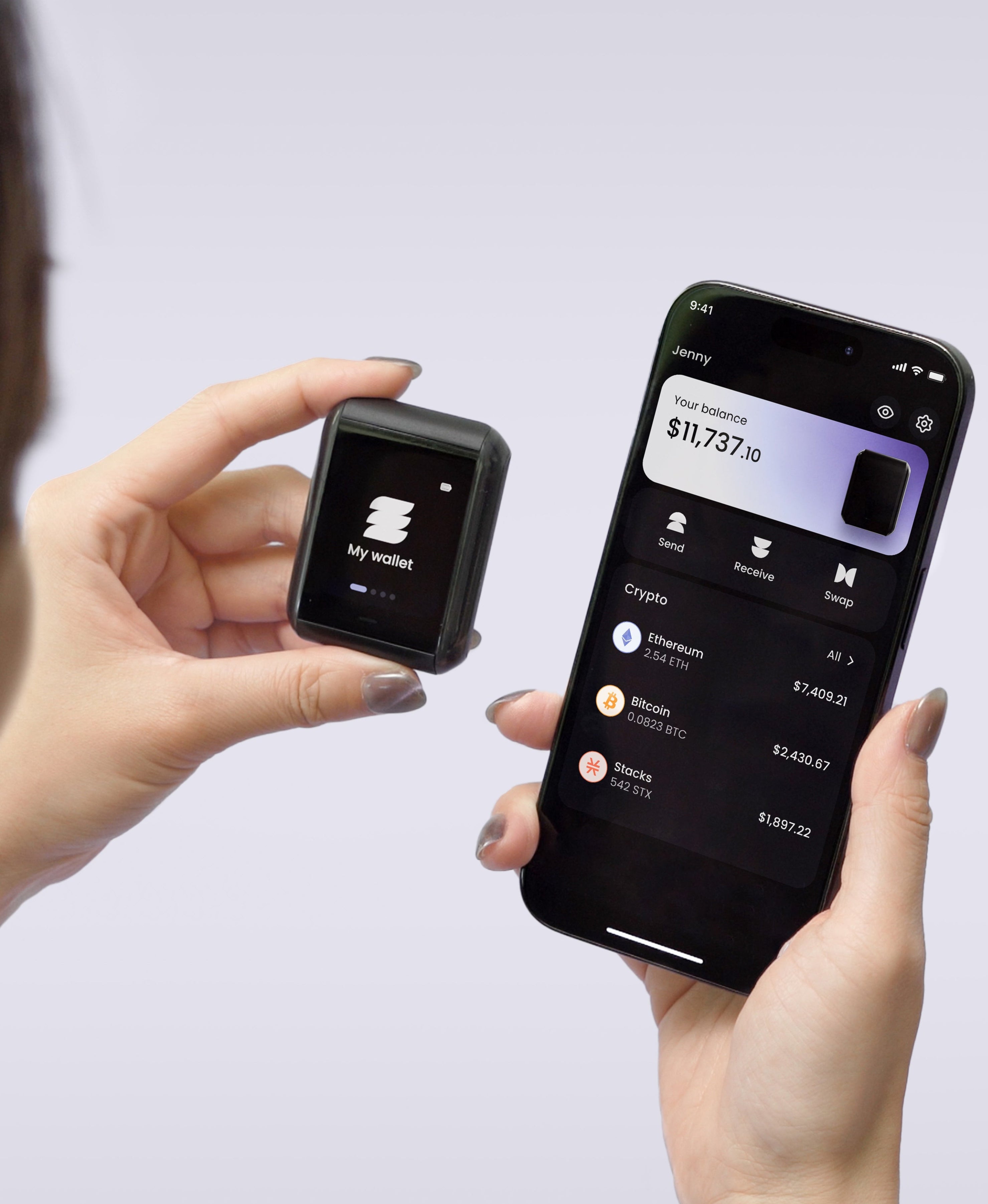
Ryder One is $229 and keeps the private key inside an Infineon SLC38 secure element with EAL6+ certification and a Halborn audit on the firmware. Communication is NFC-only, so there is no USB port, no Bluetooth radio, and no Wi-Fi surface for a remote attacker to reach. Every transaction shows on the 1.6-inch AMOLED touchscreen before you tap to approve, so a compromised phone can't quietly swap a destination address behind the scenes. Backup runs on TapSafe Recovery, a Shamir-based split across a Recovery Tag, an encrypted iCloud or Google Drive blob paired to your phone, and optional Recovery Contacts. Losing any one piece doesn't lose the wallet.
Bottom line
AI crypto is a real category and an active product frontier, and it's also a bag of very different bets. RENDER sells GPU cycles; TAO auctions ML rewards to subnets; FET runs an agent launchpad; VIRTUAL runs one for Base agent tokens; ELIZAOS ships the framework most of them build on. The tokens are speculative access to future protocol revenue, and in most cases the protocol is still proving whether that revenue will show up.
Whichever bag you pick, hold the tokens on a key you own, on hardware the internet can't reach, with a recovery plan that doesn't hinge on one object surviving everything.
Get Ryder One for $229 and keep your AI-token bag behind keys only you can sign with.
--- SEO
- Target keyword: ai crypto tokens
- SEO title: AI Crypto Tokens in 2026: What FET, TAO, and RENDER Do (54 chars)
- Meta description: AI crypto tokens sit near $22B in mid-2026. FET, TAO, RENDER, VIRTUAL, and ELIZAOS explained: what each token does and the self-custody read for holders. (156 chars)
- Hero alt text: AI crypto tokens FET TAO RENDER 2026 — Ryder self-custody hardware wallet


Share: