


The US spot Bitcoin ETF category crossed $58.7 billion in cumulative net inflows between its January 2024 launch and mid-2026. BlackRock's iShares Bitcoin Trust (IBIT) has captured the majority of that flow. As of the March 2026 fact sheet, IBIT held roughly 777,872 BTC worth about $54.4 billion, more than the next four issuers combined. For a Bitcoin holder trying to read what those flow numbers mean, the interesting question isn't the AUM chart. It's what an ETF wrapper owns, and what it doesn't.
In this piece, we cover the 2026 flow snapshot month by month, how IBIT, FBTC, and GBTC settled into their current market shares, where all the ETF-held BTC lives (spoiler: one custodian), what ETF flows don't do for the Bitcoin network, and what a self-custody holder should take from a market where nearly seven percent of BTC now sits inside a Delaware trust.
The 2026 flow snapshot
The first eighteen months of the ETF category were a straight climb. Cumulative flows crossed $30 billion by the end of 2024 and $47 billion by mid-2025, driven almost entirely by wealth advisors and 60/40 allocators finally getting a familiar wrapper for Bitcoin exposure. Then came what the industry took to calling the "February Freeze": in late February 2025, spot BTC ETFs shed about $2.61 billion during a single volatile stretch, with a record single-day outflow of $1.14 billion on February 25 as bitcoin dropped from $109,000 to below $80,000.
2026 has been choppier. January and February produced net redemptions. April rebounded hard: US spot BTC ETFs drew $1.97 billion in April, the best month of the year, with IBIT alone taking roughly $2 billion of that in net subscriptions. Then May and June turned the tape around again. From mid-May through early June, Bitcoin ETFs suffered their longest outflow streak of the year, with roughly $4.4 billion exiting across 13 consecutive trading sessions. DWF Labs later reported that H1 2026 closed as the first negative half-year since launch at around $5.4 billion in net outflows.
Even inside that softer tape, the concentration story held. IBIT alone accounted for about $2.7 billion in 2026 net inflows during a losing year; strip IBIT out and the rest of the field is deeply negative.
IBIT vs FBTC vs GBTC: how the pecking order settled
Eleven spot BTC ETFs opened for trading on January 11, 2024. Two years and change later, the market share picture is unambiguous. IBIT holds roughly 49% to 62% of category AUM depending on the day, driven by first-mover advantage on the BlackRock brand and a 0.12% expense ratio that undercuts most of the field. Fidelity's FBTC sits second at around $17 to $18 billion in AUM. Grayscale's GBTC, the closed-end trust that converted to an ETF on launch day, remains a heavy asset base at roughly $15 billion despite two years of persistent redemptions.
GBTC's story is the anti-inflow narrative that most casual coverage misses. Since its January 2024 conversion, GBTC has bled about $17.5 billion in cumulative net outflows, the largest rotation event in ETF history. Holders rotated to cheaper vehicles because Grayscale kept its 1.50% expense ratio while every new entrant priced between 0.12% and 0.25%. If GBTC's outflows are excluded from the aggregate, the category's cumulative inflow number moves closer to $75 billion, which is a cleaner read on how much fresh institutional money entered the wrapper.
Between the top three issuers (BlackRock, Fidelity, Grayscale), roughly 94% of total spot Bitcoin ETF AUM sat with those names in late March 2026. The remaining 6% is split among Bitwise BITB, ARK 21Shares ARKB, VanEck HODL, Franklin Templeton EZBC, and a handful of smaller vehicles. This is a two-firm market with a legacy trust on the way down.
Where all the BTC sits: custody concentration
The flow story is what gets headlines. The custody story is where the risk lives. Coinbase Custody holds bitcoin for nine of the twelve US spot BTC ETFs. As of April 2026, that translated to about $74 billion, or roughly 80.8% of all ETF-held BTC, sitting inside a single custody counterparty. Fidelity is the sole exception among the top issuers: FBTC uses Fidelity Digital Assets, keeping custody in-house.
Every dollar that has flowed into the ETF wrapper category is a dollar that chose a specific set of trade-offs. The bitcoin backing the fund is held in cold storage by Coinbase or Fidelity Digital Assets. A shareholder does not have a private key, cannot move the bitcoin, cannot use it on-chain, and cannot verify possession directly beyond auditor attestations and daily NAV disclosures. BlackRock has moved to reduce that concentration risk on the margin by adding Anchorage Digital as an additional named custodian in prospectus amendments during 2025, though as of mid-2026 the working assumption for most of the fund is still Coinbase.
For an ETF holder, the concentration matters because a single custody incident (a hack, a legal seizure, a subpoena-driven freeze) would land on 80%+ of the wrapper category at once. Coinbase Custody has an operational track record and SOC 2 attestations, so the base-rate risk is low; the tail risk of a single-custodian event affecting most of the flow-tracked BTC is what a diversified allocator worries about.
What ETF flows don't do for the network
Inflows into spot BTC ETFs affect price. They pull BTC out of exchange free float, tighten liquidity, and compress volatility over time. The approximately 1.29 million BTC currently held by US spot ETFs equals about 6.77% of the mined supply of roughly 19 million coins. When nearly seven percent of the supply gets locked inside a wrapper structure held by institutional allocators who rebalance on quarterly cycles rather than trade daily, effective float shrinks and price impact per marginal buyer rises.
What ETF inflows don't do is give shareholders any on-chain footprint. An IBIT share does not participate in the network. It cannot be used to run a node, verify a block, sign a message, or receive a payment. The bitcoin backing the share exists on-chain (auditable at Coinbase's published addresses), but the ownership claim exists off-chain on BlackRock's shareholder ledger. This is the same trade-off that a bank deposit represents against a physical bill in your wallet: the deposit is fine for most purposes and vastly worse for the case where the bank sits between you and your money.
From the network's point of view, ETF-held BTC is dormant supply. Those coins don't move, don't sign transactions, and don't secure anything the way an active self-custodied balance does when its holder can spend or refuse. That dormancy is priced into current market structure. It's also priced into the fragility of the story if flows reverse: when ETF holders sell, the underlying BTC comes back onto the market via the redemption mechanism, and price impact runs in the other direction.
Where Ryder One fits
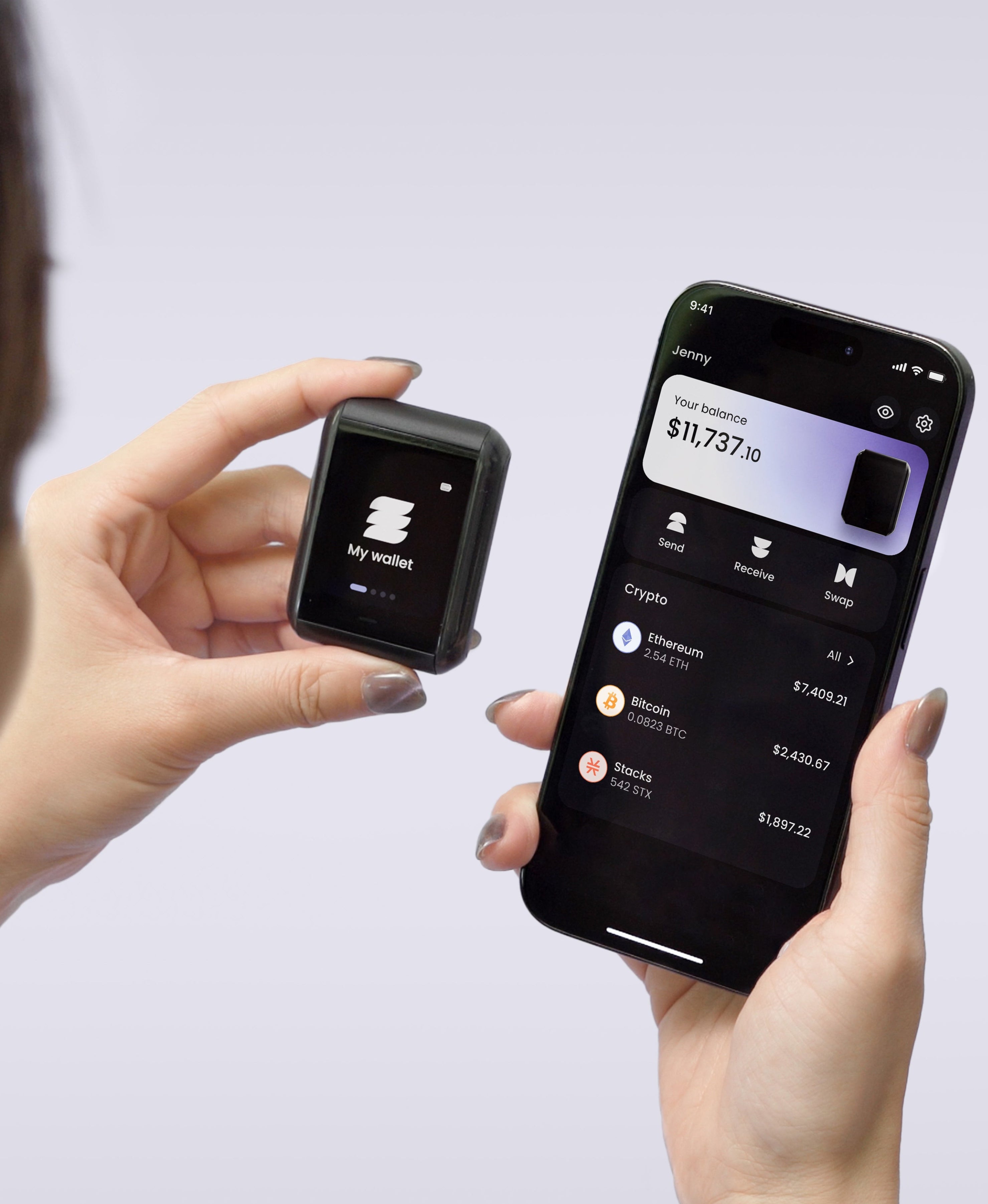
Buying IBIT and buying bitcoin are different transactions with different outcomes. One gets you tax-advantaged price exposure inside a brokerage account with zero setup and zero on-chain footprint. The other gets you a private key that lets you spend, receive, and hold outside any counterparty. Ryder One is a hardware wallet built around that second choice: it stores the private key on an EAL6+ Infineon SLC38 secure element, and every signature happens inside the chip after you press a button wired directly to it.
We designed the device around a 1.6-inch AMOLED touchscreen so you can verify each transaction with full readable detail before signing. NFC-only communication keeps wireless data paths off the device, and Qi wireless charging handles the 200 mAh battery without exposing a data port. Ryder One ships at $229 with a Recovery Tag, a Qi wireless charger, and a travel pouch.
The backup layer is TapSafe Recovery. Your Recovery Tag holds 50% of the recovery share; your paired phone holds the other 50% encrypted inside iCloud (iOS) or Google Drive (Android) rather than on the phone itself. You can add up to four Recovery Contacts, each holding a 25% share for additional redundancy, and no contact ever sees a wallet balance or a key. The BIP-39 seed phrase remains accessible on-device as a last resort, so the wallet is never locked to Ryder hardware. Readers newer to the model can start with our self-custody explainer, which walks through what direct key ownership covers.
If you want passive BTC exposure inside a tax-advantaged account and never plan to spend the coins on-chain, an ETF does that job. If you want the ability to send, receive, use Bitcoin as money, or hold outside any custodian's balance sheet, a self-custody wallet is the layer that answers. Plenty of holders own some of each.
The bottom line
Two and a half years in, the US spot Bitcoin ETF category has absorbed roughly $58 billion of net inflows, locked up 6.77% of the mined BTC supply, and settled into a two-firm market where BlackRock and Fidelity together control most of the AUM. IBIT leads at about $54 billion, FBTC sits second, GBTC has bled $17.5 billion in the largest ETF rotation event on record, and 80% of the underlying BTC lives at Coinbase Custody. Flows through H1 2026 turned negative for the first time since launch at $5.4 billion in net redemptions, though April's $1.97 billion rebound showed the inflow engine is still there when sentiment turns. For a Bitcoin holder, the takeaway is clean: buying IBIT gets you a share of a fund that holds bitcoin custodied by Coinbase; buying bitcoin and storing it on your own hardware gets you the key that controls the coin. Whichever path you pick, the layer you own is defined by the key, and the key belongs on hardware you control.
Take custody of your BTC. Ryder One keeps your private key offline on an EAL6+ secure element, with TapSafe Recovery as the backup layer.
SEO
- Target keyword: bitcoin etf inflows
- SEO title: Bitcoin ETF Inflows in 2026: The Numbers Behind IBIT's Lead (57 chars)
- Meta description: Spot Bitcoin ETFs took in $58B since 2024, with IBIT at $54B AUM and 80% custody at Coinbase. Here is what the flow story hides for BTC holders. (146 chars)
- Alt text (hero): Bitcoin ETF inflows 2026 IBIT lead — Ryder self-custody hardware wallet




Share: