

Every hardware wallet ships with the same homework assignment. Write down twelve or twenty-four words, keep them somewhere safe forever, and understand that anyone who reads them owns your crypto while you own nothing. That assignment is why seed phrase storage has turned into a small industry of steel plates, punch sets, and fireproof pouches. Before you buy any of it, it's worth being precise about what the words have to survive, because the answer changes what you should spend money on.
What seed phrase storage has to survive
Three categories of loss, and they pull in opposite directions. Destruction is the obvious one: fire, flood, a burst pipe, a house move where a box goes missing. Discovery is the mirror image, since a backup that survives everything is also a backup that a burglar, a houseguest, or a contractor can read and empty in minutes. The third is the quiet one nobody plans for, which is you being unavailable when the backup is needed, whether that's hospital, travel, or death, leaving a partner holding a metal plate with no idea what to do with it.
Most advice online optimises hard for the first category and treats the other two as somebody else's problem. Any storage plan worth following has to answer all three, and the reason we built TapSafe Recovery the way we did is that a single written seed phrase can only ever answer one of them at a time.
Paper: the default that fails quietly
Paper is what almost everyone starts with, because it comes in the box. It costs nothing, it works, and for a wallet holding two hundred dollars of test funds it's a reasonable place to begin.
The problem shows up in the failure mode. Paper doesn't announce that it has degraded; ink fades, damp warps it, a drawer gets cleared out during a move, and you don't discover any of it until the day you need to restore, which by definition is a bad day already. House fires and floods finish the job. A photograph of the phrase on your phone solves the fragile-medium problem and creates a much worse one, since cloud backups, screenshot scanners, and anyone who picks up an unlocked handset can all read it.
If paper is where you are today, the upgrade path below matters more than any judgement about how you started.
Steel: durable, and tested to destruction
Metal backups exist because someone noticed that paper burns and steel doesn't. The category now runs from $20 punch-and-plate kits to $200 machined capsules, and the honest way to compare them is to look at the testing rather than the marketing.
Jameson Lopp has been putting these products through the same brutal sequence for years: roughly 2000°F of heat for ten minutes, then a dunk in water to simulate a firefighter hosing down a structure fire, hours submerged in muriatic acid until the bubbling stops, and a 20-ton hydraulic press standing in for a building collapsing on top of the device. He has run more than seventy products through it.
The results are useful in a way most reviews aren't. Solid plates and washer-and-bolt designs generally come through with the words readable, and Lopp names the Bitplates Domino, Hodlinox, SmallSeed, and Quadrat Register 11 among those that survived without data loss. Tile-based systems are where things come apart, sometimes literally: of one popular tile product he wrote that "the additional screws that have been added to this device still don't seem to be enough to prevent the slots from expanding and thus losing tiles." Acid also erodes shallow etched or freehand-scratched lettering, so stamped and punched designs hold up better than engraved ones.
The takeaway for buying is short. Choose a solid or bolted plate over anything that holds loose letter tiles, stamp rather than scratch, and check that the product you're looking at appears in the test results at all.
Where every single-object plan runs out
Here's the part the steel plate can't fix. You've now got one object that survives fire, flood, and a hydraulic press, holding a set of words that grants complete access to everything you own. Its durability is exactly what makes it dangerous, because the same properties that keep it readable for you keep it readable for whoever finds it.
So you split the plate across two locations, which halves the discovery risk and doubles the number of places that can fail. Or you add a passphrase, which protects the plate and adds a second secret that has to be remembered or stored somewhere, moving the problem rather than removing it. Or you put it in a bank box, and now access depends on business hours and the institution's own paperwork.
None of these are bad ideas. They're all workarounds for one structural fact: when a single object grants total access, every decision you make is a trade between losing it and someone else finding it. That's the single point of failure, and no amount of steel removes it.
Split-recovery: designing the failure out
Splitting a secret into shares where no single share reveals anything is old cryptography, and Shamir's Secret Sharing is the standard version of it. Some wallets expose it as an advanced option for people willing to manage several share cards by hand. We built our own implementation into Ryder One and made it the default path instead.
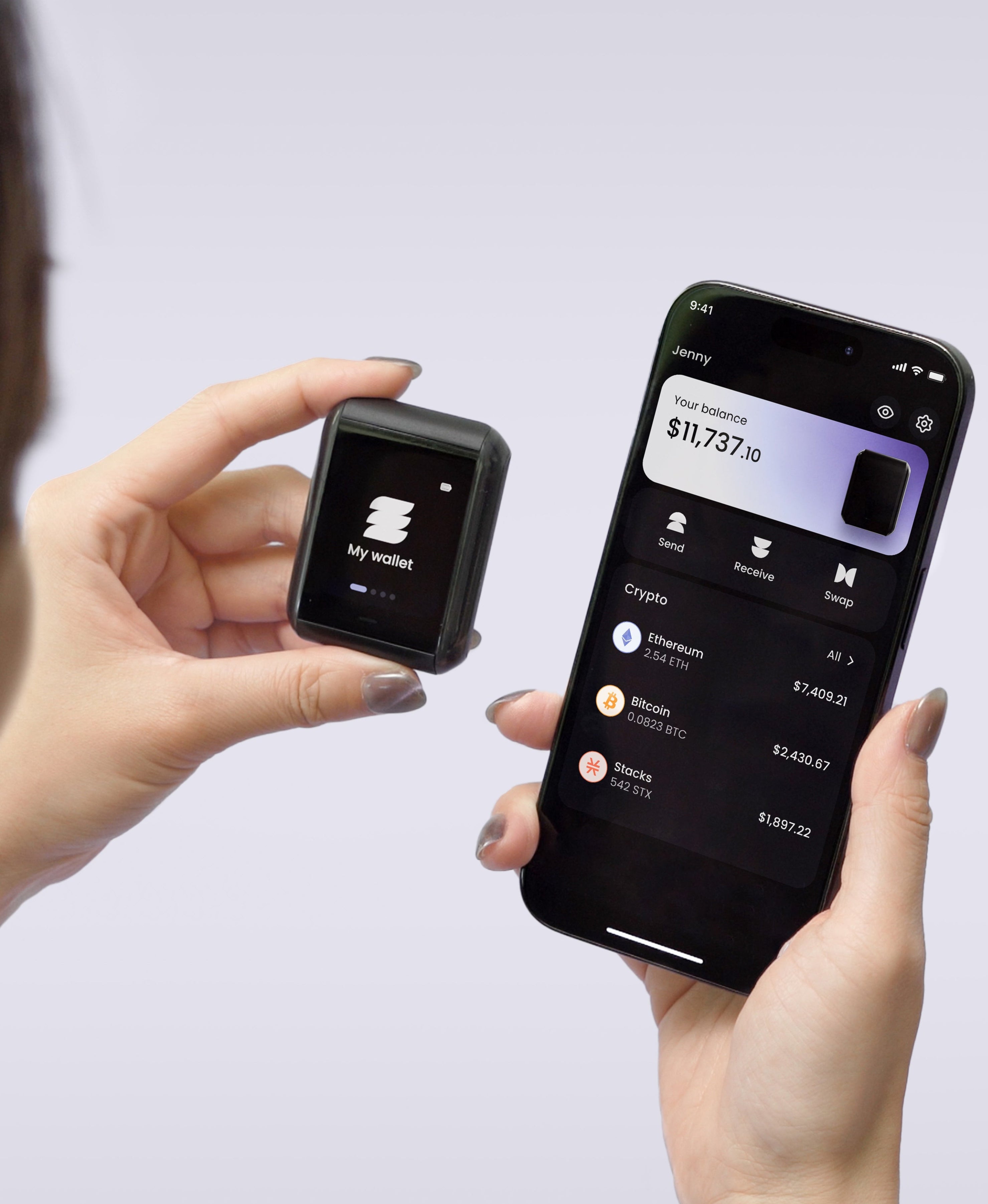
TapSafe Recovery spreads your wallet across layers rather than objects. The Recovery Tag holds 50%, draws what it needs from the NFC tap itself, and carries an IP69K rating, so it shrugs off pressure washing, dust, and temperature swings. Your paired phone holds the other 50%, stored encrypted in your own iCloud or Google Drive rather than on the handset itself, which means a stolen or drowned phone costs you nothing. Recovery Contacts are optional and hold 25% each, set up in person over NFC, and they never see your balances or your keys. Tag plus phone restores the wallet completely, and no single piece gives anyone anything on its own.
Read that against the three failure categories. Destruction is covered because the Tag surviving a fire and the phone share sitting in cloud storage are independent events. Discovery is covered because the Tag on its own is inert to whoever finds it. The unavailable-owner case is covered by Recovery Contacts, who can help reconstitute access without ever having held the power to drain the wallet. The seed phrase itself stays available on the device as a last resort, meets the BIP-39 standard, and restores into other wallets, so nothing about this locks you to our hardware.
Choosing your seed phrase storage in 2026
For a wallet you're testing with pocket money, paper in a drawer is fine and you already have it. For meaningful holdings kept on a device that hands you words to guard, a stamped solid-metal plate from the tested list is the right upgrade, ideally split across two locations you control, with a clear note for whoever would need to act if you couldn't.
For anyone who reads that last paragraph and thinks it sounds like a system they'd get wrong at some point, that instinct is worth trusting. It's the reason TapSafe exists. Self-custody shouldn't require you to be your own operations department for the next thirty years, and self-custody done well should survive one bad day without taking your savings with it.
Ready to stop guarding one object? Get your Ryder One, $149 for the Starter Combo with the Recovery Tag, wireless charger, and pouch included.


Share: