

If you're weighing Coinbase vs Kraken vs Gemini, there's a question sitting underneath the fee tables that decides the answer for you: what do you want the account to do? Someone who keeps a whole portfolio on an exchange is shopping for a bank. Someone who buys on Monday and moves the coins to a hardware wallet by Friday is shopping for a door, and a door gets judged on what it costs to walk through, how cleanly it opens on the way out, and whether the building has caught fire before. That second list is the one we use here.
Coinbase vs Kraken vs Gemini at a glance
| Coinbase | Kraken | Gemini | |
|---|---|---|---|
| What a simple buy costs | A fee plus a spread built into the quoted price, both visible in the order preview | 1% on Instant Buy, plus a spread embedded in the price | Varies by payment method, order size, asset, and jurisdiction; shown at trade review |
| Cheaper route on the same account | Advanced Trade order book, tiered by 30-day volume | Kraken Pro: 0.40% maker, 0.80% taker at the base tier | ActiveTrader: 0.60% maker, 1.20% taker at the base tier |
| Sending crypto out | Estimated network fee, with transactions batched behind the scenes | Network fee, varies by asset | Dynamic network fee that tracks the chain; Gemini states it keeps none of it |
| Cash in and out | Several methods, each with its own fee | Several methods, each with its own fee | ACH deposits and withdrawals free, wire deposits free |
| The episode on its record | Support contractors bribed in 2025, customer data taken | No comparable customer-data breach on record | Earn program froze in 2022; customers repaid in full by 2024 |
None of the three publishes one simple retail price anymore
Start here, because it changes how you read every comparison article you'll find on this topic. Coinbase's own fee disclosure says its fees "are calculated at the time you place your order and can be influenced by factors such as your chosen payment method, order size, market conditions, jurisdictional location, asset," and that simple buy and sell orders carry a spread inside the quoted price that Coinbase may keep any excess of. Gemini's retail schedule uses nearly identical language, down to the note that fees may vary between two transactions that look the same.
So the 1.49% figure you'll see quoted around the web for Gemini, or a flat percentage for Coinbase, describes a pricing model neither company publishes now. The honest version is that your retail cost is whatever the preview screen says on the day, and the only way to know it is to build the order and read the number before you confirm. Both platforms do show it there, which is the part that matters.
Kraken is the outlier for clarity. Its published schedule puts Instant Buy at 1% with a spread on top, and the Kraken Pro order book at 0.40% maker and 0.80% taker for anyone at the base volume tier. Two paths, two numbers, both printed.
The cheap door and the easy door are never the same door
Every one of these platforms runs two products behind one login: a buy button for people in a hurry, and an order book for people willing to spend ninety seconds learning it. On Kraken the gap between them is 1% versus 0.40%, so a $5,000 buy costs about $50 through Instant Buy and about $20 on Pro. Gemini's ActiveTrader base tier of 0.60% maker and 1.20% taker tightens fast as volume rises, and Coinbase's Advanced Trade works the same way.
If you're buying once a month and moving the coins straight to cold storage, the order book is worth the ninety seconds. Over a year of $500 monthly buys, the difference between a 1% easy button and a 0.40% resting order is roughly $36, which is a Recovery Tag with change left over.
Coinbase
Coinbase is where most Americans buy their first bitcoin, and the reasons are good ones: the account opens quickly, the app is legible to someone who has never used a crypto exchange before, and asset coverage is broad. Withdrawals to an outside wallet work without drama, which is the feature self-custody buyers should care about most.
One detail deserves a flag when you're sending coins out. Coinbase charges an estimated network fee, then batches user transactions together, and its own disclosure notes that "the aggregate amount of estimated network fees paid by users within a given batch may exceed the final network fee paid by Coinbase." Nothing improper is happening there, though it does mean the withdrawal fee you see is a forecast rather than a receipt. Sending over the Lightning Network carries a stated 0.2% processing fee instead.
Best for: first-time buyers who want the shortest path from bank account to bitcoin, and anyone whose priority is an app their partner could also use.
Worth knowing: in May 2025, Coinbase disclosed that criminals had bribed overseas customer support contractors to hand over customer records. Names, addresses, phone numbers, masked bank details, and identity document images for a slice of users were taken; passwords, private keys, and funds were untouched. Coinbase refused the $20 million ransom and offered the same sum as a bounty, and told the SEC it expected remediation and customer reimbursement to cost between $180 million and $400 million. The lesson for a self-custody holder is worth sitting with: no exchange can un-leak the fact that you own crypto, which is why the amount sitting in that account is the number to keep small.
Kraken
Kraken has spent a decade as the exchange that publishes its numbers and stays boring, and boring is a compliment in this category. Fee tiers are printed on a public page, the Pro interface is usable without a tutorial, and withdrawals to an outside address are treated as normal behaviour rather than something to discourage.
Best for: people who buy regularly, care about the spread, and would rather learn a limit order once than pay the convenience premium every month.
Worth knowing: the 1% Instant Buy rate is more than double the Pro taker fee before the embedded spread is counted. Kraken makes both prices public, so the cost is a choice you're making rather than one being made for you.
Gemini
Gemini built its pitch on regulation and custody discipline, and then the Earn program tested it. In November 2022 the yield product froze when its lending partner Genesis collapsed, locking up assets from more than 200,000 customers who had believed the product was low risk. What followed is the part worth knowing: a February 2024 consent order with New York's Department of Financial Services required Gemini to return at least $1.1 billion to Earn customers and pay a $37 million penalty, and by mid-2024 Gemini had returned more than $2.18 billion in digital assets, with Earn users made whole in kind.
Best for: buyers who value a New York trust charter and free ACH transfers in both directions, and who read a full repayment as evidence that the guardrails held.
Worth knowing: the repayment took eighteen months, and during that stretch the assets were beyond their owners' reach no matter what the app balance said. A yield product on an exchange is a loan you have made to somebody you cannot see.
Getting your coins off the exchange, and what happens next
Whichever account you open, the plan is the same: buy, withdraw, verify the address, and let the exchange go back to being a door. The withdrawal itself is quick on all three. Where people get stuck is the next step, because the standard advice hands you a 24-word seed phrase and tells you that everything now depends on you protecting one piece of paper for the rest of your life.
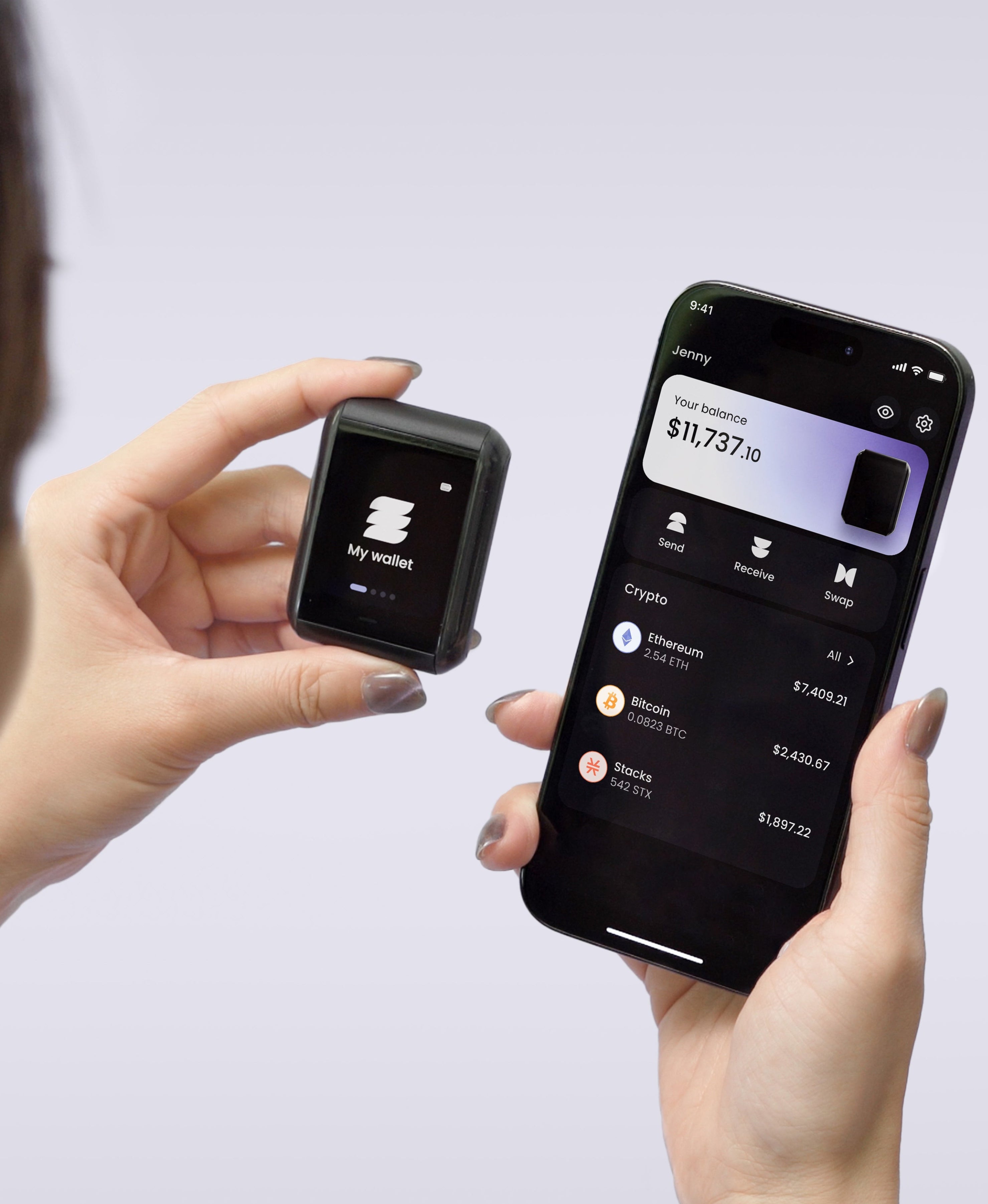
We built Ryder One so that step stops being the scary one. Setup takes under 60 seconds across three NFC taps, every transaction is verified on the device's 1.6-inch AMOLED screen before a button wired straight to the secure element can sign it, and receive addresses are checked on the device too, which is the defence against malware that swaps the address you pasted. Backup runs on TapSafe Recovery, our implementation of Shamir's Secret Sharing: a Recovery Tag holds 50%, your paired phone holds 50% encrypted in your own iCloud or Google Drive, and optional Recovery Contacts hold 25% each. No single object grants access on its own, so losing any one of them costs you nothing. The seed phrase stays available on the device as a last resort and meets the BIP-39 standard, so you're never locked to our hardware.
Which onramp fits
Coinbase fits if this is your first purchase and you want the least friction between a bank transfer and owning bitcoin. If you buy on a schedule and want published prices with a cheaper path you control, Kraken is the one to open. Gemini earns it when free ACH in both directions and a regulator-supervised charter are what let you sleep, with the Earn history read as a full-repayment record rather than a spotless one.
The choice matters less than what you do after the purchase clears. Every exchange on this list is a place to convert dollars into crypto, and the self-custody part starts the moment the coins land somewhere only you control.
Ready to move your crypto somewhere no company can freeze it? Get your Ryder One, $149 for the Starter Combo with a Recovery Tag, wireless charger, and pouch in the box.


Share: