

If you're new to crypto, the first decision you'll face is where to store it. The answer matters more than most people realize.
There are three types of crypto wallets: exchange wallets, software wallets, and hardware wallets. Most people start on an exchange, graduate to a software wallet, and eventually move to a hardware wallet when they have something worth protecting. This guide covers the best option in each category, what each one gets right, where it falls short, and which one makes most sense for the long term.
Exchange wallets: convenient, but not yours
Exchange wallets are the most common starting point. You sign up, you buy crypto, and it sits in an account. It’s simple, but the problem is that the crypto isn't really yours. The exchange holds the private keys on your behalf, which means you're trusting a company to keep your funds safe, available, and solvent.
The majority of exchanges have a similar set up, but for simplicity, these are the two most popular exchange wallets.
Coinbase
Coinbase is the most beginner-friendly exchange available. The interface is clean, the app is well-designed, and it's regulated in the US and several other major markets. For someone buying crypto for the first time, it's a reasonable place to start. Just don't use it as a long-term storage solution.
Binance
Binance is the largest crypto exchange in the world by volume, with low fees and an extremely broad asset selections. It's a popular choice for beginners getting started. Worth noting that its regulatory status varies by country, so check availability in your region before signing up.
Why you shouldn’t store crypto on an exchange
FTX was the second-largest crypto exchange in the world. In 2022, it collapsed in days. Over $8 billion in customer funds disappeared. Users had no recourse, no insurance, and no way to get their crypto back. FTX wasn't a fringe operation though. It was trusted, well-funded, and widely recommended to beginners. The entire situation was a harrowing reminder that when you don't hold your crypto, it isn’t really yours.
Exchange wallets make sense for buying and selling, but they don't make sense for storing anything you can't afford to lose.
Software wallets: your keys, your crypto, but still online
Software or hot wallets are a step up from exchanges. You hold your own private keys, which means no company can freeze your funds, go insolvent, or lose your crypto on your behalf.
The tradeoff is that software wallets live on your phone or browser, which means they're connected to the internet. Any malware, phishing attack, or compromised device is a potential threat to your funds. For smaller amounts and everyday transactions, that's an acceptable risk. For anything significant, it's worth reconsidering where you store your crypto.
MetaMask
MetaMask is the most widely used software wallet in crypto, particularly in the Ethereum and EVM ecosystem. If you're interacting with DeFi, NFTs, or any Ethereum-based application, MetaMask is likely what you'll encounter. Setup is straightforward and the browser extension integrates cleanly with most web3 apps.
The limitation is that MetaMask is EVM-focused. It doesn't natively support Bitcoin or Solana, which matters if your portfolio spans multiple chains. Though there are integrations, each of these integrations adds a layer of vulnerability as they’re third-party platforms.
Solflare
Solflare is the go-to software wallet for the Solana ecosystem. If you're buying Solana-based tokens, using Solana DeFi, or collecting Solana NFTs, Solflare is the cleaner choice over MetaMask. It's well-designed, actively maintained, and supports staking directly in the app.
Like MetaMask, it's a hot wallet. Your keys are on your device, and your device is online.
Software wallets are the first step toward self-custody. But if you're holding anything beyond what you'd be comfortable losing, the next step is taking your keys fully offline.
Hardware wallets: your keys, fully offline
Hardware wallets, or cold wallets, are the only category where your private keys never touch the internet. They're stored on a dedicated physical device, and every transaction has to be confirmed on that device before anything moves. Remote attackers have no path in.
This is what self-custody actually looks like at its best. The tradeoff is that you're fully responsible for your own recovery. That's where the wallets in this category differ most sharply.
Tangem
Tangem is the most affordable hardware wallet on the market, and one of the easiest to get started with. It's a credit card-sized NFC device with no screen, no battery, and no ports. Setup takes around 2 to 3 minutes. You scan the card, set an access code, and clone your key to two backup cards. No seed phrase required by default.
The tradeoff is that Tangem has no screen. Every transaction is reviewed on your phone, not on the device itself. If your phone is compromised or the smart contract of the token is bugged, the card signs whatever it receives without any independent verification. For smaller holdings, that's a reasonable tradeoff. For larger ones, it's worth understanding before you commit.
Each backup card also holds a full copy of your private key. If someone finds a card and knows your access code, they have full access. And there's no way to add more backups beyond the cards in your original set.
At around $69.90 for a 3-card set, Tangem is a solid entry point into hardware wallet security. As your holdings grow, you may find yourself wanting more.
Ryder One
Ryder One was built around one insight: most people won't perfectly manage a written seed phrase for five or ten years. So we replaced that model entirely.
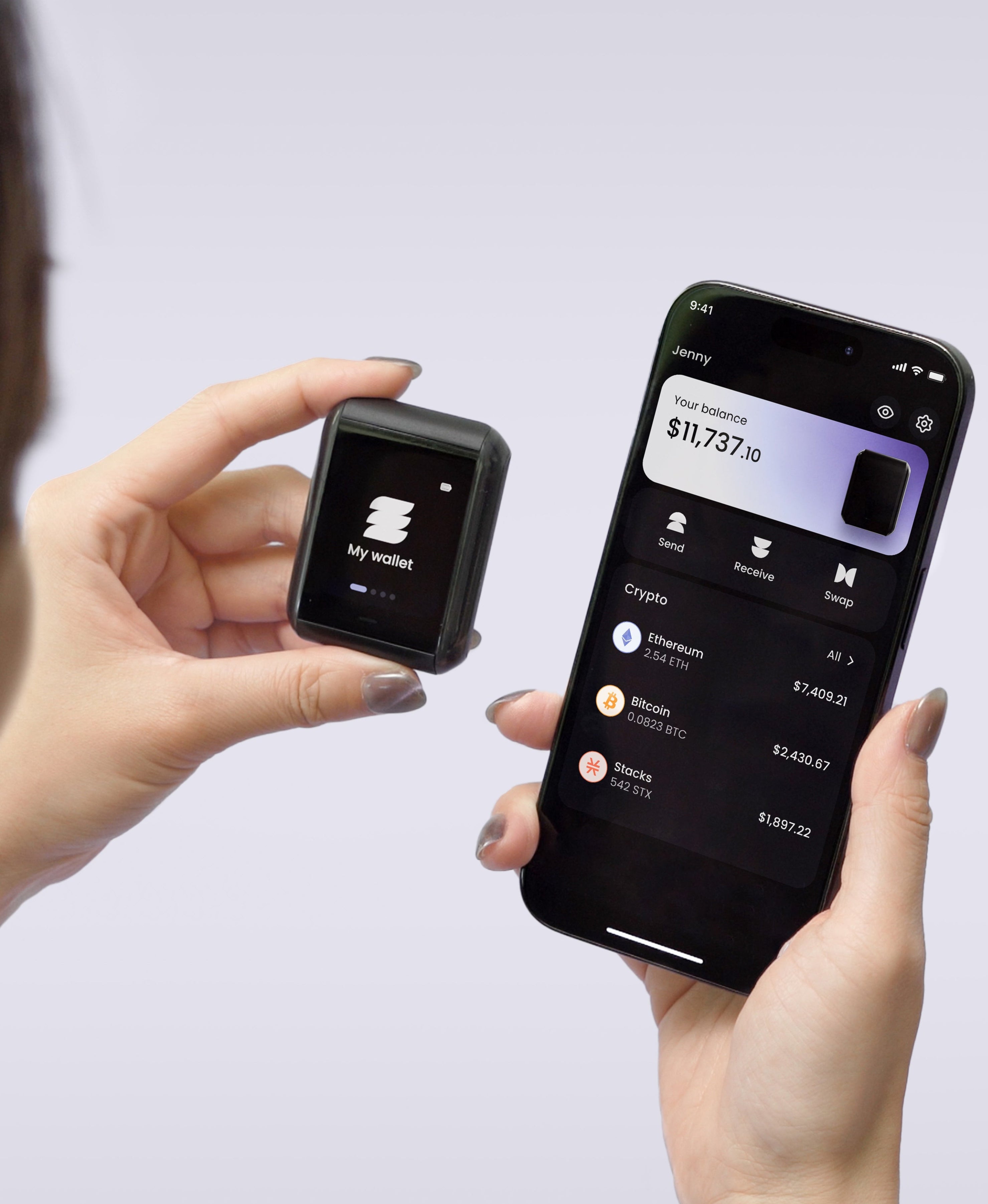
Setup takes around 60 seconds. You tap the device to your phone, the Ryder App walks you through wallet creation, and TapSafe Recovery handles your backup automatically with the included Recovery Tag. No writing, no memorizing, no single piece of paper that holds everything you own.
TapSafe distributes your recovery across three layers: a Recovery Tag, your phone, and optionally Recovery Contacts. No single component gives access to your wallet on its own, so losing one isn't a crisis. Your seed phrase is always accessible on-device if you ever need it, but you're never forced to depend on it.
Every transaction is verified on Ryder One's 1.6-inch AMOLED touchscreen, driven by the secure element. What you see on the device is what you're signing, even if your phone is compromised. That's the standard Tangem can't meet without a screen.
At $229, Ryder One costs more than Tangem. However, it includes the device, a Recovery Tag, a wireless charger, and a travel pouch. No subscriptions, no ongoing costs, and a recovery system designed to hold up over the long term.
Read our full Ryder One vs Tangem comparison
How they compare at a glance
| Coinbase | Binance | MetaMask | Solflare | Tangem | Ryder One | |
|---|---|---|---|---|---|---|
| Type | Exchange | Exchange | Software | Software | Hardware | Hardware |
| Holds your keys | No | No | Yes | Yes | Yes | Yes |
| Keys offline | No | No | No | No | Yes | Yes |
| Recovery model | Account login | Account login | Seed phrase | Seed phrase | Backup card cloning | TapSafe (distributed) and seed phrase available |
| Best for | Buying and selling | Buying and selling | Ethereum and DeFi | Solana ecosystem | Budget hardware entry | Long-term self-custody |
| Price | Free | Free | Free | Free | ~$69.90 | $229 |
Which wallet is right for you?
If you're just getting started and buying your first crypto, Coinbase or Binance are the most straightforward place to begin. Just treat it as a starting point, not a destination.
If you're active in Ethereum DeFi or the Solana ecosystem, MetaMask and Solflare give you control over your keys without the complexity of hardware. They're the right tool for everyday on-chain activity.
If you're ready to take your crypto fully offline, the choice comes down to how much you're protecting and how long you plan to hold it. Tangem is the most affordable entry point into hardware wallet security. Ryder One is built for the long term, with a recovery system designed to hold up over years, not just the day you set it up.
The pattern most people follow: start on an exchange, move to a software wallet as you get comfortable, and graduate to a hardware wallet once you have something worth protecting properly. Whenever you're ready for that step, Ryder One is built for it.


Share: