


Key Takeaways
Your private keys stay offline with both wallets. The difference is how they handle recovery and how you verify what you're signing.
- Ryder One backs up your wallet with a single tap during setup using TapSafe Recovery. No seed phrase to write down, no PIN to remember, and no single backup that gives access to your wallet if found. Every transaction is verified on-device with a 1.6-inch AMOLED touchscreen.
- Tangem uses backup cards to clone your private key across multiple NFC cards. It's affordable and simple, but has no screen — you verify transactions on your phone, not on the device itself.
- Ryder One is priced at $229 with a Recovery Tag, wireless charger, and travel pouch included. Tangem's 3-card set is priced at around $69.90.
Choosing a hardware wallet comes down to one question more than any other: what happens when something goes wrong?
You may lose your device, forget where you stored your backup, or simply make a mistake under pressure. How a wallet handles that moment is what separates good security from a false sense of it.
This article walks through where they differ, where they overlap, and what those trade-offs actually mean in practice. We built Ryder One, so we're not neutral. But we've done our best to lay this out honestly, because the right wallet is the one that fits how you actually live.
High-Level Comparison
Tangem is a credit card-sized NFC wallet with no screen, no battery, and no ports. Your private key is generated inside a Samsung EAL6+ secure element chip and cloned across multiple backup cards. It's one of the most affordable hardware wallets on the market and supports over 6,000 tokens across 80+ blockchains. If you want the lowest barrier to entry and the broadest asset coverage at the cheapest price, Tangem delivers.
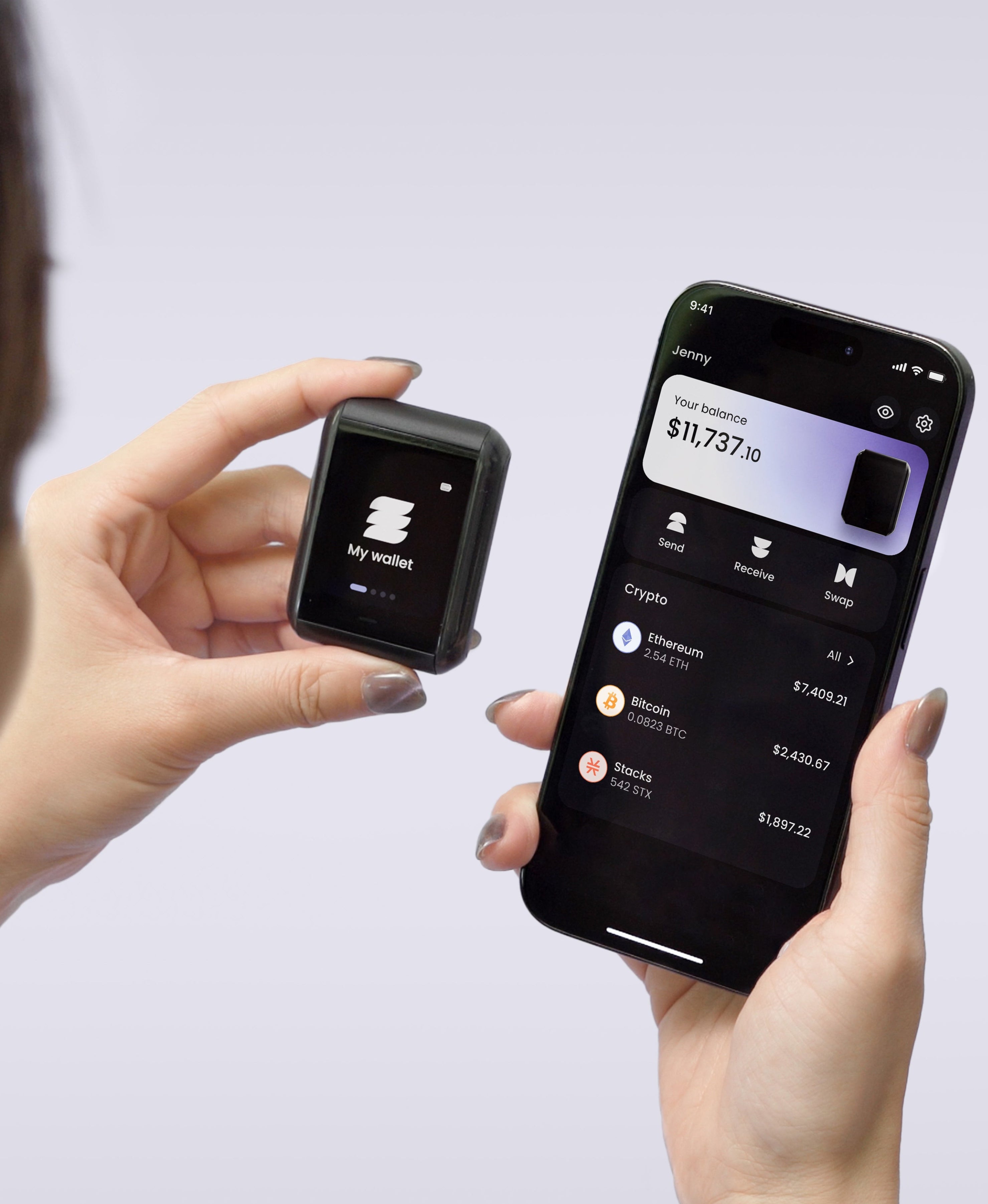
Ryder One is a portless, NFC-only hardware wallet with a 1.6-inch AMOLED touchscreen, an EAL6+ Infineon SLC38 secure element, and TapSafe Recovery built in. It's designed for people who want distributed recovery without a seed phrase, on-device transaction verification, and a mobile-first experience that doesn't require trusting your phone screen for signing.
Both wallets use NFC, both are mobile-first, and both are designed to be simpler than traditional hardware wallets. The differences are in how you recover, how you verify transactions, and what trade-offs you're willing to make.
The Biggest Differences
Transaction Verification
This is the most fundamental difference between the two wallets, and it deserves to come first.
Ryder One has a 1.6-inch AMOLED touchscreen. Every transaction is displayed on the device itself before you sign. You see the recipient address, the amount, and the network — and you confirm directly on the hardware. Even if your phone is compromised by malware, the device screen shows you exactly what you're signing. This is called "What You See Is What You Sign," and it's the standard that most hardware wallets are built around.
Tangem has no screen. Transaction details are displayed on your phone through the Tangem app. You review the details on your phone, then tap the card to sign. The card itself has no way to show you what it's signing — it receives a transaction hash via NFC, signs it inside the secure element, and returns the signature.
Tangem argues that your phone is already trusted for banking, government ID, and two-factor authentication, so it's secure enough for transaction verification. That's a reasonable position for many use cases. But it means your security model depends on your phone not being compromised. If malware on your phone changes the recipient address before sending the transaction to the card, the card will sign it without knowing anything is wrong. This is what the industry calls "blind signing" — signing a transaction without independently verifying its contents on a trusted, separate display.
This isn't a theoretical risk. According to Scam Sniffer, wallet drainer attacks — which trick users into signing malicious transactions — stole nearly $494 million from over 332,000 wallets in 2024 alone, a 67% increase from 2023. These attacks work by manipulating what users see on their screen before they approve a transaction. A device with its own screen, driven by the secure element, is the primary defense against this kind of attack. A device without a screen has no way to catch it.
For everyday transactions with small amounts, this trade-off may be acceptable. For serious holdings, the ability to verify on a separate device matters. That's why Ryder One has a screen.
 Ryder One lets you verify every transaction on its own screen, while Tangem relies on your phone for transaction review.
Wallet Recovery
This is where the two wallets take very different approaches to the same problem.
Tangem Uses Backup Cards
Tangem's recovery model is built around card cloning. During setup, your private key is generated on one card and then cloned to one or two backup cards, depending on whether you buy the 2-card or 3-card set. If you lose your primary card, the backup cards hold the same key and can take over.
It's simple and elegant. No seed phrase required by default, no words to write down. But it comes with real limitations.
If you forget your access code, recovery depends on having a second card from the same set. If you've lost your other cards, or if you've disabled access code recovery for extra security, you're permanently locked out. Recovery isn't something you do every week — it's something you might not do for five or ten years. When that moment comes, you need to recall a code you set a decade ago. If you can't, and you don't have a second card to reset it with, your crypto is gone. With Ryder One, there's no PIN or access code to remember. TapSafe recovery doesn't depend on recalling a code under pressure.
Tangem's recovery is also capped at the number of cards in your set. If you buy a 3-card set, you have two backups. If you lose two cards, you're down to your last copy with no way to create more backups. There's no mechanism to add additional recovery layers after the initial setup.
Tangem Offers a Seed Phrase, But It Comes With Risk
Tangem was originally designed to be fully seedless, with no seed phrase at all. It was their core selling point. But they've since added an optional feature that lets you generate a 12- or 24-word seed phrase as an additional backup.
The problem is that this re-introduces the exact vulnerability their seedless design was meant to eliminate. And unlike Ryder One, where the seed phrase only ever appears on the device's own screen, Tangem generates the seed phrase through the mobile app and displays it on your phone. That means your seed phrase is handled by software on an internet-connected device — the one environment where seed phrases are most vulnerable to interception.
This isn't theoretical. In late 2024, a bug in the Tangem app accidentally logged private keys for users who created wallets with a seed phrase. Those logs could be accessed through support email interactions, potentially exposing seed phrases to Tangem employees and email systems. Tangem resolved the issue and confirmed fewer than 0.1% of users were affected, but the community criticized the company's initial lack of transparency. It's a concrete reminder that generating seed phrases in a mobile app carries real risk — exactly the kind of risk that hardware-based recovery is supposed to prevent.
 Tangem's optional seed phrase flow happens through the mobile app, bringing sensitive recovery data onto your phone.
Ryder One Uses TapSafe Recovery
Ryder One was designed around one insight: most people won't perfectly manage a backup for five or ten years. With Ryder One, your wallet is backed up with a single tap during setup. Your recovery is spread across a Recovery Tag, your phone, and optionally Recovery Contacts, using a custom implementation of Shamir's Secret Sharing. No single component holds enough information to access your wallet on its own, so there's no single point of failure.
Unlike Tangem's backup cards, a Ryder Recovery Tag on its own is useless to anyone who finds it. There's nothing to steal from a single tag. You can add more Recovery Tags over time if you want more redundancy — the system isn't capped by how many cards came in the box.
If you ever need your seed phrase directly, it's always accessible on the Ryder One device itself. You're just never forced to depend on it.
In summary: Tangem replaces the seed phrase with card cloning — simple, but each card is a full copy of your key. Ryder One replaces the seed phrase with distributed recovery — no single component gives access, and you can expand your backup over time.
 Ryder One uses TapSafe Recovery to spread recovery across components, so a single Recovery Tag is useless on its own.
Here's a table that summarizes the key differences between these recovery approaches:
The Set Up
Both wallets set up quickly compared to traditional hardware wallets — that's something they genuinely share.
Ryder One setup takes around 60 seconds. You tap the device on your phone, the Ryder App walks you through wallet creation, and TapSafe Recovery is configured with the included Recovery Tag. No desktop software, no writing, no extra purchases needed.
Tangem setup takes around 2–3 minutes. You download the Tangem app, scan your primary card, set an access code, and then scan each backup card to clone the key. It's straightforward and well-guided.
The difference after setup is in what you're left with. With Ryder One, you have a device with a screen that independently verifies every transaction, and a distributed recovery system that doesn't depend on any single component. With Tangem, you have cards that are fast and portable, but every transaction is verified on your phone and each backup card is a full copy of your key.
Security Architecture: What They Share and Where They Don't
Both wallets use EAL6+ certified secure element chips to store private keys and perform cryptographic operations in isolation. Ryder One uses an Infineon SLC38 chip. Tangem uses a Samsung S3D232A chip. Both generate private keys on-device, and both communicate exclusively via NFC — no USB, no Bluetooth, no Wi-Fi. That shared foundation means a significantly reduced attack surface compared to wallets with cables or wireless connectivity.
But that's where the similarities end. The security architectures diverge in three important ways.
Transaction verification. Ryder One has a screen driven by the secure element. You verify every transaction on the device before signing. Tangem has no screen — you verify on your phone. If your phone is compromised, Tangem's card will sign whatever it receives without knowing the transaction was tampered with. This is covered in detail in the Transaction Verification section above, but it's worth repeating here: on-device verification isn't a convenience feature. It's a security layer.
Firmware updates. Tangem's firmware is immutable — it can never be updated after manufacturing. Tangem positions this as a security advantage because it eliminates the risk of malicious firmware updates. The trade-off is that if a vulnerability is discovered, it can't be patched. Ledger's security research team publicly disclosed a tearing attack vulnerability in Tangem cards in 2025 that allowed brute-forcing of weak access codes — and because the firmware is immutable, existing cards cannot be fixed. Ryder One's firmware can be updated, which means vulnerabilities can be patched and new features added over time. Updates are verified cryptographically on the air-gapped device.
Security audits. Ryder One's security has been externally audited by Halborn, a top blockchain security firm. You can read the full audit report on our website. Tangem's firmware has been independently audited by Kudelski Security and Riscure, confirming no backdoors or undocumented features. Both wallets have been externally reviewed — the difference is in what happens when issues are found after the audit.
Where They Differ
Ecosystem and Asset Coverage
This is where Tangem has a genuine and significant advantage, and it's worth being straight about that.
Tangem supports over 6,000 tokens across 80+ blockchains, including Bitcoin, Ethereum, Solana, Polygon, BNB Chain, Avalanche, Cardano, XRP, Polkadot, Cosmos, and many more. It also supports WalletConnect for DeFi access, in-app swaps, and fiat on-ramps. If broad asset coverage and DeFi access are priorities, Tangem's ecosystem is hard to beat at any price point.
Ryder One supports Bitcoin, Ethereum, Solana, Stacks, and all major tokens across the chains most people use, with new assets added regularly. The focus has been on building a secure, well-tested experience for mainstream assets rather than maximizing chain count. For most holders that's more than enough. For users with complex multi-chain portfolios, it's an honest limitation worth factoring in.
Firmware Transparency
Tangem's mobile app is open source, but its card firmware is closed source. Tangem's position is that closed-source firmware, combined with independent audits and immutability, provides stronger security than open-source firmware that could be exploited.
Ryder One's security has been externally audited by Halborn, with the full report published. Ryder is in the process of open-sourcing its firmware and TapSafe algorithm.
Daily Use
What's in the Box
Ryder One includes the device, a Recovery Tag, a wireless charger and cable, and a travel pouch. The wireless charger works with your phone and other devices too. TapSafe Recovery is included at no additional cost.
Tangem's 3-card set includes three NFC cards and a quick-start guide. No cables, no charger, no accessories. The cards don't need charging — they're powered by NFC from your phone. The minimalism is intentional and part of the appeal.
Usability Takeaways
Both wallets feel closer to consumer tech than traditional hardware wallets. Both use NFC taps instead of cables. Both have clean, well-designed companion apps.
The daily interaction is similar: open the app, initiate a transaction, tap the device to confirm. Where they diverge is in what "confirm" means. With Ryder One, you're confirming on the device's screen after reviewing the details on hardware you trust. With Tangem, you're confirming by tapping after reviewing details on your phone.
Ryder One is slightly larger — it has a screen, a battery, and wireless charging. Tangem is credit card-thin, fits in your physical wallet, and never needs charging. If portability and form factor are your top priority, Tangem wins on compactness.
User Privacy
Both wallets communicate exclusively via NFC and don't use Bluetooth or Wi-Fi, which limits exposure during normal use.
Tangem experienced a security incident in late 2024 where a bug in the mobile app accidentally logged private keys for users who created wallets with a seed phrase. The logs could be accessed through support email interactions. Tangem confirmed the issue affected fewer than 0.1% of users and resolved it promptly, but the community criticized the company's initial lack of transparency in communicating the issue.
Ryder One has not experienced a comparable incident. Ryder One's NFC-only architecture means the device never directly connects to the internet, and the seed phrase is only ever displayed on the device screen — never in the app.
Device Durability
Both wallets are built for durability, but the form factors are very different.
Tangem cards are credit card-sized plastic with no moving parts, no screen, and no battery. They're rated for 25+ years of operation and can handle extreme temperatures. No official IP rating has been published, but the monolithic design means there's very little that can physically fail.
Ryder One is IP67 rated for water and dust resistance, with an aluminum body and tempered glass. It has a battery, wirelessly rechargeable, and an AMOLED screen. Even if the battery dies completely, the device works when placed on any Qi-compatible charger.
Both are built to last. Tangem's advantage is that there's essentially nothing to break. Ryder One's advantage is that it's sealed, rated, and tested to a specific durability standard.
Cost
Tangem is significantly cheaper. A 3-card set costs around $69.90 and includes everything you need to get started. There are no subscriptions or ongoing fees.
Ryder One is priced at $229 and includes the device, a Recovery Tag, a wireless charger and cable, and a travel pouch. No subscriptions or ongoing fees either.
The price gap is real and worth acknowledging honestly. Tangem is one of the most affordable hardware wallets on the market, and for many people — especially those getting started with self-custody — that low entry price is the right choice.
What you get for the higher price with Ryder One is an on-device screen for independent transaction verification, distributed recovery that doesn't depend on any single backup, the ability to add more recovery layers over time, and a wireless charger included in the box. Whether that's worth the difference depends on how much crypto you're securing and how important independent verification is to you.
Final Verdict: Who Should Buy Which?
Choosing between Ryder One and Tangem comes down to what trade-offs you're willing to make.
Choose Tangem if you want the most affordable entry into hardware wallets, prioritize portability and simplicity, and are comfortable verifying transactions on your phone. It's an excellent choice for people getting started with self-custody or securing smaller amounts.
Choose Ryder One if you want a wallet that's easy to recover in case of loss, without depending on a single backup card that holds your full key. Every transaction is verified on-device, everything you need is in the box, and there's nothing to write down or memorize.
Here's a table to make it easier for you to compare both devices:
Ready to Make Your Choice?
Ryder One makes self-custody simple and secure. No seed phrase handling required, every transaction verified on-device, and everything you need is in the box. Learn more about TapSafe Recovery and get your Ryder One today.


Share: