

You've heard the word everywhere by now. Friends bring it up at dinner. Headlines trumpet a new all-time high one week and a 30% drop the next. Your most online cousin keeps texting you about something called "self-custody." And somewhere underneath the noise is a question that nobody seems to answer cleanly: what is crypto, exactly?
This guide is for the person who wants the unvarnished version, without the hype reel and without the doom take. A working definition, the mechanics in plain language, and a frank look at what owning crypto means once the marketing fades.
What is crypto, in one sentence
Crypto is digital money that runs on a public network instead of through a bank. Anyone with an internet connection can send and receive it, the network keeps a shared record of every transaction, and no single company controls the books.
That's it. The rest is detail.
How crypto differs from the money in your bank account
Money in your bank account is an entry in your bank's database. The bank moves the entry when you spend. The bank can also freeze the entry, reverse it, or close your account.
Crypto is different in two ways that matter. First, the record lives on a public ledger called a blockchain, copied across thousands of computers worldwide. Nobody needs to ask permission to read it or to send a payment. Second, ownership is proven by a private key, a long secret number that signs transactions on your behalf. If you hold the key, you own the coins. If someone else holds it, they do.
That's the part people miss. Crypto isn't stored on an exchange the way dollars are stored at your bank. The exchange holds the key on your behalf, and that's a custody choice, not a property right.
How crypto works, in plain language
A blockchain is a shared spreadsheet that everyone can read but nobody can secretly edit. When you send Bitcoin or Ether to someone, your wallet broadcasts a signed message: "I'm transferring 0.1 of my coins to this address." Computers on the network check the signature, confirm you have the balance, and add the entry to the next block of transactions.
Different networks confirm differently. Bitcoin uses miners that race to solve a math puzzle. Ethereum uses validators that stake their own coins as collateral. Either way, the goal is the same: agree on a single shared history without anyone in charge.
If you want a deeper look at how the keys themselves work, our public key explainer walks through the cryptography without the textbook tone.
Why people use crypto
Three use cases come up over and over.
People use crypto as a savings asset. Bitcoin and Ether have grown into trillion-dollar assets that some holders treat the way an earlier generation treated gold: a hedge against currency printing and a long-term store of value.
People also use crypto for payments when traditional rails are slow, expensive, or blocked. Sending money from the US to Argentina or the Philippines through standard remittance channels can take days and cost 5 to 10% in fees. The World Bank’s Remittance Prices Worldwide database puts the global average cost at 6.36%. By contrast, a stablecoin transfer can settle in minutes for cents.
People use crypto to access decentralized apps: lending markets, on-chain prediction markets, identity systems, and games where the items you earn are owned by you, not the publisher. This corner of the world is messy and risky, but the underlying capability is new.
The risks no one tells you about upfront
Prices swing hard. Bitcoin has lost more than 50% of its value in a single year multiple times in its history, and recovered each time, but no one is owed a recovery. Treat any allocation as money you can sit on without panic.
Scams are everywhere. The space attracts fraud the way a candy aisle attracts toddlers. Anything that promises guaranteed returns, urgent deadlines, or "exclusive" airdrops you must claim before midnight should be assumed to be a scam until proven otherwise.
Custody mistakes are permanent. There's no fraud department, no chargebacks, no resetting a forgotten password through customer support. If you lose access to your keys, the coins are gone. If you send to the wrong address, the coins are gone. The freedom and the responsibility are the same coin.
Where your crypto lives, and why it matters
Most beginners buy on an exchange. The exchange holds the keys. That's convenient, and for small amounts it's reasonable, but exchanges have failed before. FTX collapsed in 2022 with around 8 billion USD of customer funds missing. Binance settled with the US Department of Justice in 2023 for 4.3 billion USD over money laundering and sanctions violations. These weren't small operators. They were the largest names in the industry at the time.
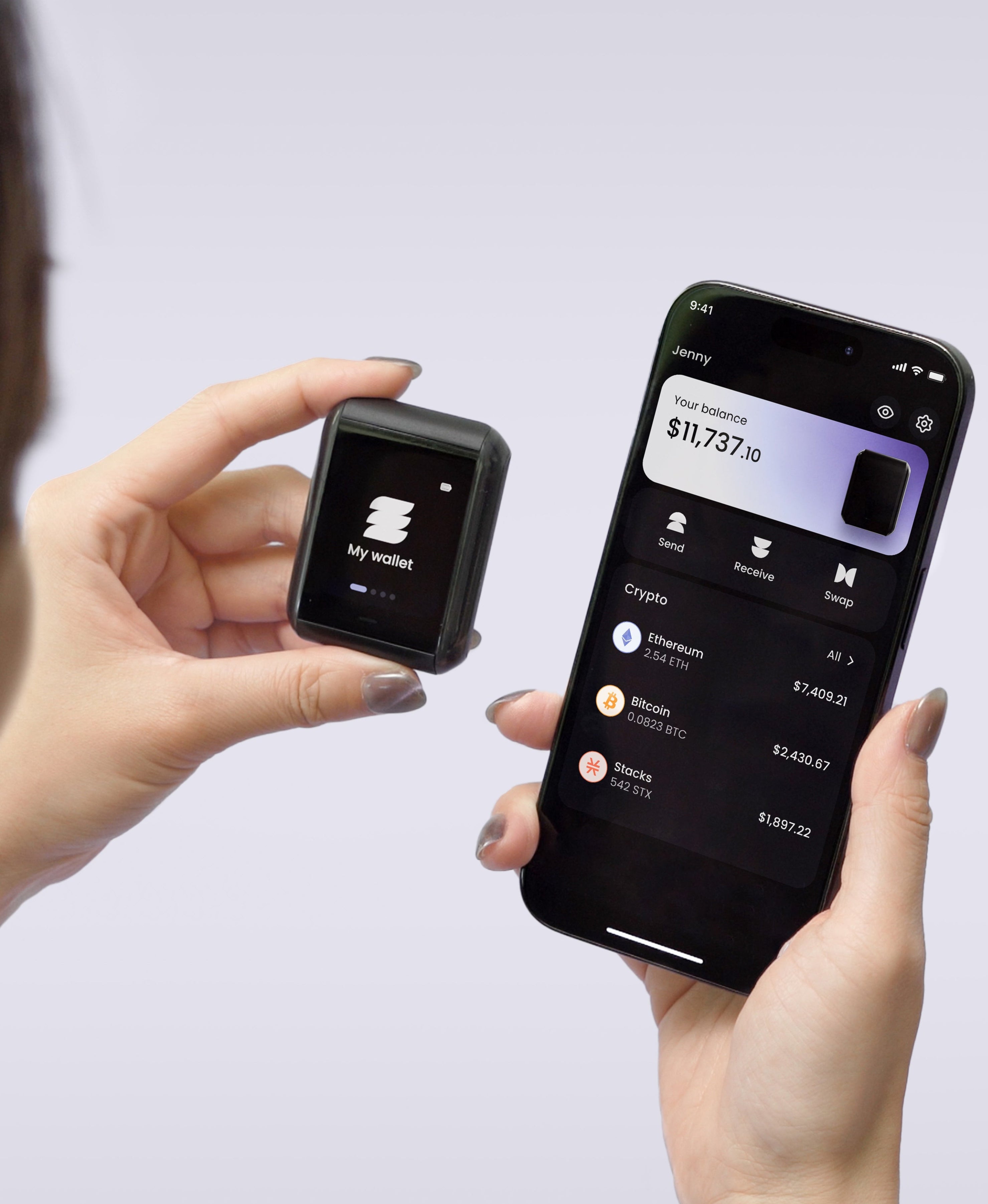
The alternative is self-custody, which means you hold the keys yourself. The cleanest way to do that is a hardware wallet, a small dedicated device that stores your keys offline and signs transactions without ever exposing them to the internet.
The standard recovery mechanism for most hardware wallets is a 24-word seed phrase you write on paper. Paper burns and floods, so the next step up is usually a stainless steel plate stamped with the same words. Metal lasts longer than paper, but your security still hinges on one object surviving everything that happens to your house over the next forty years.
We built Ryder One so the day-to-day setup doesn't pin your wallet to a single piece of metal. TapSafe Recovery splits the wallet backup across a battery-free Recovery Tag, your phone, and an optional circle of Recovery Contacts. No single component on its own gives anyone access to your coins. The seed phrase is still there as a last resort on the device, so you're never locked into Ryder hardware. You just don't have to depend on a single piece of paper or metal as your only defense.
How to start, and stay safe while you do
Buy a small amount on a regulated crypto exchange you can verify through the company registry of the country you live in. Send a tiny test transaction first when you withdraw to your own wallet. Once you've confirmed the address works, move the rest. If the amount you're holding starts to feel like money you'd be sick to lose, that's the threshold where a hardware wallet stops being optional.
Crypto isn't a single thing you either get or don't. It's a different way of holding value, and the part nobody can do for you is custody. The sooner you understand that, the safer the rest of the journey gets.
Take ownership of your keys, without the seed-phrase headache. Ryder One protects your keys with an EAL6+ secure element and replaces the single-point-of-failure backup with TapSafe Recovery. See how Ryder One works.


Share: