


# WLFI Explained: The Trump Family Crypto Token in 2026
For a project that ties a sitting president's family to a live token contract, World Liberty Financial has moved fast. The DeFi platform went online in September 2024 with Donald Trump Jr., Eric Trump, and Barron Trump listed as web3 ambassadors. Its USD1 stablecoin shipped in March 2025 on Ethereum and BNB Chain, per the company's launch announcement, with BitGo Trust Company as custodian. The WLFI governance token, originally locked to voting only, was flipped to transferable by a July 2025 community vote and began spot trading on September 1, 2025 at 12:00 UTC, per CCN's launch coverage.
In this piece, we'll cover what World Liberty Financial is and how WLFI works, how the USD1 stablecoin is issued and reserved, WLFI's tokenomics and founder allocation, the Aster and BNB Chain integrations that give USD1 active venues, where a hardware wallet fits when the issuer can freeze addresses, and the bottom-line read for a self-custody holder.
What WLFI and World Liberty Financial are
World Liberty Financial is a DeFi platform that ships a governance token (WLFI) and a stablecoin (USD1). The project positions itself as a US-anchored answer to overseas stablecoin issuers, and the Trump family sits on the marketing side as web3 ambassadors. WLFI itself carries governance rights: holders vote on protocol proposals like fee routing, listings, chain deployments, and stablecoin design changes.
WLFI began life as a claim ticket. Presale rounds priced tokens at $0.015 and later $0.05, and buyers could not move their allocations for many months. That changed after a July 2025 governance vote flipped the token to transferable status. The first 20% of presale allocations were released at the September 1 trading start, with the remainder subject to a vesting schedule shaped by later community votes.
WLFI trades on major venues today and has picked up secondary-market attention most governance tokens never see. The price story has been rough. Opening-day highs faded fast, and reports of large private treasury sales and insider borrowing sent the token to fresh lows in April 2026, Fortune reported. For a governance token, the political framing pulls attention that pure DeFi assets rarely draw.
USD1 stablecoin architecture
USD1 is a fiat-backed stablecoin issued by World Liberty Financial and custodied by BitGo Trust Company under a South Dakota trust charter. The reserves sit in cash and short-duration US Treasury bills, held through government money market funds with named managers including BlackRock. Monthly attestations follow AICPA standards, and a Chainlink-powered proof-of-reserves dashboard publishes the breakdown between cash and Treasuries against circulating supply.
The token launched in March 2025 on Ethereum and BNB Chain, then expanded across additional networks including TRON. By early 2026 circulating supply had crossed roughly $4.5 billion, putting USD1 among the faster-growing fiat-backed stablecoins of the period. That still sits well behind USDT and USDC by supply, but ahead of most other challenger dollar tokens.
Design-wise, USD1 behaves like every other centralized stablecoin. The issuer can freeze specific addresses through admin functions in the contract, which is how Tether handled 4,163 blacklisted addresses in 2025 alone, per BlockSec's tracker. USD1 inherits the same shape. Cash and Treasuries live at BitGo, the contract lives on public chains, and the issuer keeps the keys that can pause holders when law enforcement, sanctions, or fraud rules require it. If you hold USD1, you hold a claim the issuer can suspend on request. That is the general shape of every regulated dollar token, and USD1 is no different in kind.
WLFI tokenomics and insider allocation
WLFI's max supply is 100 billion tokens. The official breakdown puts about 33.9% into public token sales, 32.6% into community growth and incentives, 30% into a founder pool held across three Delaware entities, and roughly 3.5% into team and advisor pools. The founder share is where the political attention concentrates.
Trump-linked entities have been reported to hold a large slice of the founder allocation, with public disclosures pointing to DT Marks DEFI LLC as a major recipient. Reuters, Fortune, and CoinDesk have all covered the founder-side revenue rights, the private "white glove" treasury sales to accredited investors that were not disclosed at the time, and a $75 million borrow against WLFI collateral flagged by CoinDesk in April 2026. Whether the political framing reads as tailwind or risk depends on the reader, but the founder weight in WLFI's cap table is heavier than most governance tokens carry.
The governance function is where the token acquires day-to-day meaning. WLFI holders vote on stablecoin partnerships, chain deployments, listing decisions, and fee routing. The July 2025 vote that made the token transferable is one example. Later votes have shaped USD1's chain expansions and its integrations with venues that clear USD1 volume.
The Aster and BNB Chain integrations
USD1's most active venue is Aster, the BNB Chain perpetuals exchange we covered in our Aster DEX write-up. Every RWA perp on Aster (gold, silver, crude oil) settles in USD1, and USD1 sits at parity with USDT as a margin asset across the venue. USD1 pairs get zero maker fees and 0.5 basis-point taker fees, roughly an 87.5% discount versus the standard USDT taker rate. Aster also ships up to 2.5 million WLFI tokens a month in trading incentives on USD1 pairs.
The BNB Chain relationship goes wider than one venue. USD1 was among the first dollar tokens outside USDT and USDC to launch natively on BNB Chain, and the token's early growth leaned on BNB Chain rails. CZ has been publicly supportive of the WLFI project through 2025 and 2026, and YZi Labs (the venture arm previously known as Binance Labs) sits in the incubation orbit around Aster and, indirectly, USD1 flow.
For a dollar token, the venue map defines how much of the supply gets used and where. USD1 on Ethereum plays the same role USDT and USDC do: settlement asset for DeFi and CeFi, quote asset for a subset of pairs. USD1 on BNB Chain is where the perps activity concentrates. USD1 on TRON opens remittance corridors that USDT dominates today. The token's cross-chain footprint is why WLFI holders vote so often on chain deployments and integration terms.
Where Ryder One fits
Both WLFI and USD1 live on public chains. Your ownership of either token traces back to a private key. Whoever signs the transactions for a given address holds the tokens, and that account layer is where custody choices happen. USD1 adds one wrinkle: the issuer can freeze specific addresses. That is a compliance feature every regulated stablecoin ships with, and it does not change the underlying custody question. If your key is safe, your position is yours to move up until the moment an issuer freeze applies.
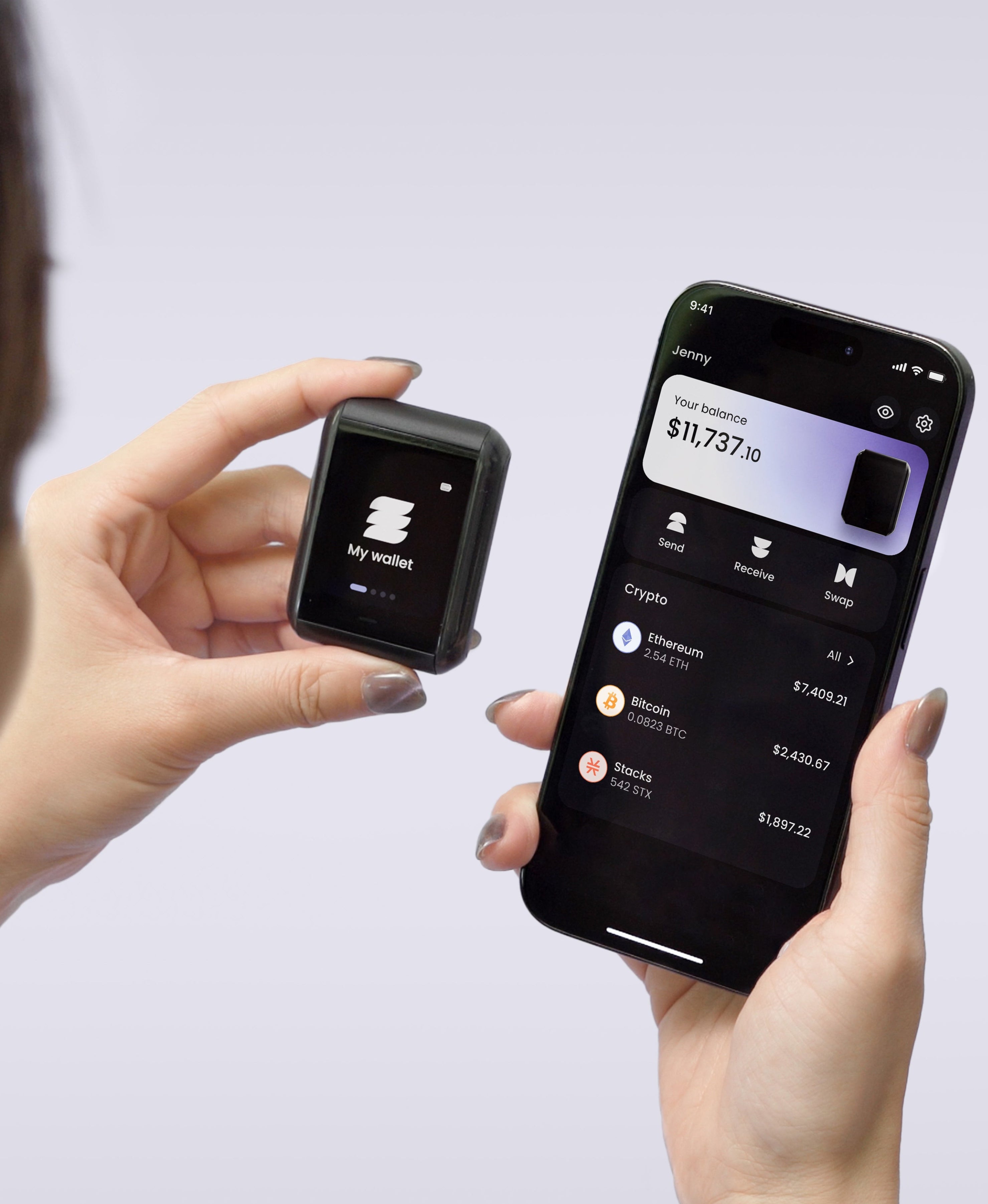
That is why the wallet holding your signing key deserves the same care as the exchange, the DeFi app, or the stablecoin issuer sitting on the other side of the trade. Ryder One is $229 and stores your private key inside an EAL6+ certified Infineon SLC38 secure element. Communication is NFC-only, meaning no USB port, no Bluetooth radio, and no WiFi surface for a remote attacker to reach across. Every transaction shows on the 1.6-inch AMOLED touchscreen with full readable detail before you tap to approve. When you're moving USD1 between BNB Chain and Ethereum, or voting a WLFI governance proposal, what displays on the device is what you sign.
Backup runs on TapSafe Recovery, our Shamir-based system that spreads wallet recovery across three parts so no single object holds full access. The Recovery Tag holds 50% via a small NFC device rated IP69K for water and dust resistance. Your paired phone holds the other 50%, stored encrypted in iCloud or Google Drive rather than on the phone itself, so a lost handset does not lose the backup. Optional Recovery Contacts each hold 25%, and none of them see wallet data. The BIP-39 seed phrase stays on-device as a fallback, so you are never locked to Ryder hardware.
If self-custody is the frame, the political story around WLFI does not change the on-chain mechanics. Your private key is what makes you the holder of either token, and no branding on either side of the trade changes that fact.
Bottom line
World Liberty Financial has moved from concept to roughly $4.5 billion in stablecoin supply and a governance token that trades on major venues in under two years. USD1 behaves like any other regulated dollar token: reserves at BitGo, Treasuries and cash on the balance sheet, monthly attestations, and issuer freeze controls at the contract layer. WLFI is a governance token with a founder pool that carries political attention most tokens never see. The Aster integration gives USD1 a home for perps flow that USDT and USDC do not have.
For a self-custody holder, the frame is the same as it was before the token traded. Your key is your position. The political framing sits outside the contract; the on-chain mechanics stay the same regardless of who is on the marketing page. Read the tokenomics, price the freeze controls into your allocation, and keep the signing key somewhere a remote attacker cannot reach.
Get Ryder One for $229 and hold your WLFI, USD1, and every other token behind hardware built for keys, not headlines.
--- SEO
- Target keyword: world liberty financial wlfi
- SEO title: WLFI Explained: The Trump Family Crypto Token in 2026 (54 chars)
- Meta description: World Liberty Financial (WLFI) went transferable Sept 2025. USD1 stablecoin custodied by BitGo, backed by Treasuries. The self-custody read on both. (150 chars)
- Alt text (hero): World Liberty Financial WLFI Trump crypto token — Ryder self-custody hardware wallet


Share: