


# Aster DEX vs. Hyperliquid: The Perps Fight of 2026
For about eighteen months, Hyperliquid ran alone as the answer to "which decentralized exchange can price perps like a centralized venue." That changed in September 2025 when Aster (a rebrand of the Astherus perp platform) launched ASTER, drew CZ's endorsement inside the same week, and started clearing daily volume that rivaled and briefly surpassed Hyperliquid. By early 2026 the two venues combined were setting monthly records above $2 trillion in perps flow, per DL News reporting on the sector. Aster is the first credible challenger with a different set of bets: BNB Chain rails, WLFI as a stablecoin partner, and hidden orders wired into the matching engine.
In this piece, we'll cover what Aster DEX is, how the September 2025 airdrop reshaped supply, how Aster and Hyperliquid compare on architecture, the WLFI and CZ connection driving momentum, where Ryder One fits when your account key sits at the head of an on-chain perps position, and the bottom-line read.
What Aster DEX is
Aster is a perpetuals-first decentralized exchange running on BNB Chain, with deposit support from Ethereum, Solana, and Arbitrum. The project began life as Astherus, a yield and perps layer inside the BNB app suite, then rebranded to Aster in mid-2025 ahead of a token launch. The product surface splits into two modes: a simple one-click interface for quick directional bets and an advanced order book called Aster Pro with hidden orders, grid trading, stock perps, and MEV-aware routing.
Stock perps are one of the sharper features. Aster lists crypto-settled perpetuals on names like Apple and Tesla with margin sizing up to 50x, giving on-chain traders a way to take equity exposure without a US brokerage account. RWA markets covering gold, silver, and crude oil settle exclusively in USD1, the stablecoin issued by World Liberty Financial. Volume backing all of this is not small: Aster has reported over $500 billion in cumulative trading volume inside its first year, with roughly 2 million users and over $260 million in open interest as of mid-2026.
The September 2025 airdrop and tokenomics
The ASTER token generation event landed on September 17, 2025 with a fixed maximum supply of 8 billion. That is a large number for a perps token; what matters is how the supply is carved up. The airdrop tranche alone accounts for 53.5% of total supply, community programs another 30%, treasury 7%, team 5%, and liquidity and listing 4.5%. Roughly 8.8% of supply, or 704 million ASTER, was released at TGE for eligible participants across the Aster Spectra and Aster Gems programs.
Price action reflected the community-heavy split. ASTER opened around $0.08, ran to $2.42 within a week, and settled with a fully diluted valuation above $7 billion by November 2025. That drew scrutiny about the monthly release schedule: the original design would have issued about 78.4 million ASTER a month on a linear vesting curve, which prompted concerns about dilution.
Aster's answer was an emissions overhaul in early 2026. Per The Block's reporting, the team cut monthly emissions by 97% and moved to a staking-only model where new supply flows to veASTER stakers. On top of that, 99% of daily fees now buy back ASTER on-market, and each buyback triggers an equal burn from the treasury reserve until circulating supply falls to 3 billion. For a token still in the top 20 by market cap, the shift from linear release to fee-driven buybacks is a bet on volume outrunning issuance.
Aster vs. Hyperliquid: architecture and design
The two venues share a shape (permissionless perps with centralized-exchange feel) and diverge on the tradeoffs. Hyperliquid runs a purpose-built L1 called HyperCore with HyperBFT consensus, no gas per trade, and its own validator set of about 21 nodes. Aster sits on BNB Chain with BNB paying gas on trades, plans an Aster Chain L1 with zero-knowledge components for Q1 2026, and pairs a matching engine with MEV-aware order routing. Neither venue is running on a general-purpose EVM in the way Uniswap does; both are tuned specifically for orderbook depth and speed.
On liquidity, the two have traded places through 2026. Aster overtook Hyperliquid on 24-hour volume in early January 2026, hitting roughly $38.8 billion versus Hyperliquid's $34.8 billion on January 5, according to KuCoin's comparison writeup. By April, Hyperliquid's open interest sat above five times Aster's, suggesting Aster's numbers ran hot on incentive campaigns while Hyperliquid held stickier positions. Both realities can be true at once: Aster is the volume story, Hyperliquid is the open-interest story.
Order types are where Aster tries to differentiate. Hidden orders keep size and price off the public book until execution, a response to CZ's public call for on-chain "dark pool" perps. That protects large traders from frontrunning without splitting the book across multiple venues. For anyone reading the tape, an Aster order flow looks different from Hyperliquid's because a chunk of the resting liquidity is invisible until it fills.
If you're picking between the two as a trader, the choice reads more as taste than as a right-versus-wrong call. Hyperliquid has deeper open interest, faster finality on its own L1, and no gas on trades. Aster brings hidden orders, stock perps, RWA markets settled in USD1, and BNB Chain composability. For a self-custody holder, both preserve key ownership at the account layer; the bridge shape and validator sets are the parts to read carefully. Our Hyperliquid write-up breaks down the L1 side in more depth.
The WLFI and CZ connection
Two names have pushed Aster's profile beyond its product surface. The first is CZ, Binance co-founder and BNB Chain's most influential public voice. In the week around ASTER's launch, CZ posted about Aster on X, which sent the token on a roughly 40x run and drew comparisons to prior BNB-adjacent launches. Aster is incubated by YZi Labs, previously known as Binance Labs before the venture arm rebranded, which places the project inside the Binance-adjacent orbit even after Binance itself formally divested from that fund.
The second is World Liberty Financial, the crypto vehicle tied to the Trump family. WLFI's USD1 stablecoin is now the collateral asset for every RWA perp on Aster, and USDT and USD1 sit as equal-tier margin assets across the exchange. USD1 pairs run at zero maker fees and 0.5 basis-point taker fees, an 87.5% discount versus the standard USDT taker rate, per The Defiant. Up to 2.5 million WLFI tokens ship monthly as trading incentives on USD1 pairs, which puts yield behind the pairing.
Whether the WLFI angle reads as tailwind or political risk depends on the reader. Either way, USD1 is on Aster in a way it is not on Hyperliquid, and that is a design choice worth pricing into the comparison.
Where Ryder One fits
Perps trading routes through an account key on either venue. On Aster, your BNB Chain wallet signs the deposit, your ASTER positions are recorded against that address, and any airdrop from partner apps hits the same wallet. On Hyperliquid, your L1 account key does the same job with a different chain underneath. Both platforms preserve self-custody at the account layer, though the bridge shape (Aster leans on BNB Chain routing, Hyperliquid on an Arbitrum contract) and validator sets differ.
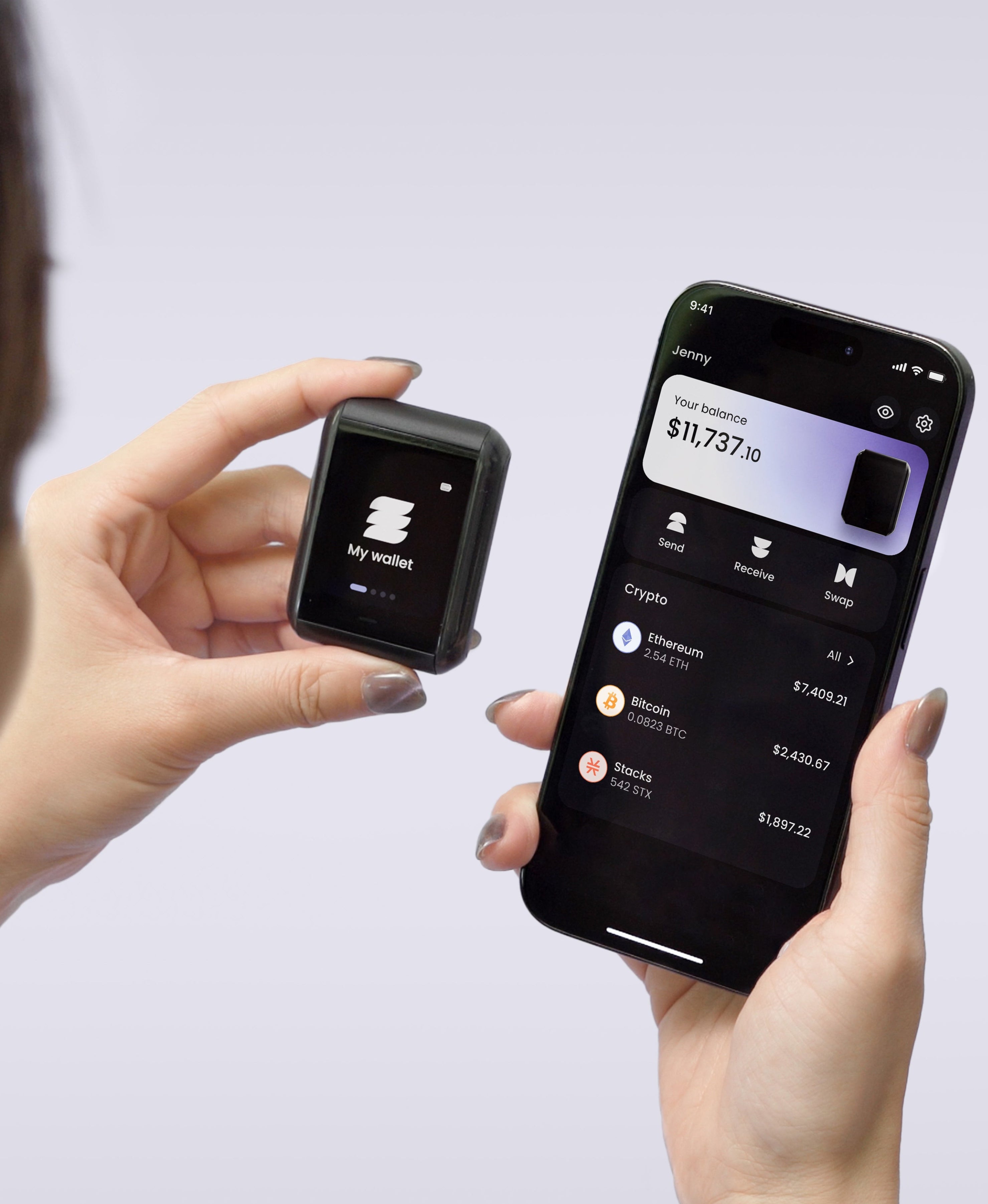
That is why the wallet holding the signing key deserves the same care as the exchange behind it. Ryder One is $229 and stores the private key inside an EAL6+ certified Infineon SLC38 secure element. Communication is NFC-only, meaning no USB port, no Bluetooth radio, and no WiFi surface for a remote attacker to reach across. Every transaction shows on the 1.6-inch AMOLED touchscreen with full detail before you tap to approve. When you're funding an Aster margin account or approving a token contract on BNB Chain, what displays is what you sign.
Backup runs on TapSafe Recovery, our Shamir-based system that spreads wallet recovery across three parts so no single object holds full access. The Recovery Tag holds 50% via a small NFC device rated IP69K for water and dust resistance. Your paired phone holds the other 50%, stored encrypted in iCloud or Google Drive rather than on the phone itself, so a lost handset doesn't lose the backup. Optional Recovery Contacts each hold 25%, and none of them see wallet data. The BIP-39 seed phrase stays on-device as a fallback, so you're never locked to Ryder hardware.
Bottom line
Aster is the first perp DEX with a plausible claim to compete with Hyperliquid on both volume and depth. The September 2025 launch put 53.5% of supply into the community's hands, WLFI's USD1 gave the venue a stablecoin edge outside the USDC-and-USDT default, and CZ's public backing plus YZi Labs' incubation pulled capital in fast. The February 2026 emissions overhaul cut dilution and turned fee revenue into buybacks. Together, Aster and Hyperliquid are now printing over $2 trillion in monthly volume across the two venues.
Picking between them is a taste question about chain preference, order types, and open-interest depth. The wallet holding the signing key stays with you regardless of which platform you pick, and that is the one part of the trade that never routes through anyone else.
Get Ryder One for $229 and put your Aster and Hyperliquid signing keys behind hardware built for the perps era.
--- SEO
- Target keyword: aster dex
- SEO title: Aster DEX vs. Hyperliquid: The Perps Fight of 2026 (49 chars)
- Meta description: Aster DEX launched ASTER Sept 2025, ran daily volume past $38B, and paired with WLFI's USD1. How it stacks up vs Hyperliquid, plus the self-custody read. (152 chars)
- Alt text (hero): Aster DEX vs Hyperliquid perps comparison — Ryder self-custody hardware wallet


Share: