


# Why Is Crypto Crashing? The Real 2026 Reasons Behind Drops
Every time the market drops more than 8% inside a week, Google Trends shows the same green spike on "why is crypto crashing" and "why is crypto down today." Those queries climb hardest at 3 a.m. UTC on a Sunday, because that is when liquidations pile up on top of thin books and holders wake up to a wallet screen they weren't expecting. The question is old; the trigger changes each cycle. In August 2024, it was the Yen carry-trade unwind. In April 2025, it was Trump's tariff announcement. On October 10, 2025, roughly $19 billion of long positions were wiped out inside 24 hours, the largest single-day liquidation event in crypto history.
Below, we walk through the six recurring drivers of crypto drawdowns, cite the 2024, 2025, and 2026 events that show each one in the wild, and cover the piece a lot of coverage skips: what these crashes expose about where you store your coins.
Macro drivers: Fed policy, the dollar, and risk-off correlation
Crypto trades as a global risk asset in normal weather and gets whipped hardest during macro regime shifts. The first place to look on a red day is the Fed. When Chair Powell strikes a hawkish tone on inflation, the effective Fed funds rate climbs, the dollar index (DXY) rallies, and every duration-sensitive asset from tech stocks to Bitcoin sells off in sympathy. That correlation ran near 0.7 with the Nasdaq through most of 2024 and 2025, and hasn't loosened much in 2026.
Look at February 3, 2025, when Trump's initial tariff order on Canada, Mexico, and China triggered a weekend crypto flush that erased roughly $500 billion in market cap inside 48 hours before the White House paused parts of the plan. The move began in equity futures and rolled into Bitcoin, Ethereum, and everything with a beta above one. When people ask "why is crypto down today," half the time the honest answer sits inside a macro chart before any crypto-native explanation.
On-chain drivers: perp liquidations, whale flows, and ETF outflows
Once the macro spark hits, the on-chain plumbing decides how deep the candle goes. The biggest amplifier is the perpetual futures market. Traders piling into 20x or 50x long positions during a rally leave the order book brittle below spot, and a 5% dip cascades into stop-outs that print a 15% dip. On October 10, 2025, roughly $19 billion of positions were force-closed after Trump's 100% tariff threat on China, with Hyperliquid, Binance, and Bybit clearing longs at prices well below fair value while books were thin.
Whale distribution is the second amplifier. When a long-dormant address or a former holder starts moving coins to exchanges, spot pressure builds even before headlines land. The July 2024 sell-off matched this pattern exactly, when the German government transferred close to $2 billion of seized Bitcoin to Coinbase, Kraken, and Bitstamp inside a month, and price fell from $66k to below $54k while headlines stayed quiet.
ETF outflows work the same way from the top down. When spot Bitcoin ETFs see net redemptions two or three days running, market makers hedge by selling spot BTC, and the drawdown extends. Farside Investors publishes the daily net flow across every US spot Bitcoin ETF, and every cluster of red days since launch has lined up with either a local top or a leg lower in price.
Regulatory shocks and geopolitics
Regulation acts as a shock rather than a drift most of the time. An SEC enforcement filing, a subpoena letter, or a new tariff announcement can move the market by high single digits inside an hour, because traders react to the tail-risk headline before waiting to see how the story unfolds. The February 2025 tariff move above is one example; the April 2, 2025 "Liberation Day" tariff announcement did the same thing at higher magnitude, when global equities and crypto shed several trillion dollars in the following 72 hours.
Sanctions and geopolitics show up the same way. A war headline, a sanctions listing against a mixer, or a court ruling against a stablecoin issuer will each move Bitcoin and Ethereum by several percent on the initial print. What softens the impact is time; most regulatory shocks digest inside a week once traders reprice the tail. What doesn't soften is the second-order damage on custody choices, which we get to further down.
Token-specific catalysts: unlock cliffs and insider selling
Some crashes don't need a macro trigger. A token with a large investor unlock scheduled for a specific date will pre-price the supply increase on the way in, then step lower when insiders distribute on venues that publish flow data. Sui, Aptos, Arbitrum, and Optimism all traded weaker into their major cliff dates in 2024 and 2025, and public trackers like Token Unlocks make the schedule visible to anyone paying attention.
Insider selling is the harder-to-track cousin. Teams that hold unlocked tokens can distribute over months through OTC desks and shell wallets, and price grinds lower on days when spot volume is otherwise quiet. When a coin sells off with no macro story and no exchange news, read the on-chain distribution pattern before assuming the market is irrational.
Bitcoin dominance rotations and the weekend liquidity hole
Two crypto-specific patterns round out the list. Bitcoin dominance, the share of total market cap that sits in BTC, tends to climb during broad drawdowns as holders rotate out of alts and into the reserve asset. When dominance grinds from 55% to 63% over two months, most alts print a steeper drawdown than the headline BTC number suggests. In the October 2025 flush, altcoin market cap fell close to 30% while Bitcoin lost around 10%, because rotation compounds price action.
Weekend and holiday liquidity is the other pattern. Traditional market makers post smaller books outside US and Asian working hours, so a Sunday 3 a.m. UTC print can move Bitcoin by 4% on a fraction of the volume a Tuesday would need. Our writeup on the recent 18% Bitcoin drop over five days traces a move that started on a weekend and ran through a US bank holiday, with the sharpest legs printing during the thinnest hours.
What drawdowns expose about custody choices
Every full drawdown surfaces the same failure modes at the venue layer. Coinbase, Kraken, and Binance have all had short outages during peak volatility over the last three years, and users trying to move funds at the wrong hour got a spinner instead of a filled withdrawal. The larger version is what happened to FTX in November 2022, when customer funds worth around $8 billion vanished inside a week, alongside Celsius and Voyager freezing withdrawals that July before filing bankruptcy. The pattern rhymes across every cycle, because a crypto exchange that holds your keys can decide when you get to move first.
Self-custody removes that decision from the venue. Holding your coins in cold storage means the exchange freeze button doesn't apply to you, and a bankruptcy filing doesn't gate your ability to move to a different venue when the tape turns. The trade you take on is responsibility for your own keys, which is why hardware wallets see more search interest during a drawdown week than during an entire rally month.
Where Ryder One fits
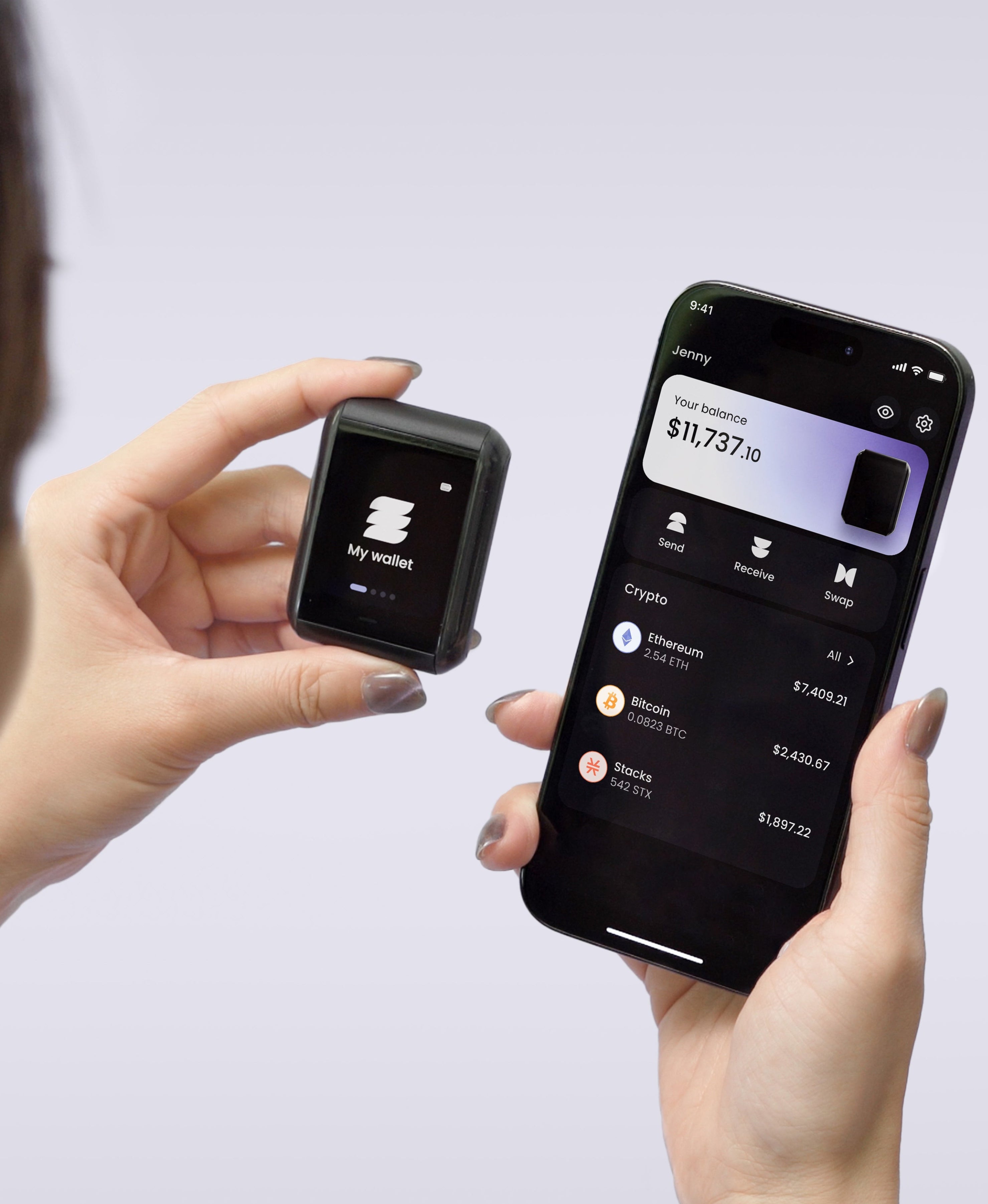
Ryder One generates and stores private keys inside an EAL6+ certified Infineon SLC38 secure element audited by Halborn, and no software path can extract those keys. When you approve a Bitcoin or ERC-20 transfer during a volatile session, the destination address and the amount render on a 1.6-inch AMOLED touchscreen in readable form before a button wired directly to the secure element becomes active, so the signing step happens on hardware rather than inside a browser app that could be spoofed under stress.
Communication is NFC-only with no Bluetooth radio a remote attacker could pivot through, and the device charges over Qi so power doesn't open a data path either. TapSafe Recovery splits your wallet's recovery secret across a Recovery Tag (IP69K rated, 50% of the share), the paired phone with the share encrypted into iCloud or Google Drive rather than sitting on the handset (50%), and up to two optional Recovery Contacts (25% each). The BIP-39 seed phrase stays accessible on-device as a last resort, so a holder is never locked into Ryder hardware. Ryder One ships at $229 with the Recovery Tag, Qi wireless charger, and travel pouch, weighs 38 grams at 41 x 55 x 14.5 mm, and carries an IP67 rating on the device with IP69K on the Recovery Tag. Practicing self-custody during a drawdown looks the same on Bitcoin as on ETH or stablecoins: keys inside the secure element, backup spread across TapSafe.
Bottom line
The next time you search "why is crypto crashing," the answer will sit inside the same six buckets: macro and dollar strength, forced perp selling, ETF outflows and whale distribution, a regulatory or tariff shock, a token unlock or insider print, and thin weekend books that amplify everything else. Knowing the drivers doesn't stop the drop; it tells you which parts of the tape to watch when the search bar fills up. What you can control is where your coins sit during the drop. Holding them on your own hardware means the freeze button, the withdrawal queue, and the bankruptcy question all belong to someone else's chart.
Ride out the next crash on your own keys. Ryder One keeps Bitcoin, Ethereum, and every supported token offline on an EAL6+ secure element, with TapSafe Recovery as the backup.
SEO
- Target keyword: why is crypto crashing
- Secondary keyword: why is crypto down today
- SEO title: Why Is Crypto Crashing? The Real 2026 Reasons Behind Drops (57 chars)
- Meta description: Crypto crashes rhyme with the same six drivers: Fed, tariffs, perp liquidations, ETF outflows, unlocks, and thin weekend books. Here's why. (138 chars)
- Hero alt text: crypto crashing 2026 reasons drops — Ryder self-custody hardware wallet


Share: