


Bitcoin opened May 2026 around $71,000 per coin. By early June it touched $59,000, then bounced back to roughly $63,000. The 18% drawdown ran in five trading days. Spot Bitcoin ETFs bled $3.4 billion in net outflows during the worst week, the largest weekly exodus since the funds launched in January 2024. Exchange order books thinned out. Retail crypto Twitter went silent.
The people who slept through it were, mostly, the ones holding their Bitcoin on hardware wallets.
This is worth being precise about. Hardware wallets don't have a technical advantage during volatile periods. The Bitcoin sitting on a hardware wallet moves with the same price as the Bitcoin sitting on Coinbase. The difference is behavioral: friction at the moment of action keeps holders from making decisions they'd regret an hour later.
This piece walks through what happened in the early-June Bitcoin drawdown, why exchange-held holders behave differently from self-custody holders during crashes, and what structural design choice underneath a hardware wallet does most of the work.
What happened: the price action
Bitcoin's June 2026 sequence looks like this:
- May 22: Local high near $71,500
- May 28: Slipping into the high $60Ks
- June 2: $59,100, 18% off the high
- June 7: $63,000, partial recovery
- June 11: $63,400, sideways consolidation
The 13 consecutive days of ETF outflows that started May 15 drained $4.37 billion from the spot ETF complex. BlackRock's IBIT alone lost $3.3 billion. Fidelity's FBTC lost $456 million. Total assets across all US spot Bitcoin ETFs fell from $104 billion to $83 billion in roughly three weeks.
For exchange-held holders, that level of outflow correlates with two patterns: holders panic-selling at the bottom, and holders rotating from spot ETFs to direct custody (sometimes to self-custody, sometimes to other custodian products).
Why hardware wallet holders behaved differently
Three structural reasons.
Signing requires the device. Selling Bitcoin held in a hardware wallet means you go find the device, plug or tap it in, open the wallet app, choose the destination exchange, copy the receive address, paste it into the wallet, verify on the device's screen, press the physical button. That's maybe two minutes of friction. In a moment of panic at 2 a.m., two minutes is enough to think twice.
No push notifications. A hardware wallet doesn't have a screen showing your balance. It doesn't push price alerts. It doesn't open by accident when you reach for your phone in bed. The wallet only matters when you choose to interact with it.
The receive address is on the wallet, not the exchange. To sell, you have to send the Bitcoin to an exchange first. That's an on-chain transaction with a confirmation delay. You can't sell instantly. Even if you decide to sell, the gap between decision and execution gives the market time to move (sometimes toward you).
These aren't accidents. They're properties of how the wallet is built.
The behavioral evidence
On-chain analytics firms track which Bitcoin moved during drawdowns by wallet age and type. Two patterns showed up in June.
Short-term holders (coins less than six months old) accounted for most of the realized losses during the drawdown. These are mostly recent buyers, often on exchanges or in newly-funded software wallets, who bought during the May rally and sold during the June correction. Their cost basis was higher than where they sold.
Long-term holders (coins more than a year old, typically held in cold storage) barely moved. The hodl wave heatmap that maps coin movement by age showed minimal activity in the long-term bands during the entire drawdown.
The pattern is consistent across every Bitcoin drawdown since 2020. Newer holders sell. Older holders hold.
The structural design choice
The mechanic that makes hardware wallets work as behavioral insulation is the same mechanic that makes them secure: the private key never leaves the device, and every signature requires a physical action. The friction that protects you against malware also protects you against your own bad decisions during volatile periods.
A hot wallet doesn't have this property. A few taps on a phone and the funds are sold. An exchange has even less of it. You can sell with a slider during the 30 seconds you spend doom-scrolling at 3 a.m.
For holders who can recognize their own behavioral patterns, the hardware-wallet choice is partly an admission: I might make a worse decision if the option were easier.
Where Ryder One fits
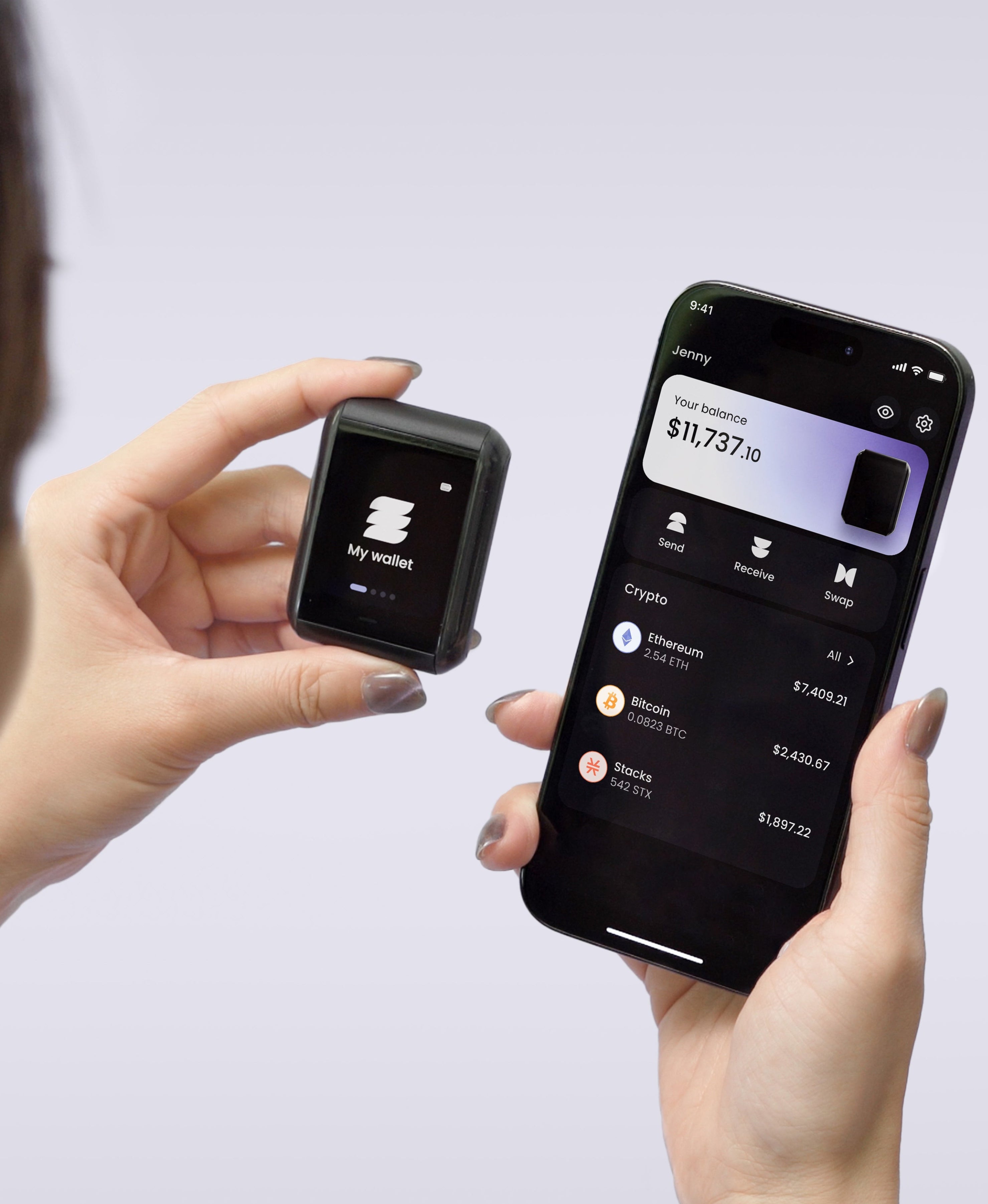
Ryder One inherits this design. The EAL6+ Infineon SLC38 secure element holds the private key offline. Every transaction is verified on the device's 1.6-inch AMOLED touchscreen with a physical button press. The wallet stays out of your daily attention until you choose to engage with it.
TapSafe Recovery handles the structural backup so the friction is purposeful rather than fragile: 50% on a Recovery Tag, 50% in your phone's iCloud or Google Drive backup, optional 25% per Recovery Contact.
The bottom line
Bitcoin's June 2026 drawdown moved $4.4 billion out of ETFs in 13 days. The holders who slept through the worst of it were sitting on cold storage, with their funds inaccessible by reflex. The hardware-wallet path removes one specific failure mode (the panic sell) from your set of available behaviors when the market is at its worst, which doesn't guarantee better long-term returns but does make some kinds of bad outcome harder to reach. For most retail holders over a multi-year horizon, that friction pays for itself many times over.
Sleep through the next 18% drop. Ryder One holds your Bitcoin offline on an EAL6+ secure element, with every transaction requiring the device, the app, and a physical button press. The wallet only matters when you choose to engage. See how it works.


Share: