

On 2 September 2026, Thailand's Securities and Exchange Commission finalised a travel rule for digital assets, and buried in it was a requirement that reaches past the exchanges themselves. Licensed operators there will have to verify ownership of, or control over, self-hosted wallets whenever assets are sent to or received from one, with the rules taking effect on 27 February 2027. If you keep your coins on your own device, that phrase describes you. An unhosted wallet is the regulatory name for the arrangement most of us would call holding your own keys, and it's worth understanding the vocabulary before somebody uses it in an email about your withdrawal.
What an unhosted wallet is
An unhosted wallet is any wallet where you hold the private key yourself and no company holds it for you. The contrast is a hosted wallet, which is what you have when your coins sit on a crypto exchange: the platform keeps the keys, your balance is a number in its database, and moving the money means asking the platform to move it. Hardware wallets, phone wallets where you wrote down the recovery words, and a key on a piece of paper all fall in the unhosted category.
You'll see several names for the same thing depending on who's writing. Regulators in the European Union settled on "self-hosted address" in the text of the Transfer of Funds Regulation, the financial crime world tends to say "unhosted", the industry says self-custody, and Thailand's new rule says "self-hosted wallet". None of these describes a different mechanism. They describe who can sign.
Why the word exists at all
The vocabulary comes from anti-money-laundering rules rather than from crypto. Banks have long been required to attach sender and recipient details to wire transfers so payments can be traced, and the Financial Action Task Force extended that same expectation to crypto through what the industry calls the travel rule. Once regulated businesses had to identify who was on the other end of a transfer, they needed a label for the case where the other end is a person with their own keys and no company standing behind them.
That label carries a consequence. Rules can only be enforced against businesses that hold licences, so the obligations land on the exchange rather than on the wallet, and what reaches you is whatever the exchange must do before it will process your withdrawal.
What the rules ask for in practice
The European Union offers the clearest picture of how this plays out, since its rules have been in force longest. Under the Transfer of Funds Regulation, the threshold is a thousand euros. The European Parliament's own summary puts it directly: when a customer sends or receives more than 1,000 euros to or from their own un-hosted wallet, the service provider has to verify whether that wallet is owned or controlled by the customer.
Verification usually takes one of two forms, and both are ordinary rather than invasive. The first is a microtransaction, sometimes called the Satoshi test, where you send a small predefined amount from the wallet to prove you can spend from it. The second is message signing, where your wallet signs a short piece of text with the key behind the address, producing a signature anyone can check without learning anything about the key. Thailand's regulator declined to mandate a method at all, leaving operators to set their own procedures in policy, and it does require transaction records to be kept for at least five years.
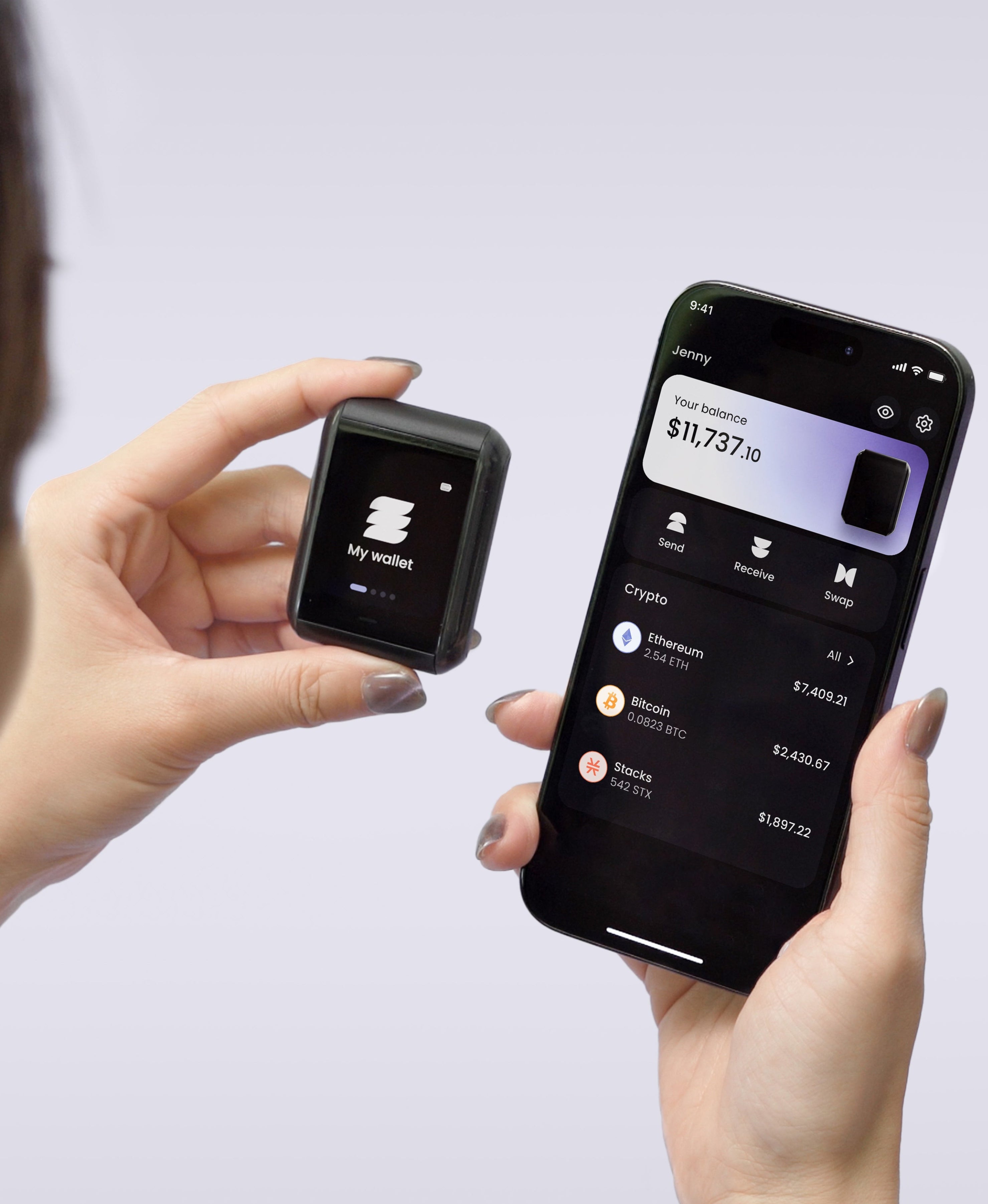
Both approaches depend on your wallet being able to perform the proof when asked. The microtransaction is the one to reach for on a Ryder One, and it works on Bitcoin, Ethereum and Solana with no special test mode involved: paste the address the exchange gave you, enter the exact amount they specified, and approve it on the device, which shows you that amount and that recipient on its own screen before it signs. Bitcoin is denominated natively in sats, so a request for a few hundred satoshis is not a precision problem. Keep the transaction ID the exchange sends back, because that, together with a note of which addresses are yours, is the record you will want the next time somebody asks.
What these rules leave alone
Here is the part that tends to get lost in the headlines. Transfers between two people using their own wallets, with no licensed business in the middle, sit outside the travel rule entirely. The European Parliament said so explicitly when the deal was struck, excluding person-to-person transfers conducted without a provider from the scope of the regulation. Nothing in the European framework registers your wallet, licences your device, or requires you to report holdings you never moved through an exchange.
What is changing is the friction at the boundary. Moving coins between a regulated platform and your own device increasingly means proving the destination belongs to you, and the direction of travel across jurisdictions points at more of that rather than less. The practical reading is that self-custody remains legal and ordinary while the on-ramps and off-ramps get more paperwork, so the habit worth building is keeping a record of which addresses are yours and being ready to demonstrate control of them.
Backup and recovery, the obligation nobody can take off you
The flip side of an unhosted wallet is the part no regulation touches: if you lose the key, no licensed entity exists to restore it. There's no account recovery queue and no ombudsman, which makes your backup the single most consequential thing in the arrangement. Paper copies fade, burn and get cleared out during a house move. Steel plates handle fire and flood and are the sensible upgrade from paper, and yet the underlying weakness persists, because one object still grants full access to anyone who reads it and total loss to you if it disappears.
TapSafe Recovery breaks up that single point of failure instead of hardening it. Half of what a recovery needs lives on the Recovery Tag and the other half travels with your paired phone, held encrypted in your own iCloud or Google Drive rather than on the handset, so replacing a phone costs you nothing. Either half alone reveals nothing usable, while the two together restore the wallet. Recovery Contacts are optional, hold a quarter share each, and can see no balances or addresses at any stage. Your seed phrase stays available on the device as a last resort under the BIP-39 standard, so you keep the freedom to move to other hardware whenever you want.
Where that leaves you
Being called an unhosted wallet holder is a description of who signs, and the regulatory attention it attracts falls almost entirely on the businesses you transact with. Hold your own keys, keep a note of your addresses, expect an exchange to ask you to prove one of them at some point, and build a backup that survives the ordinary accidents of a decade.
Ryder One is 149 USD for the Starter Combo and 179 USD for the Super Safe Combo, with a Recovery Tag, wireless charger and pouch included. Keys are generated inside an EAL6+ certified Infineon SLC38 secure element and never leave the chip, the device communicates over NFC alone with no Bluetooth and no wired data path, and every transaction appears in readable detail on a 1.6-inch AMOLED touchscreen before you approve it. The firmware has been audited by Halborn, with the full report public.


Share: