


# SUI Blockchain in 2026: The Move-Language L1 Explained
For most of the L1 conversation in the last two years, the shortlist has looked the same. Ethereum plus its rollups, Solana on the fast lane, and a handful of newer chains fighting for the third seat. Sui has grown into that third seat quietly, and by mid-2026 the network holds several of the top spots on DeFi, gaming, and consumer-app leaderboards among non-EVM networks. The chain shipped a handheld gaming device in 2025, absorbed a wave of NFT and stablecoin activity, and pushed its consensus engine through a full protocol change without downtime.
In this piece we look at what SUI is, how Move and the object model change how transactions get built, where the mainnet stands in 2026, how self-custody works for anyone holding SUI crypto, and where a hardware wallet like Ryder One fits into the picture.
What SUI is, in plain terms
SUI is a proof-of-stake layer 1 launched by Mysten Labs, a company founded in 2021 by former engineers from Meta's Diem and Novi teams. The team took the Move programming language that Diem never shipped and built a new chain around it. Mainnet went live in May 2023, and since then the network has processed billions of transactions across DeFi, gaming, NFTs, and payments. Where Ethereum thinks in accounts and balances, Sui thinks in objects: every coin, every NFT, every position is an addressable object with its own ID, owner, and history. That distinction sounds small on paper, and it changes almost everything about how transactions get constructed and signed.
The network runs on Mysticeti, a consensus protocol Mysten shipped in 2024 that cut end-to-end latency to about half a second while keeping the throughput ceiling high. Validators stake SUI, earn a share of gas fees, and rotate through the committee. Users pay gas in SUI, and applications can sponsor gas for their users if they want to. The token itself launched with a 10 billion supply cap and a multi-year unlock schedule tracked in the Sui tokenomics paper.
How Move and the object model differ from EVM and Solana
Move started at Facebook in 2019 as a bytecode language for Diem, and it survived the project because two teams (Mysten for Sui and Aptos Labs for Aptos) carried it forward in different directions. The variant Mysten uses is called Sui Move, and it leans hard into the object model. In Solidity, a token is a mapping inside a smart contract that says "address 0xABC holds 100 units." Ownership is data inside the contract. In Sui Move, a token is an object with its own ID, and its owner field points at your address directly. The contract stores logic, and your wallet holds objects.
That shift shows up everywhere. Transfers are cheaper because moving an object does not require an update to a global mapping. Parallel execution is easier because the runtime can see which objects any transaction touches before running it, and any two transactions touching disjoint sets of objects can run at the same time on different cores. The type system enforces resource safety, so a coin cannot be duplicated or lost by accident inside a contract. Ethereum bolts many of these guarantees on with linters, audits, and careful patterns; Sui bakes them into the language and the runtime.
For someone coming from EVM or Solana, the switch is bigger than a chain ID change. Solidity contracts do not compile to Sui Move, and Solana programs do not port either. Wallets have to speak the Sui transaction format and produce ed25519 signatures rather than the secp256k1 signatures Ethereum uses.
Sui mainnet and the 2026 ecosystem
By mid-2026, Sui sits among the top L1s by DeFi activity. DeFiLlama pins TVL around 2 billion USD, spread across a set of native protocols that have grown into their own category. Cetus runs concentrated-liquidity swaps and is often the volume leader on the chain. NAVI and Suilend split most of the lending market between them, with Scallop and a handful of others taking the tail. Bluefin runs an orderbook perp DEX that has climbed onto the leaderboards for non-EVM derivatives. Stablecoins on Sui grew as USDC went live via Circle's Cross-Chain Transfer Protocol in 2024, and native issuance has kept climbing since.
Consumer activity looks different from the DeFi picture. Sui shipped the SuiPlay0X1 handheld in 2025, a device that runs Steam titles and Sui-native games with an on-device wallet, and it moved the chain into a category most L1s have never touched. On the NFT and social side, mint activity clusters around a couple of native marketplaces and a growing library of onchain games. The point is that the chain has ecosystem depth beyond a single vertical, and that depth is what lets it hold TVL through a full market cycle rather than depending on one narrative.
Fees stay low because of how the object model interacts with parallel execution. A typical transfer costs a fraction of a cent, and complex DeFi transactions still land under a penny. That fee floor is what makes the chain viable for consumer use cases the way Solana is, and it is a big part of why gaming teams have picked Sui when they wanted a fast chain with room to breathe.
The self-custody read on holding SUI
Here is the piece that matters if you already have crypto sitting on Ethereum or Solana. A SUI address is a different beast from an EVM address, and the key material behind it is different too. Sui uses ed25519 by default (the same curve Solana uses), plus optional support for secp256k1 and secp256r1 for interop cases. That means the seed you generate for a Sui account produces a different keypair than an Ethereum seed at the same derivation path, and any wallet that signs SUI has to speak Sui's signing scheme end to end.
BIP-39 seed phrases still work for backup, and Sui defines its own derivation path for keys generated from that phrase. If you write down a 24-word seed for a Sui wallet, the same words will regenerate the same account on any wallet that follows the Sui spec. What you cannot do is take an Ethereum address, load it into a Sui wallet, and expect to see your ETH or your ERC-20s show up. The chains are separate ledgers with separate signing schemes.
The practical read on custody is the same as any other holding. Keys sitting on a hot wallet or an exchange are exposed to the standard set of attacks: phishing sites, browser extension malware, SIM swaps, clipboard swaps, and the occasional exchange failure. Moving the signing key to a hardware wallet cuts most of that surface off, because the private key sits inside a secure element that will never release it to a host computer under any condition. What the hardware wallet has to do, though, is speak the chain you hold. For SUI holders, that means finding a device with active Sui firmware support: Ledger and a few others ship it today.
Where Ryder One fits
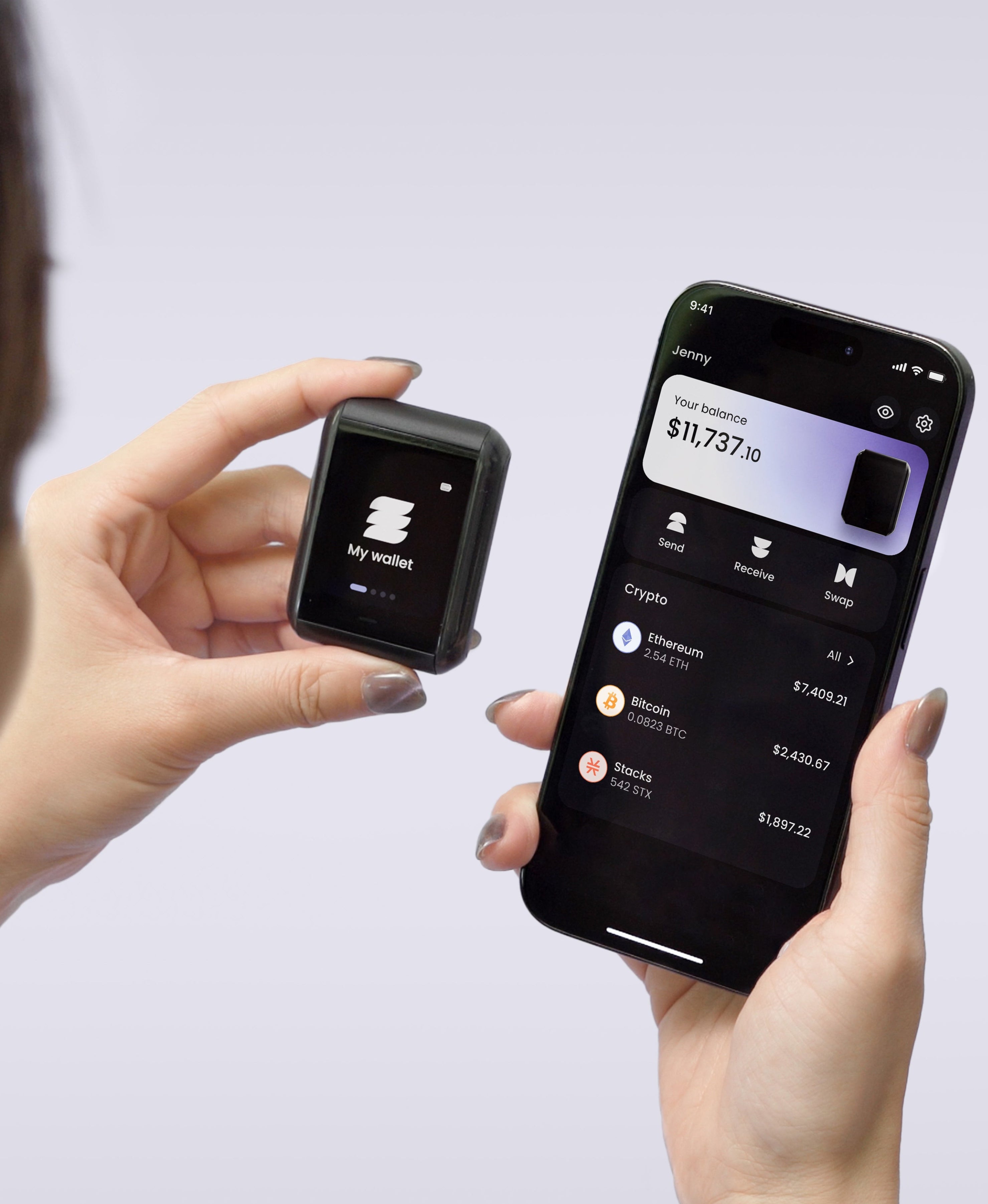
Ryder One is a compact hardware wallet built around an EAL6+ Infineon SLC38 secure element, a 1.6-inch AMOLED touchscreen, and NFC-only communication. It has no USB port, no Bluetooth radio, and no Wi-Fi. The device signs Bitcoin, Ethereum, Solana, and a growing list of top ERC-20 and SPL tokens today, and Sui sits outside that current supported set. If you are picking a device for a portfolio that includes SUI today, check the current supported-chain list on the Ryder One product page before you order.
The general self-custody frame still applies. Every transaction on any chain renders on the device screen in full readable detail before you tap the button, and the button wires directly to the secure element so no software path can sign without your input. Address verification on the device defends against clipboard-hijack attacks. Recovery uses TapSafe instead of a written paper backup: the Recovery Tag holds 50 percent of the wallet share and carries an IP69K rating for high-pressure water, and a phone backup stored encrypted in your iCloud or Google Drive holds the other 50 percent. Optional Recovery Contacts add 25 percent shares apiece, paired in person over NFC, and none of those contacts can see your balance or your keys. The BIP-39 seed phrase is available on-device as a last resort, so you are never locked to Ryder hardware. Ryder One ships at $229 with the Recovery Tag, a Qi wireless charger, and a pouch in the box.
The custody model and the recovery pattern hold regardless of which chain you keep behind them. What waits on firmware is the list of chains the device can sign directly.
The bottom line
SUI is a well-funded L1 with a coherent design story, a Move language that solves problems Ethereum has had to work around, and an ecosystem that stretches from DeFi into consumer gaming. Mid-2026 TVL sits at roughly 2 billion USD, and the chain has held that level through the noise of the broader market. The object model is the piece to internalize if you are studying the design; the ed25519 signing scheme is the piece to internalize if you are studying the custody read.
For anyone holding SUI, the hardware-wallet decision is the same as it has been for every chain since Bitcoin. Keys on a computer or a phone belong to the machine they sit on, and the machine can be compromised. A device with a secure element keeps the keys yours and shows every transaction on screen before you press the button to sign. Confirm the chain you hold is in the current firmware, then let the hardware do what it was built to do.
SEO
Target keyword: sui crypto
SEO title: SUI Blockchain in 2026: The Move-Language L1 Explained
Meta description: SUI is a Move-language L1 with a 2B USD DeFi ecosystem in 2026. Here is how the chain works, what makes SUI crypto different, and the self-custody read.
Hero alt text: SUI crypto Move blockchain 2026 — Ryder self-custody hardware wallet


Share: