

The crypto industry has a vocabulary problem. "Wallet" gets used for two completely different things: an account on a centralized exchange, and a tool that holds your private keys directly. They're not the same. They have different security properties, different failure modes, and different answers to the question of who owns the coins. A self-custody wallet is the second kind. You hold the keys. No company sits between you and your funds. If you lose the keys, no support team can recover them. If a regulator freezes the company holding your wallet, that doesn't apply to you, because no company holds your wallet. This is what "not your keys, not your coins" means in practice. Here's how self-custody wallets work, what types exist, and why holders are moving toward them in 2026.
What a self-custody wallet is
A self-custody wallet is software, hardware, or both, that holds your cryptographic private keys directly. Those keys control your coins on-chain. Whoever holds the keys controls the funds. The contrast is custodial. When you keep crypto on Coinbase, Binance, or any centralized exchange, you don't hold the keys. The exchange does. You hold a database entry that says you're entitled to a certain balance. The exchange could theoretically pay you out, freeze your account, get hacked, or collapse. FTX held customer funds in a custodial arrangement. When it failed, customers lost access to billions. The legal status of those balances is still being litigated four years later. Self-custody removes that intermediary. The keys live on your device. The blockchain recognises your address as the owner. No company has standing to interfere.
How self-custody wallets work under the hood
Every self-custody wallet generates a master seed at setup. The seed is usually displayed as a 12 or 24-word recovery phrase using the BIP-39 standard. From the seed, the wallet derives every private key for every coin and every address. When you receive funds, the blockchain associates them with one of your derived addresses. When you send funds, the wallet uses the corresponding private key to sign a transaction. The signature proves you authorised the transfer. The blockchain accepts the signature and updates the ledger. The keys don't leave the wallet during this process. The signature is broadcast publicly. The keys remain private. This is what makes self-custody work: cryptographic proof of ownership without revealing the underlying secret.
Types of self-custody wallets
Three main categories, in rough order of security strength. Software wallets (hot wallets). Apps that run on your phone or browser and hold the keys in software. Convenient. Fast. Good for small balances and active DeFi use. The keys live on a device that connects to the internet, which means malware, browser exploits, malicious smart contracts, and phishing all threaten them. Hot wallet drains accounted for billions of dollars in losses in the past few years. Hardware wallets (cold wallets). Dedicated devices that hold keys offline. The internet-connected app builds transactions, but the device signs them. The keys never leave the secure chip. Hardware wallets defend against the entire class of attacks that drain hot wallets, because the attacker would need physical access to the device and your PIN to do anything. Paper wallets. A printout of a private key and corresponding address. Functional but increasingly rare in 2026. The recovery model is fragile (one piece of paper, one fire, one missing copy equals total loss) and most paper wallets only support one coin per page. Mostly historical interest now.
Why holders are switching to self-custody in 2026
The shift has been building for years, but a few specific events accelerated it. Exchange collapses. FTX (2022, 8 billion USD in customer funds), Celsius (2022), Voyager (2022), and a long tail of smaller failures since. Each one converted exchange customers into self-custody adopters. The lesson hit hard: custodial balances are unsecured creditor positions, not ownership. Regulatory uncertainty. Different jurisdictions handle exchange insolvency differently, and none of them treat the customer as the owner of their balance the way self-custody does. Holders in countries with unstable banking systems have moved to self-custody specifically to avoid bank-style account freezes. Hot wallet drain epidemic. Address poisoning, malicious approvals, fake browser extensions, and phishing kits became industrialised. Single-day drains in the seven-figure range stopped being rare news and became regular news. Hardware wallets cut this attack surface to nearly zero. Inheritance and life-event planning. As crypto holdings cross into multi-decade time horizons, holders started taking seriously the question of "what happens to my crypto if I'm hospitalised, incapacitated, or pass away?" Custodial accounts depend on the exchange's death-claim procedures, which range from slow to nonexistent. Self-custody with structured recovery answers this directly.
The trade-offs self-custody comes with
Self-custody isn't free. It moves all the responsibility from the exchange to the holder. Lose the keys, the funds are gone. There's no password reset. There's no support ticket. There's no insurance policy. The cryptography that gives you sovereign ownership also gives you sovereign responsibility for survivability. This is where the seed phrase storage problem comes from. It's why holders end up with metal plates, safe deposit boxes, and elaborate multi-location backup schemes. The math is sound. The execution is the hard part.
Where Ryder fits
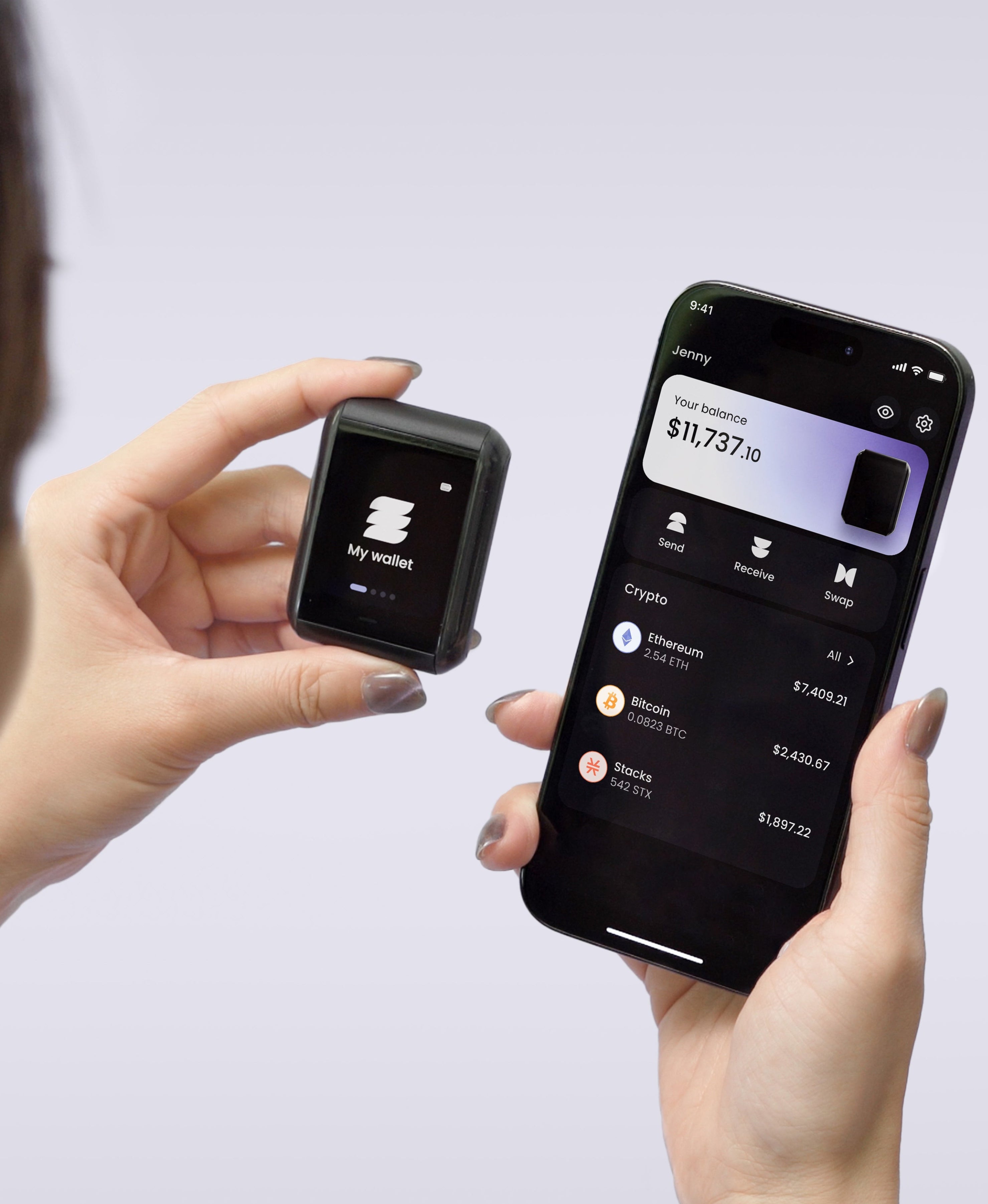
Ryder One is a self-custody hardware wallet built around the recovery problem specifically. We use BIP-39 under the hood (so you're never locked to Ryder hardware) and built TapSafe Recovery on top: a recovery model that distributes backup across three layers (a Recovery Tag, a phone backup, and optional Recovery Contacts), so no single layer alone gives access to your funds. The seed phrase remains available on-device as a last resort. The 1.6-inch screen verifies every transaction before signing. NFC-only means no USB attack surface, no Bluetooth attack surface, no internet attack surface during signing. EAL6+ secure element handles the actual key storage. The point isn't that self-custody is hard. It's that self-custody can be hard or it can work for normal humans across decades. We built Ryder One for the second case.
The takeaway
A self-custody wallet is one where you hold the keys, not a company. It's the structural answer to exchange collapses, regulatory freezes, and the long history of custodians failing. Software wallets are convenient but exposed. Hardware wallets are the standard for any balance you care about. The trade-off is responsibility: lose the keys, lose the funds. Ryder One is built around the assumption that the recovery side of self-custody should work as well as the cryptography. Setup takes 60 seconds. The structural protection lasts decades.


Share: