


# Not Your Keys, Not Your Coins: What It Means in 2026
The phrase has been around since roughly 2014, popularized by Bitcoin educator Andreas Antonopoulos. It sounds like a slogan. After a decade of exchange collapses and one tidy shutdown announcement, it reads more like a warning label.
If you've ever left Bitcoin or any other crypto sitting on an exchange, this article is worth reading before the next exchange news cycle hits.
What the phrase means: the exchange holds the keys, you hold a promise
Owning crypto means owning a private key. That key is a large, randomly generated number, and it is the only thing that lets its holder authorize a transaction on the blockchain. The blockchain doesn't know your name or your email address. It knows that whoever holds a specific private key is authorized to move the coins assigned to that key's corresponding address.
When you deposit crypto onto an exchange, you send it to an address the exchange controls. The exchange's servers hold the private key to that address. Your account shows a balance, but that balance is an entry in a database: a promise from the exchange to return those funds when you ask. That promise is backed by the exchange's solvency, its operational security, and the absence of fraud at the management level. If any of those conditions fail, your IOU can become worthless overnight.
That's what self-custody means at its core: holding the private keys yourself, so your access to your funds doesn't rest on the continued health of any institution beyond your own careful stewardship of a number.
Three collapses that proved it
The same lesson played out at different scales over a decade.
Mt. Gox was the world's largest Bitcoin exchange until February 2014, when it disclosed that roughly 850,000 BTC belonging to customers had gone missing. The exchange filed for bankruptcy, and subsequent investigation revealed that coins had been siphoned out as far back as 2011. Around 200,000 BTC was later recovered, and the bankruptcy trustee has been grinding through partial repayments to creditors with an extended deadline running to October 2026, twelve years after the original collapse. Those coins were worth approximately $450 million when the exchange folded.
Celsius Network took a different path. The lending platform froze customer withdrawals in June 2022, citing market conditions, then filed for Chapter 11 bankruptcy in July 2022. Court filings during restructuring revealed that Celsius owed roughly $4.7 billion to customers whose deposits it had used for its own leveraged strategies. Those customers had handed over their coins at the point of deposit; the exchange lent those coins out and lost them, and a bankruptcy court spent the following year deciding how much, if anything, creditors would recover.
FTX collapsed in November 2022 after reporting raised questions about its balance sheet and triggered a withdrawal run that exposed an approximately $8 billion gap in customer funds. Founder Sam Bankman-Fried was arrested and convicted in November 2023. Customer funds had been commingled with a sister trading firm's positions, and when those positions turned against them, the accounts that had looked whole on a dashboard were backed by nothing.
Each collapse had its own mechanics: a slow security failure, reckless risk management, fraud. The common thread was that customers had entrusted their keys to a third party, and when the third party failed, those customers had no recourse outside a lengthy bankruptcy process.
BitMEX in 2026: the clean shutdown that still proves the point
The BitMEX closure announcement, published July 23, 2026, is different from every case above, and understanding why makes the underlying issue clearer.
BitMEX didn't lose customer funds. There's no insolvency, no hack, no fraud case. The exchange is closing on September 23, 2026 for business reasons, and customers are being given a withdrawal window. On that level, the story is a success: the exchange managed customer funds responsibly and is winding down in an orderly way.
But the closing announcement comes with a fee structure for withdrawals after the deadline. Customers who don't act in time won't lose everything. They will, however, lose a percentage of their balance to fees on a schedule they didn't set, triggered by a business decision they had no part in. Your access to your own funds depends on whether you catch the announcement, whether you move quickly enough, and whether the platform's exit process aligns with your situation. The scenario is entirely recoverable. It's also a quiet illustration of what third-party custody means in practice: your coins are accessible on their timeline, under their conditions.
That's the BitMEX lesson. It's not a horror story. It's a reminder that even the cleanest version of exchange closure puts your funds inside someone else's process.
How private keys work
A private key is a randomly generated 256-bit number, large enough that generating the same one twice by chance is for all practical purposes impossible. From that number, a corresponding public address is derived. The blockchain records which addresses hold which amounts. To move funds from an address, you need to produce a cryptographic signature proving you know the private key for that address, without revealing the key itself.
Control of the key is control of the funds. There's no customer support number, no password reset, and no regulatory appeal that overrides this arrangement. The math is the authority, and whoever holds the key holds the crypto.
A seed phrase is the human-readable version of this: 12 to 24 words generated when you set up a wallet, containing all the information needed to reconstruct your private keys on a new device. Lose the seed phrase with no backup, and recovery becomes a matter of luck rather than process. Share the seed phrase with someone you didn't intend to, and they have full access to every coin in that wallet, with no way to revoke that access after the fact.
From exchanges to software wallets to hardware wallets
There's a spectrum of custody options, and the trade-offs at each level are worth understanding before you decide where your holdings live.
Exchange custody is the default starting point. The platform holds your keys, your interface is a login screen, and you can buy, sell, and withdraw at will as long as the exchange remains operational. For small amounts you're actively trading, the convenience is clear and the risk is proportionate.
Software wallets like MetaMask or Phantom generate and store keys on your own device. You hold the keys directly, meaning no exchange failure can take them from you. The trade-off is that the key lives inside a phone or computer connected to the internet, where malware, phishing, and compromised browser extensions can potentially reach it. A software wallet is a meaningful step toward sovereignty, and it introduces a new category of risk at the same time.
Hardware wallets move the key off the internet entirely. The private key lives inside a dedicated security chip, generated there and stored there, with no path out. When you want to sign a transaction, the transaction travels to the device, you confirm it on-screen, and the signature comes back without the key itself ever leaving the chip. The signing device has no browser, no apps, and no network connection between transactions.
For small or frequently-used amounts, exchange custody or a software wallet may be the right call. For any holding that would hurt to lose, a hardware wallet removes the largest risks from the picture.
Where Ryder One fits
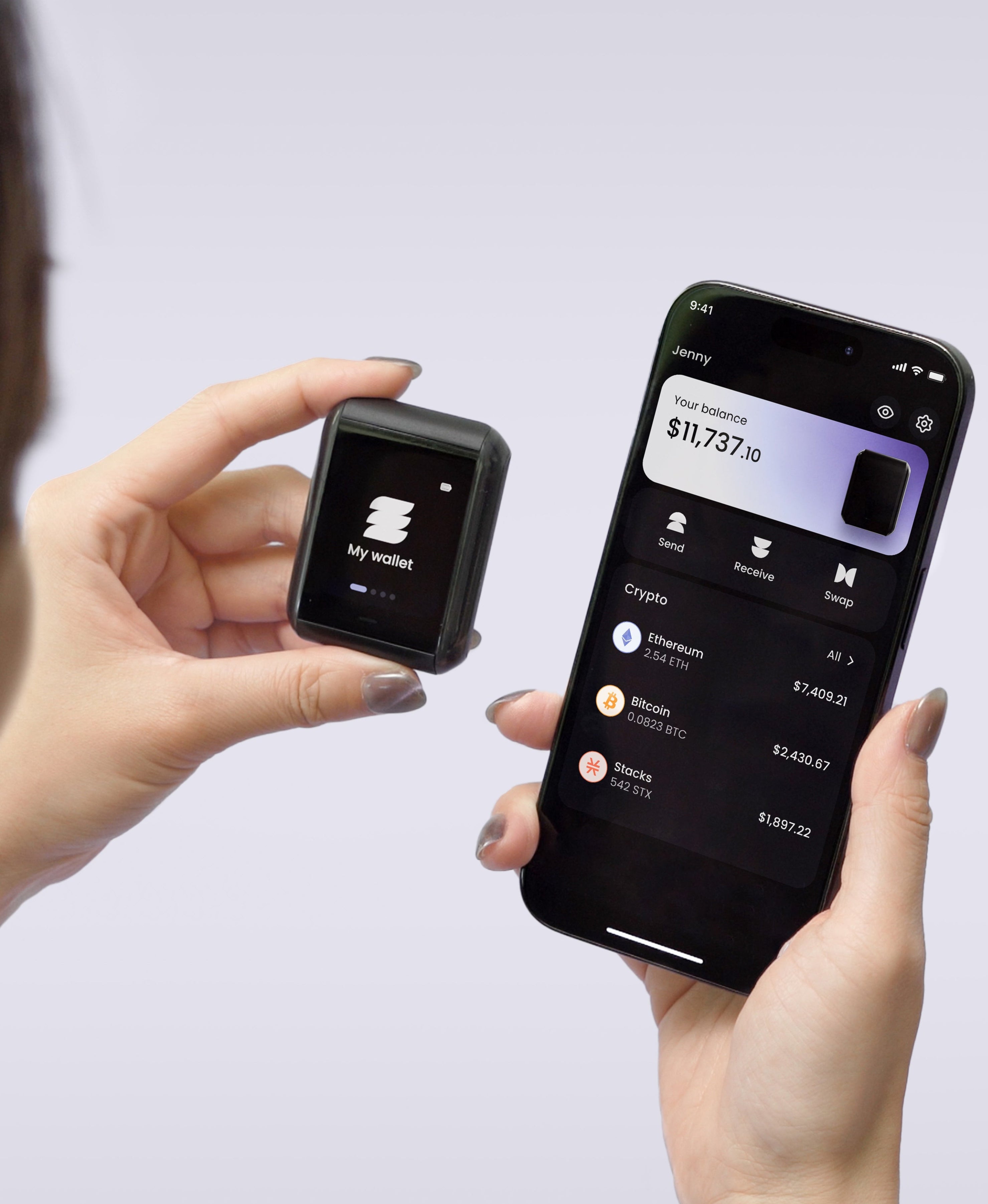
Ryder One is a hardware wallet built around an EAL6+ Infineon SLC38 secure element, the same class of chip used in passports and banking hardware. The private key is generated on that chip and stays on it permanently. Communication with a paired phone happens over NFC only, with no USB port and no persistent wireless radio.
Every transaction is decoded and displayed on the 1.6-inch AMOLED touchscreen before you confirm it: function name, token, recipient address, and amount. The confirmation button connects directly to the secure element, so no software on the connected phone can produce a signature without a press the hardware can verify came from you.
Recovery works through TapSafe, which distributes the recovery information across a Recovery Tag and an encrypted cloud backup rather than concentrating it in a paper seed phrase. The Recovery Tag holds 50% of what's needed and is rated IP69K for water and dust resistance. Encrypted in your iCloud or Google Drive account, the other half stays off the phone entirely. Neither piece alone is sufficient for recovery, which means a lost tag or a lost phone backup doesn't leave you locked out of your wallet. The BIP-39 seed phrase is available on-device for anyone who wants it, so you're never bound to Ryder hardware.
Ryder One is $229 and ships with the Recovery Tag, a Qi wireless charger, and a travel pouch.
If you hold crypto that would matter to lose, the best time to move it off an exchange was when you first bought it. The next best time is now. Start at ryder.id/products/ryder-one.
SEO
- Target keyword: not your keys not your coins
- SEO title: Not Your Keys, Not Your Coins: What It Means in 2026
- Meta description: Not your keys, not your coins explained: what it means, why BitMEX, FTX, and Celsius proved it, and how hardware wallets fix the problem for good. (152 chars)
- Hero alt text: not your keys not your coins explained 2026 — Ryder self-custody hardware wallet


Share: