

The Electrum wallet has outlasted most of the software built around early Bitcoin, and it earned that run by being fast, open and Bitcoin-only while heavier clients asked you to download the whole chain. It also has the longest incident history of any wallet in common use, and the attacks that cost its users money were strange ones: nobody broke the cryptography, and nobody needed to.
Asking whether the Electrum wallet is safe turns out to be two questions wearing one coat. The code is one question, and where that code runs is a different and larger one.
What the Electrum wallet does
Electrum is an open-source desktop and mobile client for Bitcoin, currently at version 4.8.2 as listed on electrum.org in October 2026. Rather than storing the blockchain locally, it verifies your transaction history using SPV against servers that index the chain for it, which is why it opens in seconds on a laptop that would groan under a full node.
Several features put it ahead of the average app wallet. Keys are encrypted and stay on your machine, a watching-only wallet lets you track balances on a computer that holds no keys at all, multisignature setups split spending authority across several wallets, and a plugin system connects hardware signing devices. Bitcoin is the only asset, which keeps the surface small.
Where your keys live, and why that is the whole answer
Electrum keeps an encrypted wallet file on your computer, and your password unlocks it when you want to spend. That design is sound as far as it goes, and it is also the ceiling on how safe the software can be, because the machine holding your keys is the same machine that opens email, runs a browser and installs things you half-remember agreeing to.
A hardware signing device moves that boundary. Keys get generated and held in a chip that the operating system cannot read, and the computer's job shrinks to building a transaction and showing you the result. Nothing about Electrum stops you working this way, and its plugin support exists precisely so you can.
The 2018 server attacks, and what they took
In late December 2018, Electrum users began seeing an official-looking message telling them to update their wallet, with a link attached. The message came from Electrum servers that attackers had stood up themselves, and the download at the end of the link was a doctored copy of the wallet that captured credentials and emptied balances. Reporting at the time put losses at 771 BTC, around 4 million USD, spread across a long tail of individual victims.
The underlying weakness was mundane. Electrum let servers send rich-text error messages to clients, a convenience for reporting fee problems that also let a hostile server compose something that looked like it came from the developers. Electrum stripped the formatting so the messages would read as less convincing, while noting that a fuller fix meant upgrading the whole federated server ecosystem, which no single team controls.
By April 2019 the attack had grown teeth. A botnet estimated at 152,000 infected machines flooded the legitimate servers with traffic until older clients had little choice but to connect to malicious ones, which turned a phishing campaign into something closer to a funnel.
The flaw that sat open for two years
A separate problem surfaced in January 2018. Electrum ran a local JSONRPC interface that any website loaded in the user's browser could reach, meaning a malicious page could talk to the wallet on the same computer and pull what it needed. BleepingComputer reported that the exposure had been present since 2016 before a patch closed it.
Neither episode involved a cryptographic break, and that is the pattern worth carrying away from both. Attacks against desktop wallets go after the channel, the update, the browser and the person, because those are softer than any key.
Is the Electrum wallet safe in 2026?
The software today is in better shape than its reputation suggests. Development has continued without interruption, the specific vectors above were closed, the project publishes its source, and plenty of long-term Bitcoin holders still use it as a coordinator while their keys sit elsewhere. If you download it only from electrum.org, verify the signature, and treat any in-app update prompt as suspicious until you have checked the site yourself, you have removed the route that took most of that 771 BTC.
What remains is structural. Your view of the chain comes from servers run by strangers, your keys sit on a general-purpose computer unless you pair hardware, and your recovery rests on words Electrum generated in its own seed format, which is a detail that catches people out when they try to restore the phrase onto a device expecting BIP-39.
Pairing Electrum with a signing device
Running Electrum as the interface while a hardware wallet holds the key is the arrangement that fixes the largest of those gaps, and it is how a lot of experienced users have run for years. The computer composes, the device signs, and a compromised laptop can mislead you about what you are approving only if you skip reading the device screen.
Ryder One is not part of that arrangement today. It communicates over NFC only, with no USB and no Bluetooth, so there is no plugin that lets Electrum or another desktop wallet drive it as a signer. Desktop signing sits on our roadmap, and until it ships the supported path is the Ryder app, where your phone composes the transaction and the device confirms it when you tap. If a desktop interface is a requirement for you rather than a preference, pair Electrum with a device built for that today.
How we handle recovery differently
Electrum's answer to losing your wallet file is the seed it gave you at setup, which puts you back where every software wallet puts you: one written list, stored somewhere, standing between you and your coins for as long as you hold them. TapSafe Recovery takes that weight off a single object. We split recovery with our own implementation of Shamir's Secret Sharing, so the Recovery Tag holds half while your paired phone holds the other half, encrypted into your own iCloud or Google Drive rather than sitting on the handset. Optional Recovery Contacts hold a quarter each, arranged in person over NFC, and none of them can see what you own.
No single share opens the wallet, so losing one becomes a repair job instead of a bad week. Your seed phrase stays available on the device as a last resort and follows the BIP-39 standard, which means it restores on other hardware and you are never tied to us.
What we would do with an Electrum balance
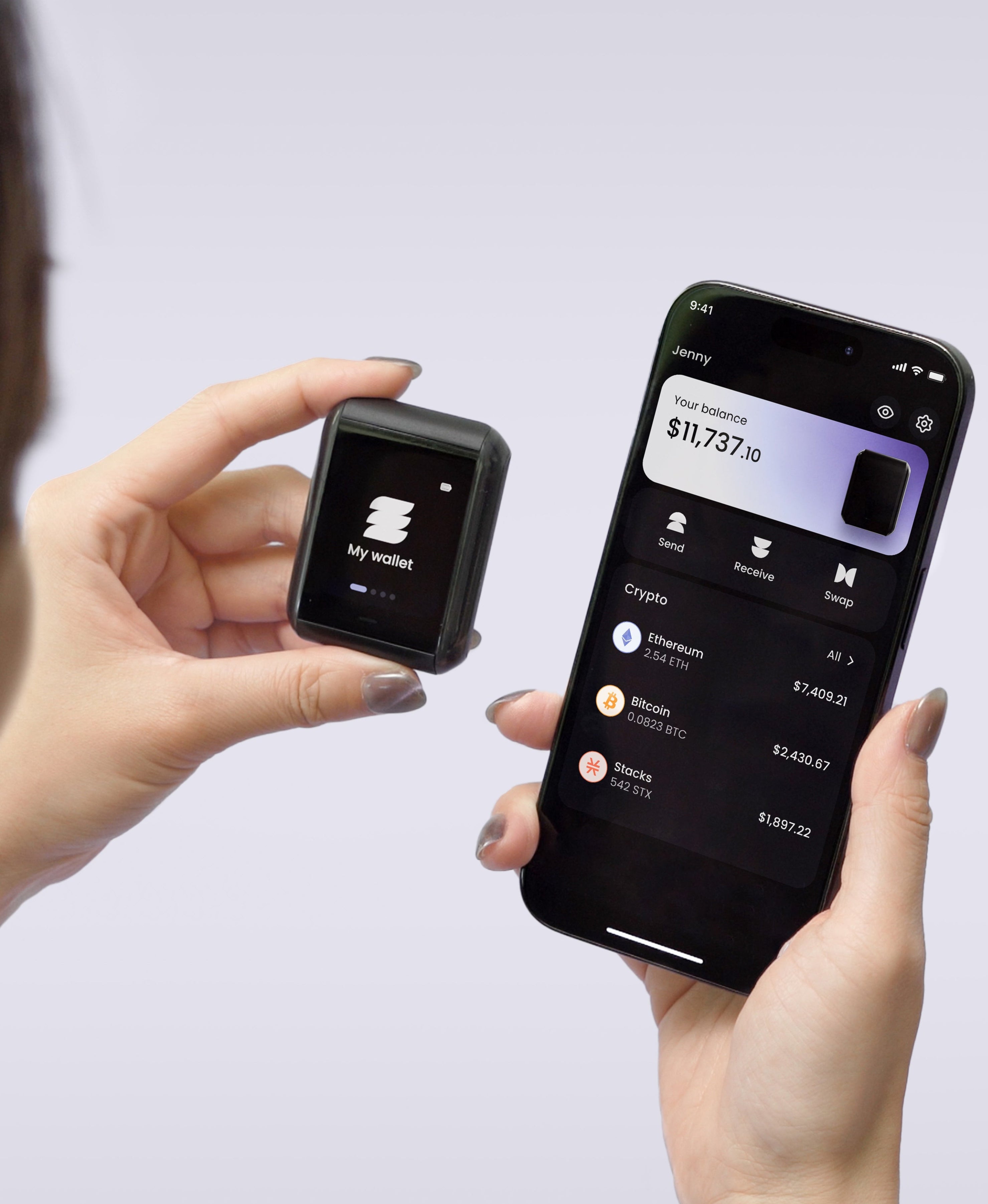
Keep Electrum if you like it, because a watching-only setup on a laptop is a reasonable way to follow your coins. Move the key off that laptop. On the Ryder One the private key is generated inside an EAL6+ certified Infineon SLC38 secure element and never leaves the chip. Transactions render in readable detail on a 1.6-inch AMOLED touchscreen before approval, receive addresses are verified on the device, and the button that authorises a signature connects directly to the secure element, so no software path can sign by itself. Communication is NFC only, with no Bluetooth radio and no Wi-Fi, and Halborn published a full independent audit of our firmware. You can import an existing 12 or 24-word phrase and layer TapSafe on top of it.
Setup runs three taps in about 60 seconds. The Starter Combo is 149 USD and the Super Safe Combo is 179 USD, each shipping with the Recovery Tag, a Qi wireless charger and a pouch. Supported assets are Bitcoin, Ethereum, Solana and a growing list of top ERC-20 and SPL tokens. Get your Ryder One.


Share: