


# Ethereum L2s in 2026: Arbitrum vs Optimism vs Base vs zkSync
Ethereum's L2 landscape has consolidated into a handful of winners by 2026. When Dencun dropped blob fees an order of magnitude in March 2024 and Fusaka pushed further in mid-2026 with PeerDAS, the roadmap made rollups the settlement path for almost every consumer-scale transaction on Ethereum. That thinned the field: a few dozen credible L2s in 2023 became four dominant names by mid-2026, with Arbitrum, Optimism, Base, and zkSync Era pulling most of the users, developers, and total value locked between them.
In this piece we cover what a rollup is in plain terms, how the four biggest Ethereum L2s differ on architecture and governance, where fees and withdrawal times sit after Fusaka, the self-custody read on holding assets across chains, and where Ryder One fits when a portfolio spans more than one L2.
What Ethereum Layer 2 rollups are
A rollup is a chain that batches transactions off Ethereum, then posts a compressed record of them back to Ethereum for settlement. Two flavors dominate today. Optimistic rollups (Arbitrum, Optimism, Base) assume batches are valid unless someone submits a fraud proof during a challenge window, which is why withdrawals to L1 take about seven days. Zero-knowledge rollups (zkSync Era, Linea, Scroll, Starknet) publish a cryptographic proof of correctness with each batch, so a withdrawal can finalize in about 24 hours once the proof lands on L1.
The economic logic behind both is the same. Ethereum mainnet processes something on the order of fifteen transactions per second across billions of USD in daily settlement value, and every transaction competes for the same block space. Rollups sit one level up: they run their own execution, compress the result, and pay Ethereum only for the data-availability slot they need to post their batches. That is why gas on Base or Arbitrum costs cents while an L1 swap can cost several dollars, and it is why Fusaka's PeerDAS blob-capacity boost flows through as another step-down in L2 fees rather than an L1 change users can feel directly.
Arbitrum: the TVL leader with Stylus
Arbitrum, built by Offchain Labs, has been the largest Ethereum L2 by total value locked for most of the last three years. Per DefiLlama's L2 dashboard it sits above $17 billion in mid-2026, ahead of Base and Optimism on standalone chain size. The main chain, Arbitrum One, runs the Nitro stack that swapped in Geth as the execution engine back in 2022 and cut fees by roughly an order of magnitude at that time. Arbitrum Nova targets social and gaming workloads through an AnyTrust data-availability committee, and Arbitrum Orbit lets teams launch their own L3 chains that settle back to Arbitrum One.
The technical bet worth watching is Stylus, a second virtual machine that runs alongside the EVM and executes contracts written in Rust, C, and C++ compiled to WebAssembly. Stylus went live on mainnet in late 2024 and has been picking up adoption from teams that want gas-cheap compute-heavy operations (cryptography, image processing, complex math) without abandoning Solidity for the rest of their stack. Governance runs through the ARB token and the Arbitrum Foundation, with a bicameral DAO that has been funding developer grants, gaming ecosystems, and a growing pile of Orbit chains through 2025 and 2026.
Optimism and the Superchain vision
Optimism is smaller than Arbitrum on standalone TVL but larger on ambition. The OP Stack is Optimism's open-source rollup framework, and it now powers a growing constellation of chains that share sequencing, bridging, and governance standards: Base, Zora, WorldChain, Unichain, Mode, and dozens more. Together with Optimism Mainnet these form the Superchain, a design where every chain settles to Ethereum yet also treats the others as peer networks for near-instant transfers and shared upgrades.
The Superchain vision puts more weight on being the L2 framework everyone else uses than on being the biggest L2 by TVL, and that bet has been paying off. The OP token governs both Optimism Mainnet and Superchain-wide standards through the Optimism Collective, which has distributed more than $200 million in Retroactive Public Goods Funding to open-source infrastructure since 2022. Base's success sits inside that framework, as does WorldChain's identity network and Uniswap's Unichain, and every one of those chains benefits from OP Stack upgrades that Optimism ships first.
Base: Coinbase's consumer bet
Base is the OP Stack chain that Coinbase runs and operates. It launched in August 2023 and crossed $10 billion in TVL by mid-2026, driven by USDC volume, DeFi migrations from Ethereum L1, and the consumer traction from the Coinbase Base App rebrand in July 2025. The chain runs on a single Coinbase-operated sequencer today, with Base's team publishing a decentralization roadmap that would open sequencing to third parties once the Superchain's shared sequencer set ships.
Base does not have a native governance token. Coinbase's team argues that pushing a token launch would pull focus away from the product side of building consumer surfaces, and so far the market has agreed. Value accrual for users comes through the chain being cheap and fast: transactions typically settle in about two seconds under Flashblocks, and gas often lands in single-digit-cent territory. Our earlier deep dive on the Base network in 2026 walks through the Basechain rebrand, the merchant integrations, and the Base Pay flow in more detail if you want the full picture.
zkSync Era and the ZK Stack
zkSync Era, built by Matter Labs, is the largest zero-knowledge rollup by TVL and the flagship deployment on the ZK Stack. Where optimistic rollups rely on a challenge window to catch invalid batches, zkSync Era submits a validity proof with each state update, so once a batch's proof settles on Ethereum the state is final and a bridge withdrawal can complete in roughly 24 hours instead of seven days.
Two design choices set zkSync apart. First, native account abstraction: every account on zkSync Era is a smart contract by default, so features like paying gas in any token, session keys, and social recovery are protocol-level features rather than per-app add-ons. Second, the ZK Stack framework lets other teams launch independent ZK chains that share bridges and liquidity across a Hyperchain network, similar in spirit to the Superchain but built on validity proofs. Matter Labs launched the ZK token in June 2024 through a large airdrop, with governance now handled by the ZK Nation foundation that funds ecosystem development and protocol upgrades.
Comparison table: TVL, fees, withdrawal, token
| L2 | Rollup type | Mid-2026 TVL | Typical gas | L1 withdrawal | Native token | |---|---|---|---|---|---| | Arbitrum One | Optimistic | ~$17B | 1 to 5 cents | ~7 days | ARB | | Optimism | Optimistic | ~$4B | 2 to 8 cents | ~7 days | OP | | Base | Optimistic (OP Stack) | ~$10B | 1 to 3 cents | ~7 days | None | | zkSync Era | Zero-knowledge | ~$3B | 3 to 10 cents | ~24 hours | ZK |
TVL figures track DefiLlama's rollup dashboard and vary with the ETH price, and L2Beat publishes a parallel view that weights bridged assets and native issuance differently. Optimistic rollups all use trusted bridges that unlock funds after the seven-day challenge window, so users who want faster liquidity route through third-party bridges like Across or Hop that front the withdrawal for a small fee. Fusaka's blob-capacity increase via PeerDAS has been pulling those gas figures further down through mid-2026 as each rollup adjusts its posting cadence to the new headroom.
Self-custody read on multi-L2 holdings
Here is the part that catches people the first time they hold assets across chains. An Ethereum address is not chain-specific: the same key that controls your ETH on mainnet controls the version of that address on Arbitrum, Optimism, Base, and zkSync Era. What changes between them is the chain ID your wallet sends, the RPC endpoint it queries, and the bridge you used to move funds across in the first place. Your private key does not need to know which L2 the transaction is destined for beyond the chain-ID field in the signed payload.
That is a useful property because it means a single hardware private key can custody a multi-chain portfolio without any per-chain provisioning. It also means every L2 carries its own operational risks: sequencer downtime that pauses transactions, bridge exploits that steal assets in flight, and governance decisions on native tokens that shift power around inside each chain. Holding on hardware does not eliminate those risks; it does keep the signing key out of reach when a compromised RPC or a phishing dApp tries to submit a signature you did not authorize.
Where Ryder One fits
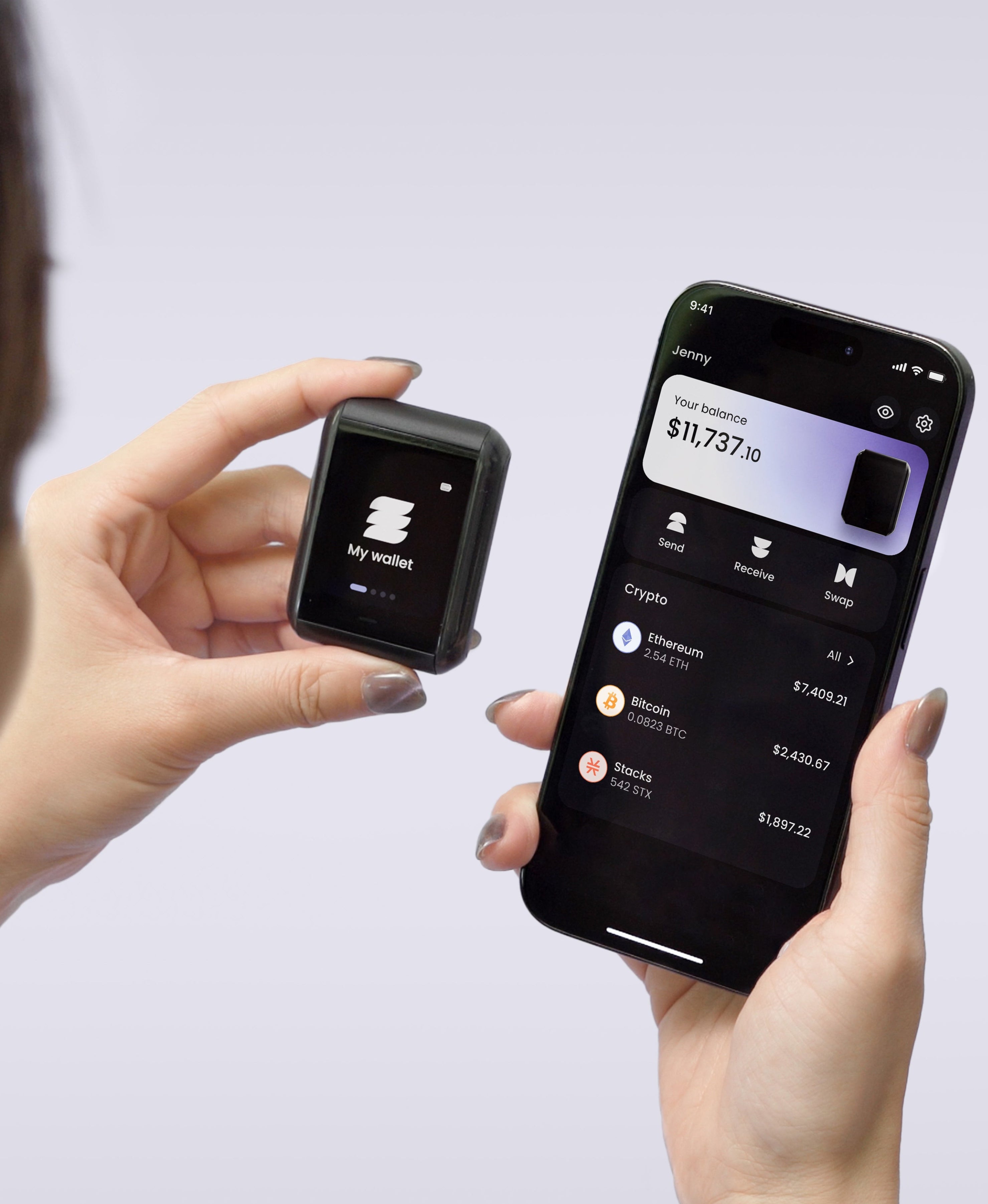
Ryder One treats Arbitrum, Optimism, Base, and zkSync Era the same way it treats Ethereum mainnet: EVM-compatible chains that share the same signing curve, so the chip signs their transactions with the same key material and no per-chain migration is needed. The 1.6-inch AMOLED touchscreen renders the destination address, the amount, and the chain ID before a button wired directly to the EAL6+ certified Infineon SLC38 secure element becomes active, so an approval on Base looks the same as an approval on Ethereum L1 with the chain field visible in plain text on the device you tap.
Communication stays NFC-only, with no USB port and no Bluetooth radio that a bridge-exploit contract could pivot through remotely. TapSafe Recovery splits the wallet's recovery secret across a Recovery Tag rated to IP69K (50% of the share), the paired phone with its share stored encrypted in iCloud or Google Drive rather than on the handset itself (50%), and up to two optional Recovery Contacts (25% each). The BIP-39 seed phrase is always available on-device as a fallback, so a holder is never locked to Ryder hardware. Ryder One ships at $229 with the Recovery Tag, a Qi wireless charger, and a travel pouch, measures 41 x 55 x 14.5 mm at 38 grams, and carries an IP67 rating on the device. Practicing self-custody across four L2s looks the same as practicing it on one chain: keys inside the secure element, backup spread across TapSafe.
Bottom line
Ethereum's L2 field has narrowed into four dominant names by mid-2026, and each carries a different bet. Arbitrum leads on TVL and pushes multi-VM execution through Stylus. Optimism trades standalone size for framework reach through the Superchain and the OP Stack. Base rides Coinbase's consumer distribution to the largest onchain payments footprint and ships without a native token. zkSync Era holds the ZK crown with native account abstraction and 24-hour withdrawals. All four ride the same Fusaka blob-capacity gain into cheaper fees, and all four sign with the same secp256k1 curve, so a hardware wallet that handles Ethereum handles the whole set with a chain-ID swap and nothing more.
Hold your ETH and every L2 balance behind keys you control. Ryder One keeps ETH, ARB, OP, ZK, and every ERC-20 across Ethereum's Layer 2 stack offline on an EAL6+ secure element, with TapSafe Recovery as the backup.
SEO
- Target keyword: ethereum layer 2
- SEO title: Ethereum L2s in 2026: Arbitrum vs Optimism vs Base vs zkSync (59 chars)
- Meta description: Arbitrum, Optimism, Base, and zkSync compared on TVL, fees, withdrawal times, and self-custody across Ethereum's Layer 2 stack in mid-2026. (139 chars)
- Hero alt text: Ethereum L2 Arbitrum Optimism Base zkSync 2026 — Ryder self-custody hardware wallet


Share: