


# Ethereum Fusaka Upgrade: What PeerDAS Changes for You
Ethereum shipped Pectra in May 2025 and Fusaka in mid-2026, back-to-back upgrades that carry the protocol into the scaling phase of its roadmap. Fusaka went live after months of testnet activations on Holesky and Sepolia, with client teams (Geth, Nethermind, Besu, Erigon, Reth, Prysm, Lighthouse, Teku, Nimbus, Lodestar) coordinating a single mainnet fork slot published on the Ethereum roadmap page. If you searched "ethereum fusaka" hoping to understand what changed, why it matters for L2 fees, and whether your wallet needs anything from you, this walks through it.
In this piece we look at what the Fusaka upgrade is, how PeerDAS works in plain terms, what changes for Layer 2 fees and everyday Ethereum users, how a protocol upgrade like this affects self-custody, and where Ryder One fits into the picture.
What Fusaka is
Fusaka is a hard fork name that follows Ethereum's pattern of pairing an execution-layer name and a consensus-layer name into a single upgrade. The execution side is Fulu, named after a star, and the consensus side is Osaka, named after a Devcon city. Client teams merged the two into one coordinated release so mainnet only had to swap forks once. That pattern followed the same rhythm as Pectra (Prague plus Electra), which we covered earlier for staking economics.
Where Pectra reshaped validator economics with EIP-7251 (raising the max effective balance to 2,048 ETH) and EIP-7002 (execution-layer withdrawals), Fusaka is squarely aimed at data availability and rollup scaling. The centerpiece is EIP-7594, PeerDAS, backed by a set of supporting proposals that harden the fork-choice rule, tune blob pricing, and prepare the ground for higher blob throughput in future forks. Fusaka does not touch the core signing scheme, the account model, or the way transactions get authorized by a private-key holder.
PeerDAS explained in plain terms
The concept to hold in your head is that Ethereum rollups (Arbitrum, Optimism, Base, zkSync, and dozens of others) post their data back to Ethereum as blobs, a special data type introduced by EIP-4844 in the Dencun fork. Before Fusaka, every consensus node had to download every blob to know the data had been published. That download requirement is what capped Ethereum at three to six blobs per block through 2025 and early 2026, because bandwidth budgets on average home nodes stopped scaling.
PeerDAS (Peer Data Availability Sampling) rewrites that assumption. Each blob gets erasure-coded across a large number of small columns, and every node downloads only a random sample of those columns from its peers. Because of the properties of the erasure code, if enough columns are available across the peer network as a whole, any node can reconstruct the full data when it needs to, and a node can verify with high probability that the data was published without ever downloading the full payload itself. Vitalik's write-up on scaling data availability sampling is the reference explainer, and the ethresear.ch thread on 2D erasure coding walks through the math.
The practical result is that bandwidth per node drops even as network-wide blob capacity climbs. Fusaka ships with a target of around nine blobs per block and a ceiling near fifteen, roughly double the pre-fork configuration, and each subsequent upgrade in the roadmap can raise those targets as client teams gather live-network data.
What Fusaka changes for L2 fees and Ethereum users
Rollup fees are set by two inputs. One is the L2's own operating cost, which is small. The other is the price of posting compressed transaction data back to Ethereum as a blob, which dominates the fee bill on most rollups. Cheaper blob space flows through to lower per-transaction costs on Arbitrum, Optimism, Base, Scroll, Linea, and the rest of the roster, with the size of the drop depending on how quickly each L2 adjusts its own fee model to the new capacity.
L2 fees dropped by roughly an order of magnitude after Dencun in March 2024, and Fusaka is expected to deliver a further step-down whose size depends on demand. When blob demand exceeds supply, blob fees rise via the EIP-4844 pricing curve, and if L2 adoption keeps climbing the market can absorb the added capacity quickly. The rollup-centric roadmap post from 2020 laid out the direction that Fusaka now delivers on, and the Ethereum Foundation's release notes for Dencun track the shipping timeline that led into it.
For an everyday holder swapping tokens on a rollup, bridging back to Ethereum, or paying a friend in USDC on Base, the visible change is a smaller line item on the fee estimator. Wallet UIs that quote gas in dollars will show lower numbers on rollups, and the psychological gap between "L1 is expensive" and "L2 is cheap" widens further. Ethereum L1 gas prices themselves are not directly affected by Fusaka, so long as rollup demand keeps migrating to L2s where the new blob capacity absorbs the load.
The self-custody read on protocol upgrades
Here is the part that gets muddled every time Ethereum ships a fork. A hard fork changes the protocol rules that nodes and validators follow. It does not change the cryptography that turns a private key into a signature. Fusaka leaves the secp256k1 signing curve, the transaction envelope, and the EIP-1559 fee model in place, so any wallet that could sign an Ethereum transaction before Fusaka can sign one after Fusaka using the same key material. No key migration and no seed regeneration is required for a self-custody holder.
What can shift is the surface area around signing. Fusaka introduces new blob dynamics and, through supporting EIPs, tweaks how fee-market inputs get displayed on rollups. Wallet firmware that renders human-readable fee estimates may want an update so quotes reflect the new blob-pricing regime, and hardware wallets that verify calldata on-device may want firmware that recognizes any new transaction fields surfacing in rollup interactions. Those are firmware updates delivered through the vendor's normal update flow, and the private key inside the secure element does not need to change.
The broader lesson is that protocol upgrades on Ethereum are backwards compatible for signing purposes by design. A hard fork that broke existing signing paths would strand every wallet in circulation, which the client teams and the community treat as a red line. Anyone who tells you Fusaka requires you to move your ETH to a fresh address is either confused or steering you toward a scam.
Where Ryder One fits
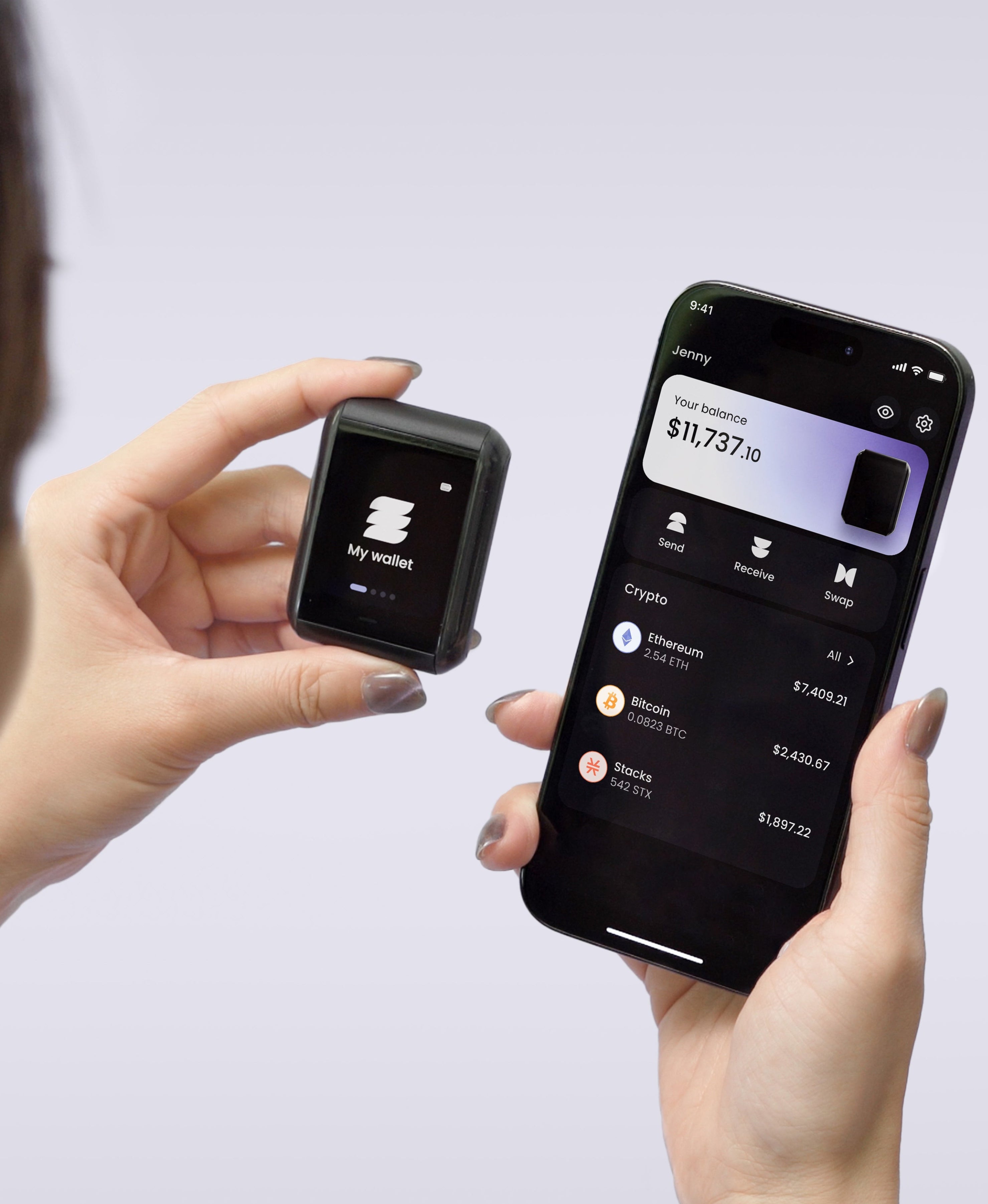
Ryder One generates and stores private keys inside an EAL6+ certified Infineon SLC38 secure element audited by Halborn, and the keys never leave the chip. Fusaka does not change that arrangement one bit. When you approve an Ethereum or L2 transaction after the fork, the destination address and the amount render on the 1.6-inch AMOLED touchscreen in readable form before a button wired directly to the secure element becomes active, so the signing step happens on hardware rather than inside a browser that could be spoofed by a phishing page.
Communication stays NFC-only, with no USB port and no Bluetooth radio a remote attacker could pivot through, and the device charges over Qi so power delivery does not open a data path either. TapSafe Recovery splits the wallet's recovery secret across a Recovery Tag (IP69K rated, 50% of the share), the paired phone with the share encrypted into iCloud or Google Drive rather than sitting on the handset (50%), and up to two optional Recovery Contacts (25% each). The BIP-39 seed phrase stays available on-device as a last resort, so a holder is never locked into our hardware. Ryder One ships at $229 with the Recovery Tag, Qi wireless charger, and travel pouch, measures 41 x 55 x 14.5 mm at 38 grams, and carries an IP67 rating on the device with IP69K on the Recovery Tag. Practicing self-custody through a hard fork looks the same as practicing it on a quiet Tuesday: keys inside the secure element, backup spread across TapSafe.
Bottom line
Fusaka lands in mid-2026 as Ethereum's scaling-focused hard fork, pairing Fulu on the execution layer and Osaka on the consensus layer to bring PeerDAS to mainnet. The headline win is that consensus nodes can now verify blob availability by sampling columns instead of downloading every blob, which raises blob capacity per block and pushes rollup fees another step lower. Nothing in the fork touches the signing model, so self-custody wallets keep working with the same keys they already hold, and the only wallet-side change to watch for is a firmware update that adds Fusaka-aware fee estimation once the new blob market finds its price.
Hold your ETH through every hard fork with keys you control. Ryder One keeps ETH and every ERC-20 offline on an EAL6+ secure element, with TapSafe Recovery as the backup.
SEO
- Target keyword: ethereum fusaka
- SEO title: Ethereum Fusaka Upgrade: What PeerDAS Changes for You (52 chars)
- Meta description: Ethereum's Fusaka upgrade brings PeerDAS to mainnet in mid-2026, cutting L2 blob fees further with no key migration needed for holders. (135 chars)
- Hero alt text: Ethereum Fusaka PeerDAS upgrade — Ryder self-custody hardware wallet


Share: