

Last reviewed 10 October 2026. Written while the Ledger wallet-drain investigation is unresolved. Ryder makes the Ryder One, so we have a commercial interest in this comparison and you should read it on that basis.
Any honest Ryder One vs Ledger security comparison has to start by saying what the current incident does not provide, which is a controlled test between two brands. A reseller investigation tells you about a distribution channel. It cannot rank the engineering of two devices, and we are not going to pretend otherwise while the story is still moving. What follows is drawn from published documentation on both sides, with our own interpretation labelled as interpretation. This piece stays on security and recovery; if you want the full feature-by-feature picture including coins supported, apps and price, read Ryder One vs Ledger: Which Hardware Wallet is Best For You? alongside it.
Where the backup models differ, and it is the biggest difference
This is the one place where the two products take substantially different approaches, and it is worth more of your attention than chip comparisons.
Ledger's recommended backup remains the Recovery Sheet: you write the 24 words down during setup and keep the paper safe. Ledger also sells the Recovery Key, which its technical overview describes as a PIN-protected card that stores a copy of your recovery phrase, communicates with NFC-capable Ledger devices over NFC only, and wipes its memory after three wrong PIN attempts. Ledger is explicit that the Recovery Key complements the Recovery Sheet rather than replacing it, and that the sheet is still the recommended form of backup. Anyone reducing all Ledger recovery to a scrap of paper is skipping a product Ledger sells.
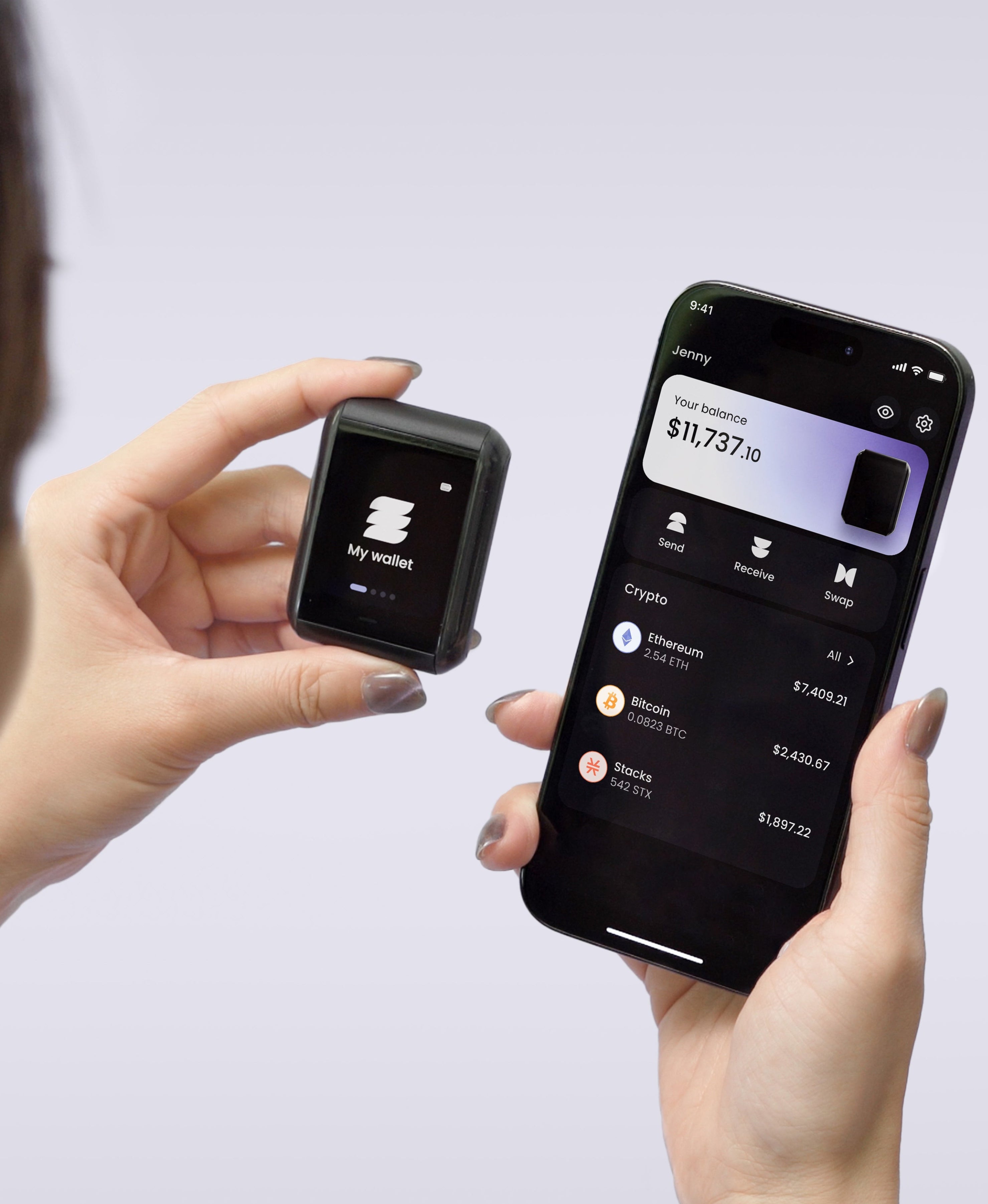
Our approach splits the backup instead of concentrating it. TapSafe Recovery distributes encrypted pieces so that a Recovery Tag is worth half a recovery, the paired phone is worth the other half with its share held encrypted in your own iCloud or Google Drive, and optional Recovery Contacts are worth a quarter each while seeing nothing about your wallet. Any combination reaching a full recovery works, so two tags will do it, as will the phone plus two contacts.
| Backup question | Ryder One | Ledger |
|---|---|---|
| Default during setup | Distributed TapSafe pieces, no transcription step | Write down the 24-word phrase on the Recovery Sheet |
| Additional option | Extra Recovery Tags, optional Recovery Contacts | Recovery Key, a PIN-protected NFC card holding a phrase copy |
| Phrase still available | Yes, viewable on the device as a fallback, BIP-39 standard | Yes, the phrase is the backup |
| What one lost item costs you | Survivable if another combination still reaches a full recovery | Depends entirely on whether a copy exists elsewhere |
Our interpretation: removing the transcription step removes the mistakes attached to that step, and it replaces them with a different job, which is keeping a distributed arrangement working and understood by whoever may need it. Neither model is maintenance-free. The useful question is which chore you will keep doing in five years.
Ryder One still has a recovery phrase, and we should say so clearly
A point that gets lost when people summarise us. Ryder OS 1.6.0 added the ability to import an existing 12 or 24-word recovery phrase directly into a Ryder One and then layer TapSafe backups on top of that wallet. Our recovery documentation also states the seed phrase stays viewable on the device at any time as a fallback.
Both facts matter for the implant discussion running alongside the current investigation. "No phrase to write down during standard setup" is a claim about the default flow. It should never be stretched into "no phrase is ever displayed on this device", because words rendered on a screen are words rendered on a screen, whichever logo is on the case.
What the audit establishes, and what it leaves out
Ryder's documentation identifies an Infineon SLC38 secure element certified to CC EAL6+. That is a statement about a component's certification, and it is not a comparative result against another wallet.
The Halborn report is more specific than the word "audited" suggests, and the specifics are the reason to read it. Halborn assessed the Secure Element JavaCard firmware from 28 October to 5 December 2025, scoped to the JavaCard applet in a named repository commit. It lists two medium findings, both marked Not Applicable, and six informational findings, all marked Solved. New features after the remediation commits are recorded as out of scope.
We would rather point at that than wave a badge. It is a real assessment of a defined piece of firmware over a defined period, and it is not evidence that a retail unit cannot be opened and modified, nor that every current feature was examined. We did not carry out an equivalent reading of Ledger's published security assessments for this article, which is exactly why there is no chip-versus-chip table here. Lining up a verified claim on our side against a vague one on theirs would produce a comparison that flatters us and informs nobody.
Ryder One vs Ledger security: the questions worth asking of either manufacturer
| Decision | What to establish, for both devices |
|---|---|
| Backup and recovery | What you need to restore access, and what happens when one item is gone |
| Secret display | Which flows put a phrase on screen, and which components touch it |
| Device authenticity | What the check verifies, and which hardware changes it cannot see |
| Independent review | The exact component, version, dates, findings and exclusions |
| Ongoing maintenance | How updates are authenticated, and how security notices reach you |
On the third row, Ledger has already published its own answer, and it is a credit to them that they did it before this incident rather than after. Their purchasing guidance states that the authenticity check cannot detect unauthorized physical modifications to the hardware such as spying implants when the original secure element is intact, and that no global supply chain is entirely immune to sophisticated interception. We cannot point to a document of our own that answers that row with the same candour, and that is a gap on our side rather than theirs.
Would moving to a different wallet fix a compromised one?
No, and this is the claim we most want to shoot down, including when it would help us. A recovery phrase that somebody else has seen stays compromised wherever you load it. The words are the access, so importing them into a Ryder One carries the exposure along with them, and a new PIN or a new backup method changes nothing about who else holds a copy.
If your keys may be exposed, the task is a new wallet with a phrase you generated and watched appear, and then moving assets to it. That is true of our hardware and everyone else's.
Who each one fits
Ledger is the better fit if you want the largest asset coverage and the longest track record in the category, you are comfortable owning a written phrase as the thing your crypto depends on, and you would rather buy from a brand whose support and documentation are extensive. Its trade-off is the one the current story is probing: a backup model that concentrates everything into a single object, and a distribution network that Ledger itself says cannot be made entirely tamper-proof.
Ryder One is the better fit for a narrower case: you hold Bitcoin, Ethereum, Solana or major ERC-20 and SPL tokens, you do not want your recovery resting on one piece of paper in one location, and a distributed backup you can repair after losing a single piece is worth more to you than the widest coin list. Its trade-off is a shorter history, a narrower asset range, a battery to charge, and a recovery arrangement that asks you to understand several pieces instead of one.
Neither of those is a security ranking, because the evidence to produce one does not exist. Pick against the failure you would struggle to survive. If that failure is losing your only backup, our recovery documentation is the part to read, and the Ryder One is built around it. If it is waking up to find your chosen asset unsupported, buy the wallet with the longer list.


Share: