


Ethereum's Pectra upgrade went live on May 7, 2025, bundling 11 EIPs that included the largest changes to staking economics since the Merge. By mid-2026, the upgrade's effects on yield, validator behavior, and protocol-level decentralization show up clearly in the data, and any conversation about Ethereum staking yield in 2026 has to start there.
For ETH holders running validators, delegating to a staking service, or trying to understand where yields are heading, the post-Pectra picture differs from the 2024 baseline. This piece walks through what Pectra changed for staking, where current yields sit by venue, the risks worth knowing, and how holders should think about custody while their ETH is at work.
What Pectra changed for staking
Three direct effects landed on staking economics.
EIP-7251 raised the max effective balance from 32 ETH to 2,048 ETH. Before Pectra, every validator was capped at 32 ETH of effective balance, which forced large stakers to run hundreds or thousands of validator processes in parallel. After Pectra, a single validator can hold up to 2,048 ETH. Operational complexity dropped sharply at the high end, and consensus overhead per ETH staked dropped along with it. The full text of EIP-7251 details the consolidation mechanics.
EIP-7002 introduced execution-layer-triggered exits. Validators can exit staking via a smart contract call instead of needing the validator's signing key. Delegated staking gets safer because the delegator can force-exit without trusting the validator operator to cooperate.
EIP-6110 moved validator deposits on-chain. Activation now happens through Ethereum's execution layer rather than the prior bridge contract, which cut activation time from days to minutes and removed a long-standing piece of infrastructure dependency.
The combined effect: staking is now more efficient at scale, more flexible for delegators, and operationally simpler. Yield economics shifted as a result.
Where staking yield sits in 2026
Current ETH staking yields cluster by venue.
Solo validators. Roughly 3.2% to 3.8% annual yield, down from 5.5% in 2023. The decline reflects more ETH staked overall (around 32% of supply per beaconcha.in), which spreads issuance rewards across a larger validator set.
Liquid staking through Lido and Rocket Pool. Roughly 3.0% to 3.5% net yield after protocol fees, slightly below solo staking because operator fees come out of the gross.
Centralized staking via Coinbase, Kraken, and Binance. Roughly 2.5% to 3.0% net yield after exchange fees, which often run 25% or more of staking rewards.
Restaking through EigenLayer and similar protocols. An additional 1% to 3% layered on top of base ETH staking, with an elevated risk profile that includes shared slashing conditions. EigenLayer's documentation covers the mechanics in detail; we treat restaking risk in a separate piece.
The 3% to 3.5% range sits well below the 5%-plus yields of 2022 and 2023. The trade-off is a structural one: as more ETH gets staked, network security improves while per-validator yield compresses. Long-term holders generally accept that compression as the supply-and-demand math working as designed.
What's driving the yield trajectory
Three factors are shaping where yields go from here.
More ETH staked, fixed issuance. Roughly 32% of all ETH is now staked, up from 14% in 2022. Protocol issuance is roughly fixed in ETH terms, so more validators sharing a fixed pie means less per validator.
MEV income volatility. Around 30% of validator income comes from MEV (maximal extractable value, the priority-fee tips and ordering revenue from transactions). MEV depends on on-chain activity, and the 2024 and 2025 DeFi slowdown reduced MEV per validator. As activity returns, so does that line of income.
Restaking absorption. EigenLayer and similar protocols absorb a sizable share of validator activity now. Solo operators face a choice between higher gross yield with restaking risk on top, or lower gross yield with simpler operation.
What this means for self-custody ETH holders
A few questions are worth answering before you stake.
Stake or don't stake? A 3.5% yield compounds into a real number over multi-year horizons. For holders with 32+ ETH (the floor for solo validation), running a validator is operationally manageable with modern tooling. For smaller positions, liquid staking through Lido or Rocket Pool delivers similar economics without a minimum.
Custody during staking. Most staking options ask the holder to either run a validator client (which has key-management implications) or delegate to a service (which has trust implications). The cleanest answer for hardware-wallet holders is to keep withdrawal credentials anchored to the hardware wallet so eventual exit proceeds land in self-custody.
Lockup and exit. ETH staked solo can be exited via EIP-7002, but exit queues still apply (one to three weeks is typical right now). Liquid staking gives instant liquidity through a tokenized claim like stETH, with the trade-off of smart-contract exposure.
The risks worth knowing
Slashing. Validators can be slashed for double-signing or missing attestations under specific conditions. Slashing risk is small for properly configured validators, and most slashing events in Ethereum's history have come from infrastructure mistakes rather than malicious behavior. The penalty itself is partial in most cases, though it grows if multiple validators are slashed together (the "correlation penalty" is the part that matters most for large operators).
Smart-contract risk in liquid staking. Lido and Rocket Pool have both been audited extensively, and the contracts have years of live operation behind them. The exposure isn't zero, and it's worth understanding the failure modes before allocating large positions.
Centralization concerns. Lido alone holds roughly 28% of all staked ETH. Pectra made alternative staking easier on the operational side, but Lido's dominance hasn't shifted in any meaningful way yet. For holders who weigh decentralization, this is part of the venue selection.
Where Ryder One fits
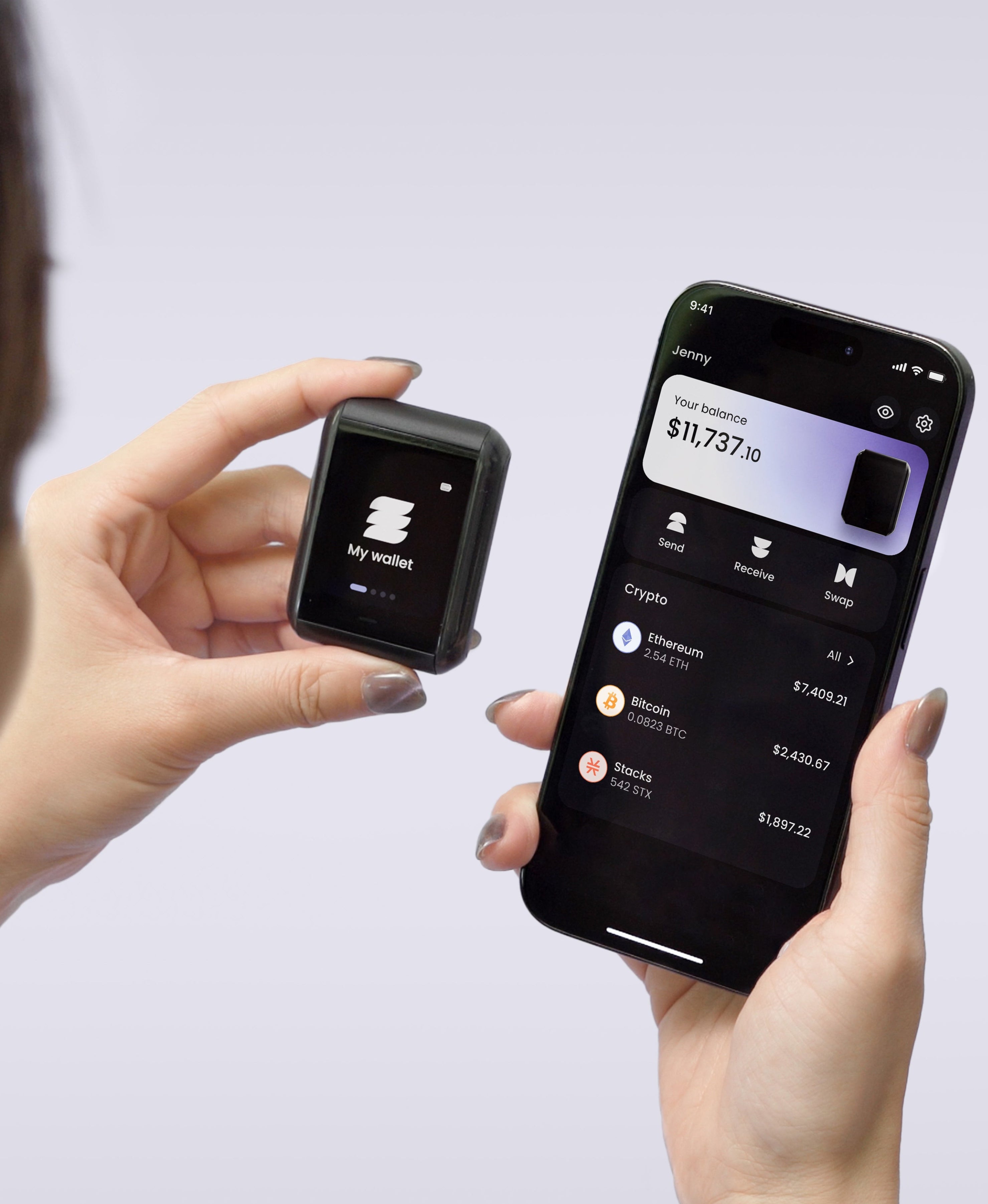
Ryder One holds your ETH and the withdrawal credentials for staking on an EAL6+ Infineon SLC38 secure element, with private keys generated inside the chip and never exported. If you're running a solo validator, the withdrawal address gets set to a Ryder One receive address, so the eventual exit returns funds to a wallet only you control. If you're using liquid staking, the stETH or rETH token sits on the device the same way ETH does.
We don't run validator-client duties on the wallet (that runs on a separate machine), but we do hold the keys that decide where staking rewards and exit proceeds land. We built TapSafe Recovery on top of the chip so the backup distributes across a Recovery Tag, a phone backup encrypted in iCloud or Google Drive, and optional Recovery Contacts. The BIP-39 seed phrase remains accessible on-device as a last resort, so you're never locked to our hardware.
The bottom line
Pectra reshaped Ethereum's staking landscape in May 2025 by lifting validator efficiency, enabling smart-contract-triggered exits, and simplifying operations at the high end. Current yields sit at 3% to 3.5% across the major venues, down from 2022 and 2023 highs but still material over multi-year holdings. The post-Pectra environment gives self-custody ETH holders clearer paths to delegate, exit, and configure withdrawal credentials, and the cleanest custody arrangement for most holders is a hardware wallet that owns the withdrawal address while validator duties run elsewhere.
Stake ETH with the withdrawal credentials you control. Ryder One holds your ETH and your validator's withdrawal address offline on an EAL6+ secure element, with TapSafe Recovery handling the backup.
SEO
- Target keyword: ethereum staking yield
- SEO title: Ethereum Staking Yield in 2026: After Pectra (44 chars)
- Meta description: Post-Pectra ETH staking yields sit at 3 to 3.5 percent across solo, liquid, and CEX venues. Here's what changed and what holders should think about. (152 chars)


Share: