


# Coinbase Base App: How Onchain Consumer Finally Ships
Coinbase spent most of a decade shipping a wallet product that looked like a wallet product. In July 2025 that changed. At its "A New Day One" event in Los Angeles, Coinbase renamed Coinbase Wallet the Base App and repositioned it as a consumer super-app built around a Farcaster social feed, Zora's content-coin minting, USDC payments through Base Pay, and hundreds of embedded mini-apps for trading, prediction markets, and games. Base creator Jesse Pollak led the announcement and framed it as the moment onchain consumer software stops behaving like an infrastructure demo. Post-launch data supports the framing: Zora's daily coin mints jumped from about 4,000 to over 38,000 inside two weeks, Farcaster casts spiked, and USDC settlement volume on Base climbed alongside merchant integrations like Shopify.
In this piece we'll cover what the Base App is now, what the July 2025 rebrand shipped, how its passkey-based custody stacks up against a hardware wallet, where the consumer wallet layer sits in mid-2026, and how Ryder One fits when your daily driver is doing this much at once.
What the Base App is now
The Base App is Coinbase's rebrand of Coinbase Wallet into a single consumer surface that combines wallet, social feed, and payments. It's a separate product from Base itself (now called Basechain), the Ethereum L2 that Coinbase runs: the L2 is where transactions settle, while the Base App is where end users interact.
Sign-in happens through a Coinbase Smart Wallet account created with a passkey on your phone, and once you're in, the app defaults to a Farcaster feed where posts can be tokenized as Zora content coins with a single toggle. The Pay tab uses NFC to turn any modern smartphone into a contactless USDC terminal, and swaps happen inside the same interface that used to hold the token list.
Reviewers have been kind to the shape, if cautious on the substance. Bankless described the app as an "onchain command station" that weaves social, mini-apps, chat, payments, and swaps together with Base Account smart wallets giving one-tap sign-in across apps. That framing matches how the app feels: onboarding takes under a minute, the feed reads without knowing what a "cast" is, and the payments flow looks closer to Cash App than to a crypto product.
Where it differs from Cash App is what happens beneath the surface. The wallet is self-custodial by default. Coinbase can't move your funds, and if you lose your passkey without a backup you lose access. That's a very different failure mode than a Cash App balance, and it is the core question anyone new to the app needs to sit with.
The July 2025 rebrand and integrations
The rebrand landed with three integrations that mattered. First, Farcaster: the Base App ships with a "Sign In with Farcaster" flow so your onchain social identity carries between the wallet and the wider Farcaster ecosystem. Every post can be tokenized. Every profile has a Creator Coin. The feed reads like a familiar social app with a market attached.
Second, Zora. The Base App folds Zora's automatic tokenization tech into the post composer, so any cast can mint an ERC-20 with one tap and appear as a tradable coin the moment it hits the feed. As we covered in our Zora Coin explainer, the mechanic is small in code and large in behavior: 1% trading fees split between creator, referrer, and protocol, with liquidity paired against the poster's Creator Coin. When the rebrand shipped, daily coin creation on Zora roughly doubled inside 48 hours and kept climbing.
Third, USDC and Base Pay. The Pay tab supports NFC contactless USDC transfers with no interchange fees and near-instant settlement. Merchants got their own version: Shopify switched on early-access checkout over Base, offering sub-1% settlement fees against Visa's 2 to 3 percent. Coinbase's L2 rebranded during the same event, with Base becoming Basechain and rolling out Flashblocks for 200-millisecond block times.
Passkey custody versus a hardware wallet
Here's where the picture gets more careful. The Base App runs on Coinbase Smart Wallet, an ERC-4337 smart-contract account whose signer is a passkey stored on your phone or laptop. Passkeys use WebAuthn under the hood; the private key that authorizes signing lives inside your device's secure enclave (Apple's Secure Enclave, Android's StrongBox) and never leaves it, and biometric approval unlocks each signing session. Some Coinbase Smart Wallet flows can layer in an optional MPC signer through providers like Turnkey, whose keys sit in AWS Nitro Enclaves.
For most casual use, this is a solid model. It beats exchange custody outright because Coinbase can't seize funds it doesn't hold. Browser-extension hot wallets look worse by comparison, since the passkey never touches an app process directly and stays gated by biometrics. The design also removes seed-phrase friction, which is the top reason casual users give up on self-custody.
What it doesn't do is match a hardware wallet on the dimensions that matter when the numbers get large. Your passkey lives on a device that also runs your browser, your messages, your camera, your remote-work software, and every app you installed last year. If that device is compromised at the OS level, or if your iCloud or Google account gets phished, an attacker can potentially provision a new passkey and reach your smart wallet. Passkey recovery flows through your Apple ID or Google account, so account-level takeover of those services is the failure mode to plan around. On a hardware wallet, keys sit inside a certified secure element with no operating system to compromise, and signing requires a button press on the device you hold.
For a $500 experiment on Zora, a passkey is fine. For life savings, it isn't equivalent to a chip you can hold in your hand and disconnect from the internet.
Where the consumer wallet layer sits in 2026
A year after the rebrand, the wallet market has moved. Rainbow doubled down on multichain UX, MetaMask Mobile shipped account-abstraction upgrades, Trust Wallet added Solana-native support, and Phantom kept eating Solana share while pushing into Ethereum. Against that field, the Base App entered with the distribution advantage of Coinbase's install base and the product advantage of a consumer feed that gives new users a reason to open the app between transactions.
The pitch that stuck was retention. A wallet no one opens except to send a transaction has almost no way to introduce a user to onchain habits. A wallet that opens to a Farcaster feed, that lets you tap a post to mint a coin, that runs a payment at the corner shop, that reminds you your position moved: that wallet gets opened. Daily active wallet count is the metric Coinbase pointed the market at during the launch, and merchant USDC volume through Base Pay is the second. Both are trending in the right direction through mid-2026 as Shopify and other checkout integrations mature.
That momentum doesn't rewrite the custody math above. It sharpens it. As more of an average user's onchain life migrates into one app, the value stored behind the passkey grows, and so does the cost of an account-level compromise.
Where Ryder One fits
For day-to-day use, the Base App is a good product. For anyone holding size, or anyone whose onchain identity now maps to a Farcaster profile with Creator Coin allocations streaming in over five years, the passkey on a phone isn't the right final resting place for the keys.
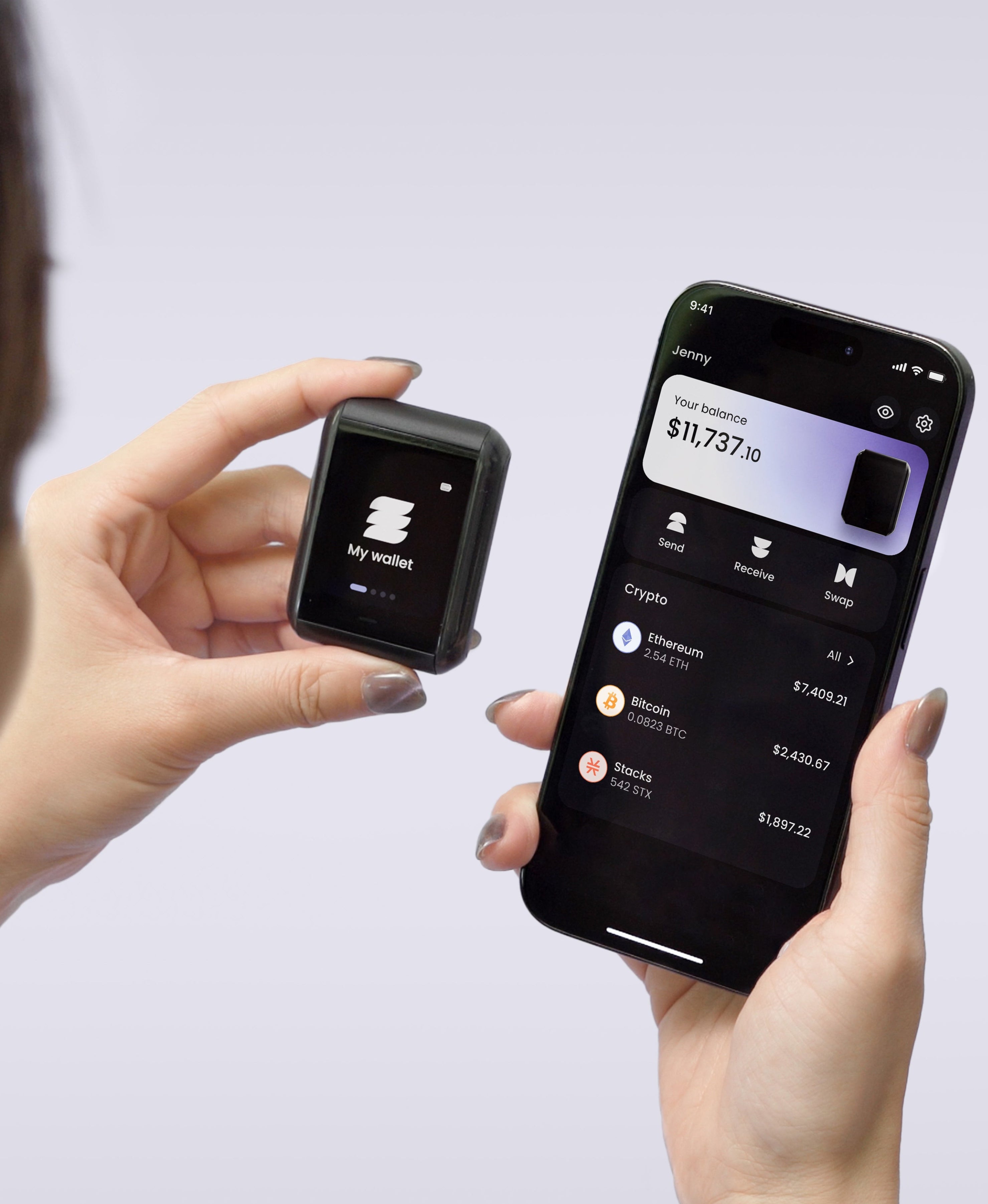
That's the gap Ryder One fills. At $229, it keeps your private keys inside an EAL6+ certified Infineon SLC38 secure element. Communication is NFC-only, so there's no USB data path, no Bluetooth radio, and no WiFi surface for an attacker to reach across. The 1.6-inch AMOLED touchscreen shows the full transaction detail before you approve, so when you're signing a swap or approving a Zora coin trade, the destination address and amount appear on the device you tap. Anti-blind-signing means nothing is hidden behind an opaque hash.
Backup is the other half of the design. TapSafe Recovery uses Shamir's Secret Sharing to split wallet recovery across three layers so no single object holds full access. The Recovery Tag holds 50%. A paired phone holds the other 50%, stored encrypted in your iCloud or Google Drive rather than on the device itself, so a lost phone doesn't lose the backup. Optional Recovery Contacts each hold 25%, and none of them can see wallet data. The BIP-39 seed phrase is always accessible on-device as a fallback, so you're never locked to Ryder hardware. If you're new to the model, what is a hardware wallet is a good place to start.
Think of the Base App and a hardware wallet as complementary. The consumer app is where you interact with Farcaster, mint content coins, and settle payments. Your long-term keys sit on hardware, where transactions that matter get signed.
Bottom line
Coinbase spent the first half of 2025 rebuilding what a consumer wallet is, and the Base App is what shipped. Farcaster social, Zora coins, USDC payments, and a mini-app store all sit under one passkey, with self-custody by default and Coinbase Smart Wallet handling the account abstraction. The metrics since launch suggest the bet is working: Zora mint volume up an order of magnitude, USDC settlement volume growing with Shopify's rollout, and daily active wallets climbing.
For most casual users, the Base App is a good place to spend time onchain. For anyone holding position, the passkey model is a step up from exchange custody and a step down from a chip you keep offline. Use the Base App for what it's good at, and put the keys that matter on hardware.
Get Ryder One for $229 and keep your long-term keys behind a device built for the size that isn't disposable.
--- SEO
- Target keyword: base app
- SEO title: Coinbase Base App: How Onchain Consumer Finally Ships (53 chars)
- Meta description: Coinbase rebranded its wallet as the Base App in July 2025, a consumer super-app with Farcaster, Zora, and USDC baked in. Where passkey custody stops. (150 chars)
- Alt text (hero): Coinbase Base App onchain consumer wallet — Ryder self-custody hardware wallet


Share: