


# Zora Coin: Farcaster's Onchain Social Bet, Explained
Zora took the "every post is a coin" idea that Friend.Tech turned into a punchline and shipped it as a working protocol on Base. On April 23, 2025 the ZORA ERC-20 went live on Coinbase's L2 with a total supply of 10 billion tokens and a retroactive airdrop covering 10% of the float, aimed at creators, collectors, and early users active since 2020. The launch arrived with baggage: a viral "Base is for everyone" post that rocketed to a $17 million market cap in under an hour before dumping 90% prompted accusations of insider positioning. Base's Jesse Pollak later admitted approving the post and denied coordination with Zora's airdrop plans. Coinbase, meanwhile, insisted Base didn't launch or sell a token.
In this piece, we'll walk through what Zora and the ZORA token are, how content coins work in practice, what the April 2025 controversy revealed, where the market cap sits mid-2026, and why a hardware wallet is the layer that matters when your feed becomes a bag of ERC-20s.
What Zora is, and what ZORA the token does
Zora is an onchain media protocol that runs its own OP Stack Layer 2 and lets any post become a tradable ERC-20 coin. The company started as an NFT marketplace in 2021, pivoted through several product shapes, and landed on a content-tokenization model that pairs Farcaster's social graph with automatic coin minting on Base. Every user gets a Creator Coin tied to their username, with a fixed supply of one billion tokens; half of that supply trades immediately, while the other half streams to the creator over five years per Zora's own docs.
The ZORA token itself is separate from those per-user coins. It's a network token on Base, launched April 23, 2025, with a 10 billion max supply and a distribution split across the airdrop (10%), a treasury (20%), incentives (20%), team and investors, and initial liquidity. Circulating supply as of July 2026 sits at roughly 4.46 billion, about 44.7% of the max. Price has been rough: an August 2025 peak near $0.15 gave way to a recent low around $0.0065 in July 2026, with a market cap around $31.5M. That's a chart shape a lot of 2025 launches share.
How content coins work
The mechanic is deceptively small. You post something on Zora or on Farcaster with a Zora Frame; a smart contract on Base mints a new ERC-20 with a fixed one-billion supply; you receive 10 million tokens as the creator, and the rest slots into a Uniswap-style pool paired with your Creator Coin. Anyone with a Base wallet can buy, and every buy or sell pays a 1% fee split between the creator, referrers, and the protocol. When Coinbase rebranded its wallet to the Base App in July 2025 and folded Zora's tokenization tech into the default social feed, daily coin creation doubled inside 48 hours and roughly 100,000 new content coins minted in that window.
For a creator, the pitch is that fandom becomes tradable and you clip fees as trading grows. Collectors get something closer to owning a share of an artist's attention than a jpeg. Traders get thousands of micro-liquidity pools per day and thousands of tiny speculative openings. Whether any of those pitches translates into durable returns is a separate question. Friend.tech's FRIEND token traded down about 98% from launch value, a cautionary reference point for anyone bullish on social-token velocity as a sustained trade.
The April 2025 controversy, in plain terms
The three weeks around the airdrop were messy. In mid-April 2025 the Base team posted "Base is for everyone" on Zora; because Zora auto-mints a coin for every post, the phrase itself became a memecoin with a $17M market cap inside an hour. It collapsed 90% shortly after. Crypto Twitter framed it as either a marketing stunt gone wrong or a soft launch that let insiders position ahead of ZORA's airdrop.
Coinbase's response was that "Base did not launch a token" and "Base did not sell this token," pointing at Zora's automatic tokenization as the mechanism responsible. Jesse Pollak later said he personally approved the post and dismissed manipulation claims, and he denied coordinating with Zora on the April 23 airdrop timing. No formal insider-trading case has been brought over the episode, though CoinDesk documented Coinbase-linked criticism throughout the week of promotions. The takeaway that stuck was less about who bought early and more about how an "automatic tokenization" primitive can turn an ordinary social post into a $17M event with no formal listing.
What holders should watch in the second half of 2026
A few dashboards matter more than headline price for anyone using the protocol day-to-day. Creator Coin unlocks are one: half of every Creator Coin's supply drips to the creator over five years, so as 2026 progresses more creator-side supply reaches wallets that can sell. Content Coin liquidity is thin by design; the top few coins hold real depth while the long tail is close to zero. Zora Attention Markets, which the team launched on Solana in February 2026, extend the coin model to trends, memes, and hashtags, and the early data on whether that broadens the user base or dilutes attention is still emerging.
Volume concentration is the other thing to track. Roughly 1.6 million coins have been created across more than 200,000 creators, with cumulative trading volume above $445 million. Numbers like that make the protocol look healthy in aggregate, but a large chunk of that volume clusters around a small share of creators and hype events. If your read on Zora is "the internet's tip jar," the aggregate is the story. If your read is closer to "I want to trade this," the concentration is the story.
Where Ryder One fits
Content coins live in your wallet. Creator coins live in your wallet. The ZORA governance token lives in your wallet. When Zora's social feed doubles as a portfolio of ERC-20s on Base, the wallet stops being a payments tool and becomes the security surface for your online identity. Losing keys means losing money and the coins tied to your posts, your followers, and your Creator Coin allocation streaming in over five years.
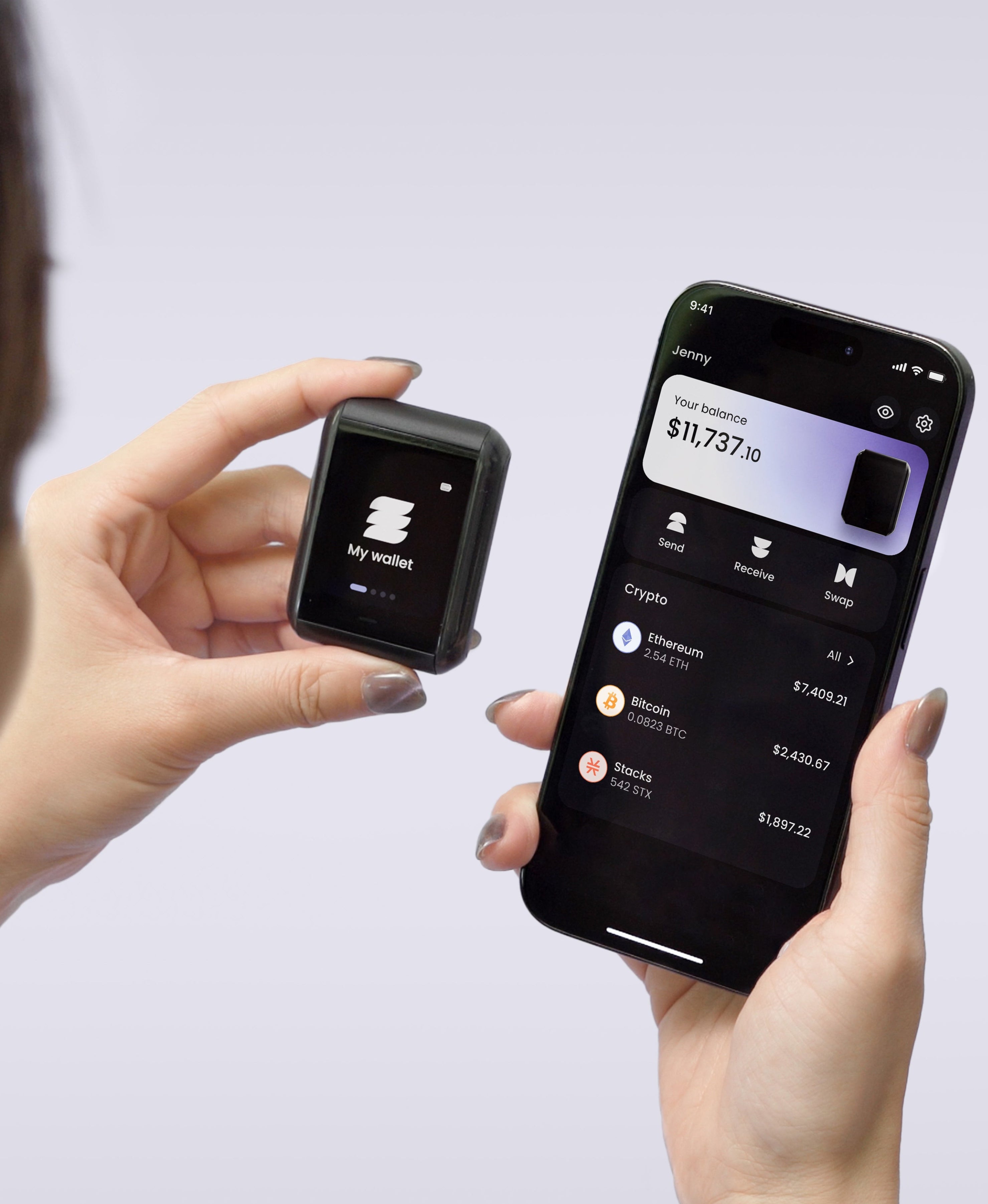
Ryder One is $229 and keeps your private keys inside an EAL6+ certified Infineon SLC38 secure element. Communication is NFC-only: no USB data transfer, no Bluetooth, no WiFi surface for an attacker to reach across. The 1.6-inch AMOLED touchscreen shows the full transaction details before you approve, so when you're signing a Zora coin swap or a Base App transaction you see the destination address and amount on the device itself. Anti-blind-signing is the point.
Backup runs on TapSafe Recovery, our Shamir-based system that splits wallet recovery across three layers so no single object holds full access. The Recovery Tag holds 50%. A paired phone holds the other 50%, stored encrypted in your iCloud or Google Drive rather than on the device itself, so a lost phone doesn't lose the backup. Optional Recovery Contacts each hold 25%, and none of them see wallet data. The BIP-39 seed is always on-device as a fallback, so you're never locked to Ryder hardware. If you're new to any of this, what is self-custody is a good place to start.
Bottom line
Zora took the meme of "every post is a coin" and shipped it. The ZORA token is a bet on that protocol capturing enough of the creator-economy fees to justify a $32M cap at current prices, and on Base App integration continuing to funnel new users into content-coin creation. The April 2025 launch was noisy, the price chart since has been ugly, and the durability question mirrors what Friend.tech never solved: does social-token velocity produce lasting demand, or does it burn out once the incentive spigot slows?
For anyone playing on Zora in 2026, the practical read matches every other Base-native protocol: keep positions sized to what you can lose, keep wallet hygiene tight enough to assume something will go wrong, and hold keys on a device where signing takes a physical button press and full transaction detail on-screen.
Get Ryder One for $229 and put the keys behind hardware built for the onchain-social era.
--- SEO
- Target keyword: zora coin
- SEO title: Zora Coin: Farcaster's Onchain Social Bet, Explained (52 chars)
- Meta description: ZORA launched on Base in April 2025 with a 10B supply. Content coins, creator economy, and why self-custody is the layer that matters. (135 chars)


Share: