

Spot Bitcoin ETFs went live in January 2024 and they changed how millions of people own Bitcoin. You can buy IBIT or FBTC in a brokerage account in about thirty seconds. No keys, no wallet apps, no recovery phrases to forget. For people who watched the FTX collapse and decided crypto was too messy to bother with, this looked like the safer path. But the question of bitcoin ETF vs bitcoin held in your own wallet isn't really about convenience. It's about who owns the Bitcoin.
What you own when you own an ETF share
When you buy a share of IBIT or FBTC, the issuer (BlackRock for IBIT, Fidelity for FBTC) holds Bitcoin in custody on your behalf. As of March 2026, IBIT used Coinbase (via Coinbase Prime/Coinbase Custody) and had about \$51.9B in AUM, while FBTC used Fidelity Digital Assets and had about \$12.8B in AUM. The share you hold is a claim on a fraction of that Bitcoin, so you don't have keys, you can't send Bitcoin to a friend or pay for anything in Bitcoin. You can sell the share for dollars during US market hours. Most spot Bitcoin ETFs in 2026 use Coinbase Custody as the underlying custodian, and that concentration is part of why the ETF stack adds counterparty risk (see this overview of custodians across major spot Bitcoin funds: https://finance.yahoo.com/markets/crypto/articles/5-asset-managers-control-wall-203747851.html). So when you buy IBIT, the chain looks like this: you own a share of an ETF, the ETF owns a custody account, the custody account holds Bitcoin. There are three parties between you and your Bitcoin. Each one is a counterparty. Each one is a place where things can go wrong. This isn't hypothetical. ETF issuers hire compliance teams to limit custodian risk, but they can't remove it. They can only spread it across enough lawyers and insurance to make it manageable.
What self-custody means
Self-custody means you hold the keys. Bitcoin doesn't live in a wallet, exactly: it lives on the blockchain. What lives in a hardware wallet is the private key that proves you control a specific amount of it. A hardware wallet keeps that key on a chip that never connects to the internet, so the only way someone can move your Bitcoin is by getting physical access to the device and your unlock code. The structural difference is this: with an ETF, your ownership is a record on someone else's database. With self-custody, your ownership is a record on the public Bitcoin blockchain, and only your key can change it. No one can freeze it, claw it back, or refuse a withdrawal during a market panic.
The case for the Bitcoin ETF
ETFs solve specific problems for specific holders. If you want Bitcoin exposure inside a retirement account, an ETF is the only path: you can't put a hardware wallet in an IRA. If your tax situation is complicated and you'd rather get a 1099 from a broker than reconstruct cost basis from on-chain transactions, the ETF is simpler. If your Bitcoin allocation is small enough that the cost of running self-custody (the device, the time to learn the workflow, the discipline to manage backups) outweighs the benefit, an ETF gets you exposure without the overhead. The expense ratios are reasonable now, but confirm the current fee schedule on each fund's issuer page and prospectus. On a 10,000 USD position, that's roughly 12 to 25 USD a year. Cheap in dollar terms. Expensive in concept, since you're paying someone to hold an asset you could hold yourself, but cheap on the spreadsheet.
The case for self-custody
Self-custody is what Bitcoin was built for. The original Bitcoin whitepaper opens by describing a system where peer-to-peer cash moves without going through a financial institution. When you hold Bitcoin in an ETF, you're going through about three financial institutions to do something the whitepaper wanted you to do alone. The practical case is more concrete than the philosophical one. 1. You don't pay an annual fee to hold your own asset; the expense ratio is zero, and over thirty years it compounds. 2. You can move Bitcoin any day, any hour, including weekends and holidays when ETF markets are closed. If something happens at 3am Sunday, you can act. If you're in an ETF, you can't. 3. You can use Bitcoin. Pay for things, send remittances, contribute to projects, fund your own family in another country. ETF shares can do none of that. They convert to dollars, and then you wire dollars. 4. You're not exposed to issuer or custodian failure. If BlackRock and Coinbase Custody both stay solvent for the next forty years, the ETF is fine. If either one doesn't, your ETF position depends on the bankruptcy outcome of a company you don't control. 5. You're outside the FTX failure mode. The 8 billion USD that customers lost on FTX in 2022 vanished because they were trusting an exchange's balance sheet. ETF customers trust an ETF's balance sheet. Self-custody customers don't trust a balance sheet at all. Their ownership is on-chain.
The objection that pushes most people back to ETFs
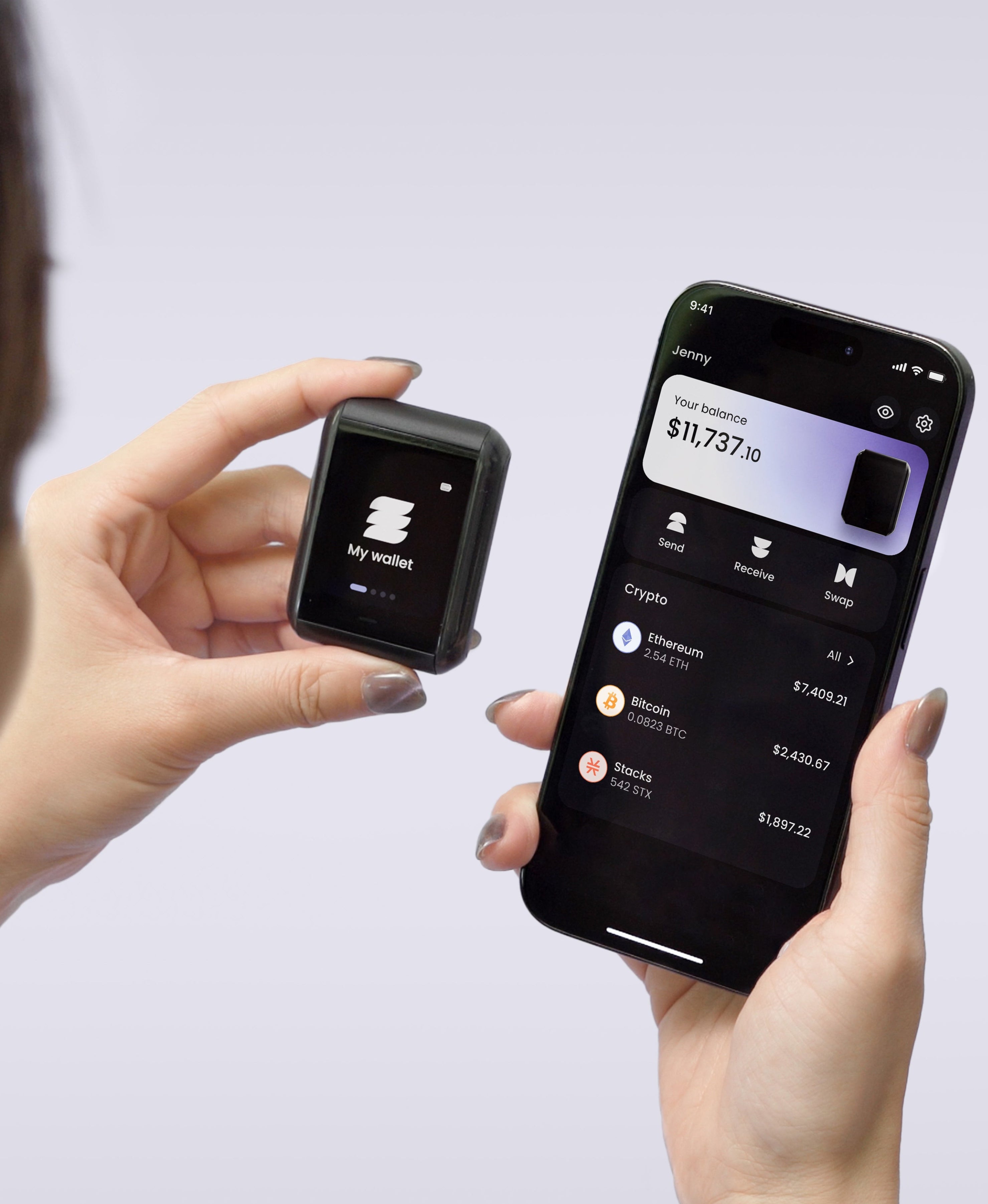
The fear that stops most holders from self-custody is the seed phrase. The standard hardware-wallet workflow asks you to write down 24 words on paper, store them somewhere you'll remember in twenty years, and never lose them. Lose the words, lose the Bitcoin. There's no support line. The internet is full of stories of people who threw out the wrong drawer. The traditional answer was paper, then metal. A stamped steel plate is the standard upgrade once you decide paper isn't enough: it survives fire, water, and the passage of time better than paper. But your Bitcoin still hinges on one piece of metal surviving every move, fire, flood, and family event between now and the day you need it. It's a single point of failure made of harder material. We built a different answer. TapSafe Recovery, which ships with Ryder One, splits your wallet recovery across three independent layers. The Recovery Tag holds 50%: battery-free, NFC, IP69 rated, built to last decades. Your paired phone holds the other 50%, stored encrypted in iCloud or Google Drive, not on the phone itself, so losing the phone doesn't lose the backup. You can optionally distribute 25% pieces to up to four Recovery Contacts, where no contact can see your wallet on their own. No single component gives anyone access. No single failure takes it down. The seed phrase still exists on the device as a last resort, so you're never locked into our hardware. You're just not forced to depend on twelve words and a piece of paper. That's the structural answer to the recovery objection. The choice between bitcoin ETF vs bitcoin in your own wallet isn't a question of risk tolerance anymore. The recovery part of the equation has been fixed.
What we recommend
For most holders we talk to, the answer is a split. Some Bitcoin in self-custody, because that's the part you own and want to hold for years. Some in an ETF if you want IRA tax treatment or have a small allocation that doesn't justify a hardware wallet. The pattern we see most often is the opposite split: holders treating an ETF as their primary Bitcoin position because it's the path of least resistance, then keeping a small hardware-wallet position as a hobby. That gets the priorities backwards. The ETF is the workaround for situations self-custody can't reach, like retirement accounts and complex tax. It's not the default. If you're sitting on Bitcoin and trying to decide which way to hold it, the question is simpler than the comparison usually makes it look. You're either OK with another company controlling your Bitcoin, or you're not. The ETF has its uses, but it doesn't make you a Bitcoin owner, it makes you a Bitcoin-fund shareholder.
Hold the Bitcoin, not a claim on it. Ryder One keeps your private keys offline on an EAL6+ secure element, with firmware independently audited by Halborn and TapSafe Recovery so you're never one piece of paper away from losing access. See how it works.


Share: