


# Hyperliquid HYPE: One Year After the $12B Airdrop
When Hyperliquid launched HYPE on November 29, 2024, it did something almost no crypto project had tried at scale: allocated zero float to VCs and dropped 31% of the supply into user wallets on day one. 310 million tokens went to roughly 94,000 addresses that had traded on the platform, and at peak the airdrop was worth around $12 billion in USD terms, one of the largest single distributions in crypto history. Twenty months later HYPE sits in the top 20 by market cap, Hyperliquid's own Layer 1 clears the majority of on-chain perpetuals volume, and the ecosystem has its own stablecoin.
In this piece, we'll walk through what Hyperliquid is, how the November 2024 airdrop landed, where HYPE has gone since, the USDH launch and HyperEVM sidechain, the custody model behind the Arbitrum bridge, and why hardware still matters when your keys sit at the head of an L1 account.
What Hyperliquid is
Founded in 2022 by Jeff Yan (a Harvard math grad who traded at Hudson River Trading and ran Chameleon Trading), Hyperliquid is a perpetuals-first decentralized exchange with a twist most DEXs skip: it runs on its own Layer 1 rather than sitting on top of Ethereum or a shared L2. That L1 is tuned for orderbook trading, with a custom consensus called HyperBFT that clears matches at speeds closer to a centralized exchange than a typical AMM. Cross-margined perps, sub-second finality, and no gas per trade make it read like Binance's front end with an on-chain settlement layer underneath.
The result is scale. Hyperliquid processed $172.6 billion in 30-day perps volume in early 2026 per DefiLlama, and its share of on-chain perp volume has ranged from 32% to 44% depending on the reporting window, well above every other decentralized venue tracked. Fee revenue at that volume runs at an annualized rate above $700M, putting Hyperliquid alongside the largest cash-flow-positive protocols in DeFi.
The November 2024 airdrop
The airdrop is worth understanding on its own merits because it broke the template. Most L1 launches route 20% to 30% of supply to VCs and another chunk to team lockups, with a modest slice left for community distribution. Hyperliquid inverted that shape. Of the 1 billion HYPE genesis supply, 310 million tokens went to about 94,000 wallets that had used the testnet or mainnet during the pre-launch period. No VC allocation was announced, and no public sale preceded the drop.
At the airdrop moment HYPE opened around $2, and within a few days it was trading in the $12 range. Peak valuation put the drop's paper value near $12 billion, edging out prior record-holders including Uniswap's UNI and Arbitrum's ARB. For the median recipient the airdrop was worth tens of thousands of dollars at open and low six figures at peak, which explains why "Hyperliquid points" became crypto Twitter's most-watched leaderboard through 2024.
HYPE's price journey since
The chart tells a story worth reading in full. After opening at roughly $2 at genesis, HYPE ran to about $35 by year-end 2024 on momentum from the drop and the platform's growing volume share. Through 2025 it climbed further: Gate's price archive shows an all-time high near $59 in September 2025, and the token spent most of Q4 2025 between $40 and $55 as HyperEVM launched and ecosystem projects picked up.
2026 has been more volatile. HYPE opened the year around $25 as broader crypto sold off, ran to fresh highs above $70 in May on stablecoin-launch momentum, and settled into a $25 to $40 range through mid-year. The token now sits in the top 20 by market cap. Circulating supply remains below 40% of the 1 billion total, so the ongoing unlock schedule matters as much as spot price for anyone modeling the next twelve months.
USDH and HyperEVM
Two upgrades reshaped the network beyond spot HYPE trading. The first is HyperEVM, an EVM-compatible sidechain that went live in late 2024 and lets developers deploy Solidity contracts alongside Hyperliquid's orderbook exchange. That opened the door to a proper app ecosystem: lending markets, yield vaults, and a HYPER app store with third-party frontends now sit on the same account balances users trade with.
The second is USDH. In September 2025 the Native Markets team won a validator vote to issue the network's stablecoin, beating out Paxos, Ethena, Frax, and Sky. USDH is backed 1:1 by short-dated Treasuries and cash equivalents, with reserves custodied through JPMorgan and managed by BlackRock and Superstate. The revenue-share design routes yield back to the Hyperliquid ecosystem, closer to Ethena's model than Circle's, and gives the L1 a settlement asset that doesn't depend on USDC bridged in from Arbitrum.
The custody question on L1 deposits
Here's where self-custody holders should slow down. Hyperliquid's user experience feels like a centralized exchange, but the account behind the trades is controlled by your private key. That's the non-custodial half of the story. The custodial half is the bridge: to fund an account on Hyperliquid's L1, you deposit USDC to an Arbitrum contract, and that contract is administered through a Hyperliquid Foundation multisig. Withdrawals take roughly four minutes because the L1's validator set signs off before the Arbitrum contract releases funds back to you.
What that means in practice: your funds sit on Hyperliquid's L1, not on Arbitrum where you deposited. The keys that authorize your trades live on your device. But the bridge that lets you exit sits behind a validator set of hot signers, cold signers, and emergency lockers coordinated by the Hyperliquid Foundation. If the bridge is paused, halted, or exploited, on-chain balances are still yours in name; getting them back to Ethereum L1 requires the bridge to function. This is a different risk shape from holding spot BTC or ETH in a hardware wallet. It's closer to trusting a validator committee than a broker, though the exposure isn't identical to leaving USDC on Binance.
For anyone using Hyperliquid for active trading, the self-custody read is that your account key is what matters, and the bridge risk is a known variable to size against.
Where Ryder One fits
If you traded the airdrop, if you're still active on Hyperliquid, or if you hold HYPE as a spot bag, the same rule applies as with any on-chain asset: the wallet is the layer that defines ownership. HYPE, USDH balances outside the exchange, LP positions on HyperEVM, and any airdrop from ecosystem projects (there have been several) all live behind whichever key you're signing with.
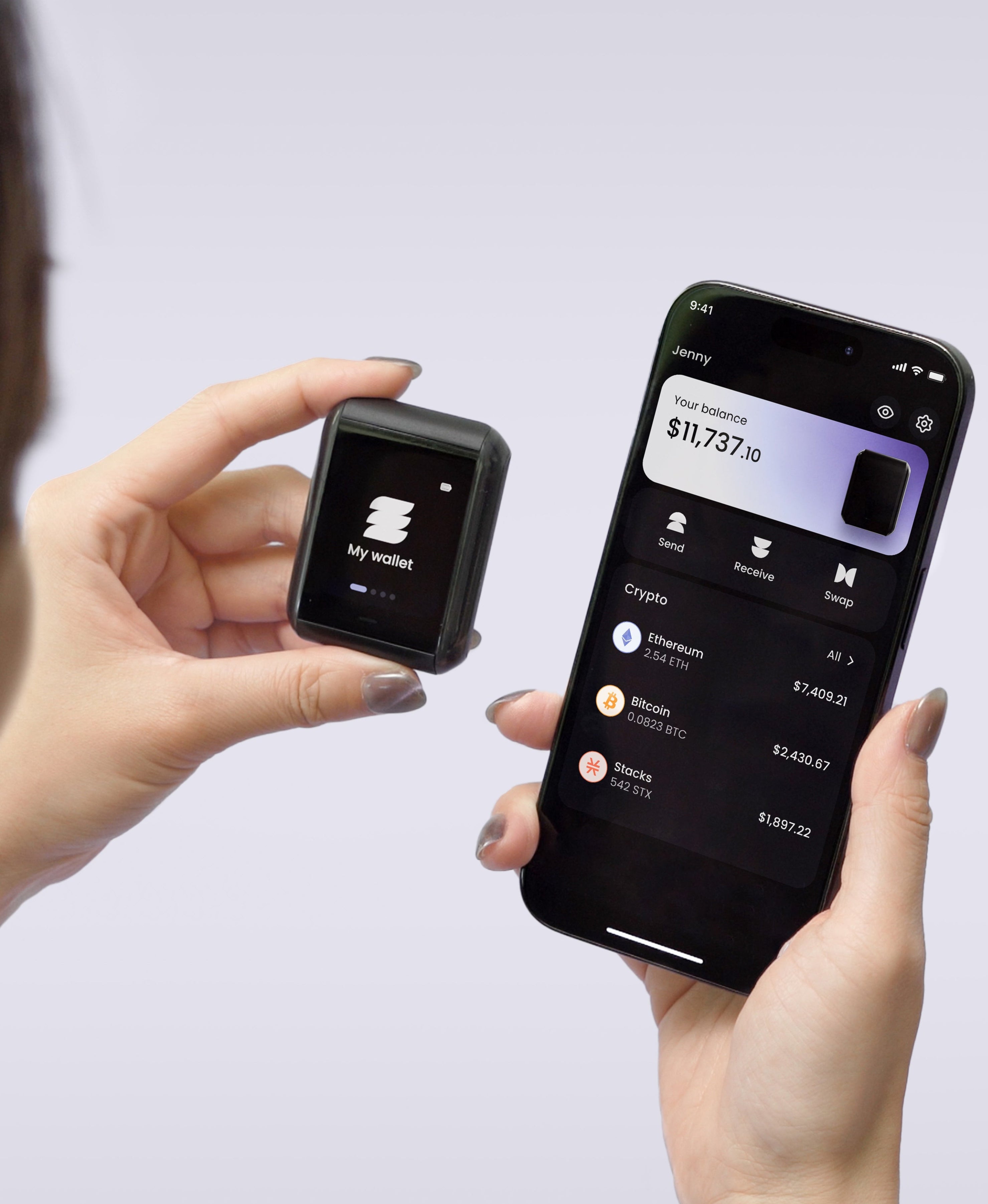
Ryder One is $229 and keeps that key inside an EAL6+ certified Infineon SLC38 secure element. Communication is NFC-only, so there's no USB port, Bluetooth radio, or WiFi surface for an attacker to reach across. The 1.6-inch AMOLED touchscreen shows the full transaction detail before you approve, which matters when you're signing a Hyperliquid deposit, a HyperEVM contract call, or a token swap where the destination address is what stands between you and a drained wallet.
Backup runs on TapSafe Recovery, our Shamir-based system that spreads wallet recovery across three layers so no single object holds full access. The Recovery Tag holds 50% via a rugged NFC device rated IP69K for water and dust. A paired phone holds the other 50%, stored encrypted in your iCloud or Google Drive rather than on the phone itself, so a lost handset doesn't lose the backup. Optional Recovery Contacts each hold 25%, and none of them see wallet data. The BIP-39 seed phrase remains on-device as a fallback, so you're never locked to Ryder hardware.
Bottom line
The Hyperliquid airdrop reset what a token launch could look like. Zero VC allocation, 31% straight to users, and a network that has since become the deepest on-chain perps venue by a wide margin. USDH gives the network a native settlement asset, HyperEVM adds an app layer, and HYPE captures fee flow across the whole stack while staying in the top 20 by market cap through a volatile 2026.
The trade-off worth reading closely is the deposit model. Trading on Hyperliquid feels self-custodial because the keys are yours, and it is self-custodial at the account layer. Getting funds back to Ethereum crosses a validator-guarded bridge, which is a trust assumption to price into any position you park there. Whichever way you play it, the wallet holding the key is the layer you own outright.
Get Ryder One for $229 and put the signing key behind hardware built for the on-chain-trading era.
--- SEO
- Target keyword: hyperliquid
- SEO title: Hyperliquid HYPE: One Year After the $12B Airdrop (49 chars)
- Meta description: Hyperliquid's HYPE airdrop set the crypto record at $12B. One year on: HYPE, USDH, HyperEVM, and the custody read on L1 deposits. (129 chars)


Share: