

At around 04:28 UTC on 11 September 2026, an attacker exploited a vulnerability in the Bitcoin bridge run by the cross-chain protocol Symbiosis and minted 46.1 billion tokens that nothing was backing. The gap between wrapped Bitcoin vs Bitcoin is usually an abstract discussion about trust assumptions, and then an incident like this one turns it into an accounting question with a number attached.
Symbiosis posted the details the same day: BTC routes were halted, the team recovered roughly 15 BTC into a multisig it controls, and a white-hat bounty of 20% was offered to the attacker through 13 September. Other routes across EVM chains, TRON and TON kept running. Cointelegraph reported that despite the 46.1 billion figure, the attacker's net proceeds came to 4.3 wrapped Bitcoin, worth about 336,000 USD, according to the blockchain security firm Blockaid. The 15 BTC recovered was worth roughly 1.1 million USD. Symbiosis has not explained how the recovered amount relates to those proceeds, and said final accounting was still in progress.
What a wrapped token is, underneath the word
Bitcoin does not run smart contracts the way Ethereum or Solana do, so if you want to use BTC inside a lending protocol or a decentralised exchange on another chain, somebody has to build a bridge. The pattern is almost always the same. You send BTC to an address controlled by the bridge, the bridge holds it, and the bridge issues you a token on the destination chain that is meant to be redeemable one for one.
That token is an IOU. It trades at parity as long as everyone believes the redemption will work, and the belief rests on two things holding at once: the coins on the Bitcoin side are still there, and the contract on the other side only issues tokens when coins arrive. Break the second condition and the first stops mattering, because the supply of claims no longer matches the supply of coins backing them. A bridge exploit that mints unbacked tokens is an attack on the ledger of who is owed what.
Why 46.1 billion turned into 336,000 USD
The distance between those two numbers is the useful part of this incident. Minting a claim is easy once the contract is broken; converting the claim into something somebody else will accept is the hard part, because the moment you try to sell, you run into the available liquidity in the pools and into people watching the chain. Blockaid flagged the exploit the day it happened, the team halted BTC routes, and the attacker walked away with a small fraction of what was nominally created.
None of which makes the outcome good. Liquidity providers took the loss, and Symbiosis said it was contacting affected LPs directly and building a compensation framework. Anyone holding the bridged token at the wrong moment was holding a claim against a system that had just stopped being able to honour claims at face value.
Wrapped Bitcoin vs Bitcoin: the difference is who holds the coin
Here is the distinction stripped of jargon. When you hold BTC in your own wallet, the entry on the Bitcoin ledger is yours and moving it requires your key. When you hold a wrapped version, the entry on the Bitcoin ledger belongs to whoever runs the bridge, and what you hold is a token on another chain saying that entity owes you. Your key still controls the token. It does not control the coin.
That is a trade people make deliberately and often sensibly, because the wrapped version does things the coin cannot. It earns yield, it collateralises loans, it moves through decentralised exchanges in seconds. The mistake is treating the two as interchangeable when deciding where your long-term holdings live. Bridges add a custodian and a contract to the list of things that have to keep working, and both have failed before across the industry.
A workable rule: the portion of your Bitcoin you are using belongs on whatever rails the use requires, and the portion you are holding for years belongs on the Bitcoin chain, in cold storage, under a key you control. Bridging your entire position because part of it needs to be somewhere else is how people end up exposed to a contract bug in a protocol they had never examined.
Reading a bridge before you use one
You cannot audit a bridge yourself, but a few questions sort the field quickly. Start with where the custody sits and who can sign, because a single multisig with a handful of known signers is a different risk from a federation or a threshold scheme, and each has a failure mode worth understanding. The second question is whether the mint path has ever been independently reviewed, and whether that report is published in full rather than summarised in a paragraph. Last, look at what happens to holders when something breaks: the Symbiosis response of halting routes fast, publishing a timeline within hours and contacting LPs directly is close to the best version of a bad day, and plenty of protocols have handled smaller incidents far less openly.
Then ask the question people skip. If this bridge stopped existing tomorrow, what would you be holding? For coins you keep on the Bitcoin chain, the answer is the coins. For a wrapped token, the answer depends on a recovery process that has to be designed, funded and executed by a team having the worst week of its year.
Self-custody moves the risk rather than deleting it
Pulling everything into a hardware wallet removes the bridge and the contract from your exposure. It hands you a different job, which is keeping the key alive for as long as you intend to hold, and that job is where most self-custody losses come from. There is no bounty offer and no compensation framework for a recovery card that went out with the recycling.
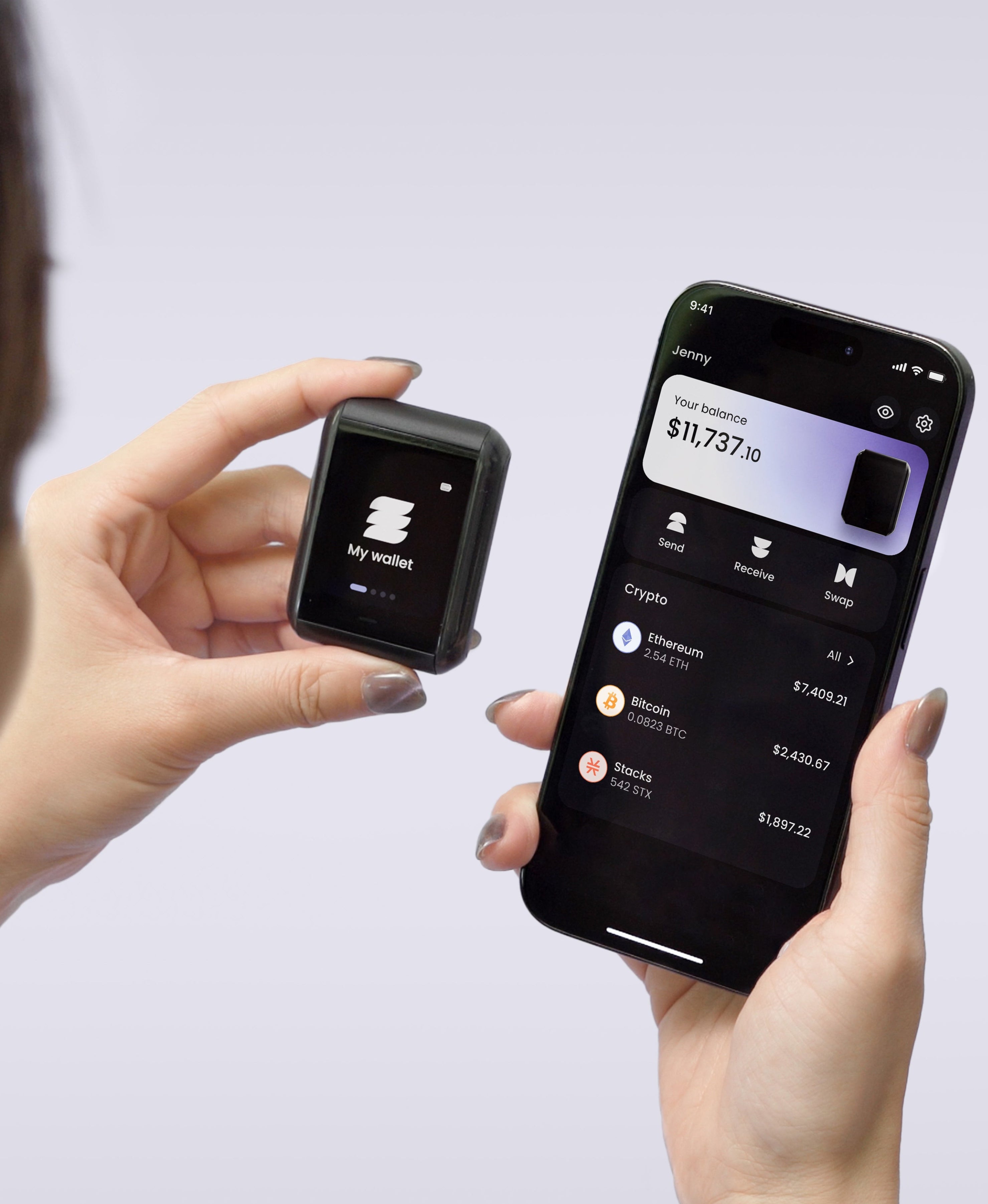
TapSafe Recovery is our answer to that job. Rather than asking you to protect one object perfectly, recovery is split across a Recovery Tag holding 50% and your paired phone holding the other 50%, kept encrypted in your iCloud or Google Drive instead of on the handset itself. Optional Recovery Contacts hold 25% each and learn nothing about your wallet in the process. It runs on a custom implementation of Shamir's Secret Sharing, and the seed phrase remains available on the device as a last resort under the BIP-39 standard, so your coins are never tied to our hardware. Keys are generated inside an EAL6+ certified Infineon SLC38 secure element and never leave it, and the firmware audit by Halborn is published in full.
The takeaway
Bridges are useful and they will keep being built, because the demand for Bitcoin liquidity on other chains is not going away. Use them with your eyes open about what you are holding while your coins are on the other side of one. A wrapped token is a claim on a system, priced at parity for as long as the system works, and 11 September was a reminder that the parity is maintained by code and people rather than by arithmetic.
Ready to hold the coin instead of a claim on it? Get your Ryder One for 149 USD.
Meta description: Wrapped Bitcoin vs Bitcoin came into focus when a Symbiosis bridge exploit minted 46.1 billion unbacked tokens. What you hold when your BTC is bridged away.
Target keyword: wrapped bitcoin vs bitcoin


Share: