


# Worldcoin (WLD) in 2026: Sam Altman's Iris Scans, Explained
Worldcoin shipped to the public in July 2023 with a pitch that sounded like science fiction: walk up to a chrome-colored Orb, look into its camera, and mint a cryptographic proof that you are a unique human. Three years later the project has rebranded to World, opened storefronts in six U.S. cities, and passed 12 million verified users, all while regulators from Nairobi to Hamburg have taken turns challenging the biometric database behind the project.
In this piece we cover what World is now, how the Orb turns an iris scan into a World ID, where WLD sits as a token, the privacy pushback that follows the Orb from country to country, and where a hardware wallet fits if you hold WLD.
What Worldcoin (now World) is
The project was co-founded by Sam Altman, Alex Blania, and Max Novendstern in 2019 under the operating company Tools for Humanity. It shipped to the public in July 2023 as Worldcoin, and the WLD token listed on major exchanges on July 24, 2023. On October 17, 2024, Tools for Humanity rebranded the whole thing to World, unveiling a redesigned Orb built on Nvidia's Jetson chipset and pitching the technology as the human-verification layer for an internet increasingly filled with AI agents.
The premise is old, the execution is new. Every online service that cares about who is behind an account (dating apps, financial platforms, voting, airdrops) faces the same problem: bots are cheap, verified humans are not. World's argument is that a one-time iris scan can bootstrap a persistent, privacy-preserving credential that any application can check without learning who you are.
That credential is called a World ID. The token is called WLD. World Chain, which launched in October 2024 on Optimism's OP Stack, is the L2 where verified humans get priority block space and partial gas subsidies. The three pieces (Orb, ID, chain) are the whole product.
How the Orb turns an iris into a World ID
The Orb is a chrome sphere about the size of a bowling ball. You stand in front of it, and its cameras capture a high-resolution image of your irises. On-device processing hashes the biometric data into an "iris code," a compact numeric fingerprint. The raw image is discarded (per the project's public technical claims) and the iris code is used to check whether the same human has been enrolled before.
If the check passes, the Orb signs a zero-knowledge credential that gets attached to a Semaphore group on World Chain. That credential is your World ID. Applications can query "is this address a verified human" without learning your name, address, or the underlying biometric data. In principle the setup lets you prove personhood without revealing identity.
In May 2025, Tools for Humanity launched the Orb Mini in the United States, a portable version of the same hardware. Storefronts opened in San Francisco, Los Angeles, Miami, Atlanta, Austin, and Nashville, with plans to place 7,500 Orbs across the country by year end. New verifications came with 16 WLD as a signup incentive.
Adoption keeps climbing. World reports over 26 million signups and roughly 12 million verified humans as of mid-2026, up from about 10 million verified in late 2024, which now makes the World database the largest voluntary biometric collection ever held by a private company.
WLD tokenomics and growth
WLD launched with a fixed cap of 10 billion tokens for 15 years post-launch. Roughly 3.53 billion tokens circulate today. The remaining supply is scheduled for release to the Worldcoin Foundation, Tools for Humanity, early contributors, and verified humans via a claim schedule that pays a small tranche to each World ID holder every couple of weeks.
At today's price near $0.41, WLD carries a market cap of about $1.46 billion, ranking around #44 by cryptocurrency market cap on CoinMarketCap. A scheduled emission cut on July 24, 2026 drops daily new supply by 43%, easing the sell pressure that has weighed on the price through 2025.
The token has two functional roles. First, WLD is the reward paid to verified humans as an ongoing claim. Second, WLD can pay gas on World Chain, though ETH remains the native gas token. Beyond World Chain, WLD trades as an ERC-20 (and OP-based variant) on the usual exchanges and DEXes, and holders can move it between wallets exactly as they would any other token.
That is the piece most casual coverage skips. If you hold WLD in the World App (Tools for Humanity's official wallet), your keys are custodied client-side in that app. If you move WLD to a self-custody wallet, you hold the keys directly. The World ID (the credential) is tied to your enrollment; the WLD token is tied to whatever wallet address you decide to send it to.
The privacy pushback
The regulatory story is where World gets contested. Iris hashes are biometric data under GDPR and comparable frameworks, and multiple national authorities have taken issue with how consent was gathered, how minors were screened, and how much users understood about what the Orb was doing when they scanned in.
- Kenya suspended the project in August 2023 and the Kenyan High Court declared World's operations illegal in May 2025, ordering the deletion of collected iris data.
- Spain ordered a three-month halt in March 2024 through its data protection agency (AEPD), citing insufficient information for enrollees, no verification for minors, and no clear withdrawal mechanism. Portugal followed with an identical three-month ban days later.
- Hong Kong's Office of the Privacy Commissioner ordered Worldcoin to stop all operations in May 2024, after finding that 8,302 Hongkongers had already been scanned.
- Germany's Federal Data Protection Authority (BfDI) issued a ruling in December 2024 ordering the deletion of iris data collected without a sufficient legal basis and requiring a GDPR-compliant deletion process within one month.
Colombia, Brazil, Indonesia, and Argentina add to the list of jurisdictions with open investigations or paused operations, and the pattern is consistent. Privacy regulators are not satisfied with the claim that iris hashes are irreversibly one-way. The project maintains that raw images are discarded and only a mathematical hash is stored; regulators want proof, consent controls, and deletion pathways that meet local law.
The U.S. rollout in May 2025 landed in the one major jurisdiction without a federal biometrics law comparable to GDPR. Illinois's BIPA statute is the strongest state-level constraint on biometric collection, and it does apply to Illinois residents. The six World storefront cities all sit outside Illinois, which is no accident.
Where Ryder One fits
The World ID credential and the WLD token are two separate things, and that separation is the important one for anyone thinking about custody.
The World ID lives inside World's proof-of-personhood system. You can't move it, sell it, or transfer it. It is tied to the biometric enrollment that created it, and if you regret enrolling, the recourse is a deletion request through whatever channel your local regulator supports.
The WLD token is a different story. It moves as an ERC-20 on Optimism and World Chain, listed on the same exchanges as any other mid-cap token in circulation. Sending it works the way any other token transfer works. The token sits behind a private key. If your key is compromised, your tokens leave the wallet. If your key is safe, your tokens stay put. The whole custody question for WLD is the custody question for any crypto asset. Our what is self-custody glossary post covers the ground rules.
The default World App is a self-custodial wallet with keys held on the user's device. That is better than an exchange account and worse than a hardware-backed key. A phone runs a browser, an app store, and monthly OS patches on a screen someone else might see; mobile malware families targeting crypto wallets have grown steadily through 2024 and 2025, and every WLD signup incentive shipped to the same World App broadens the phishing target.
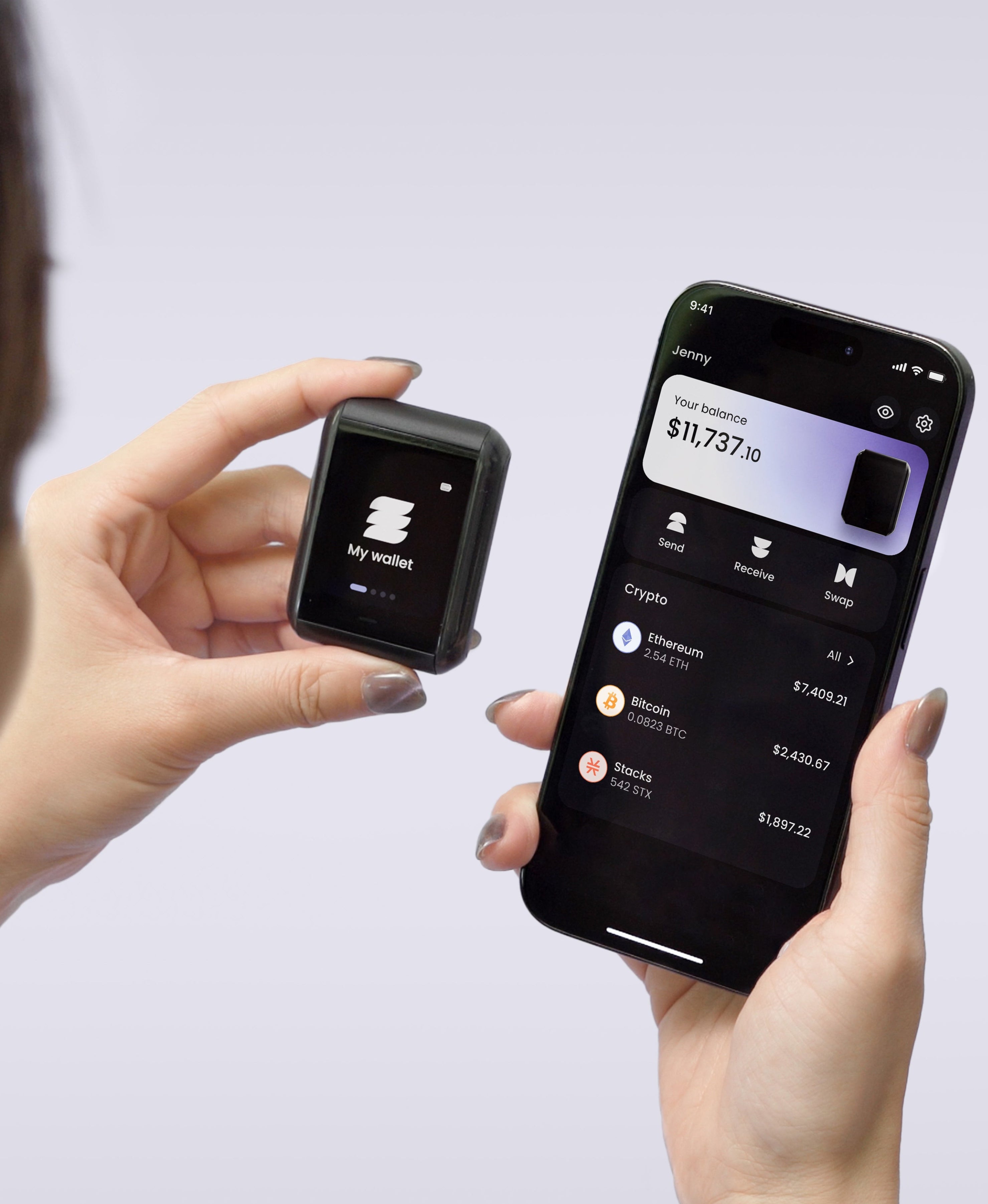
Ryder One is $229 and keeps your keys inside an Infineon SLC38 secure element with EAL6+ certification. The device speaks NFC only, so there is no USB port, no Bluetooth radio, and no Wi-Fi surface for a remote attacker to reach. The 1.6-inch AMOLED touchscreen shows every transaction on-device before you tap to approve; a compromised phone can't quietly swap a destination address behind the scenes. Backup runs on TapSafe Recovery, a Shamir-based split across a Recovery Tag, an encrypted iCloud or Google Drive blob paired to your phone, and optional Recovery Contacts. No single object holds full access on its own.
Pair Ryder One with a wallet that supports WLD, keep the tokens behind the hardware key, and connect to World Chain apps through WalletConnect when you want to. The claim schedule keeps running against your World ID; the tokens land in whatever address you point it at.
Bottom line
World is trying to solve a hard problem. Distinguishing humans from AI agents at scale is an open question the internet has never had to answer before, and biometric proof-of-personhood is one of the more coherent technical answers on offer. The engineering is interesting.
The privacy trade is contested. If handing an iris hash to a private company for a one-time enrollment feels acceptable in your jurisdiction, the World ID has utility for airdrops and applications that check for personhood. If it doesn't feel acceptable, the trade isn't obligatory: nothing about crypto requires an iris scan.
Either way, the WLD token behaves like every other ERC-20 on an OP-stack chain. Whatever you decide about the ID, hold the token behind a key you can prove is yours, on hardware that can't be reached from the internet, with a recovery plan that doesn't depend on a single point of failure.
Get Ryder One for $229 and keep your WLD behind keys only you can sign with.
--- SEO
- Target keyword: worldcoin
- SEO title: Worldcoin (WLD) in 2026: Sam Altman's Iris Scans, Explained (58 chars)
- Meta description: Worldcoin rebranded to World in Oct 2024 and has 12M verified humans. WLD supply, price, regulator pushback, and the self-custody read for holders. (148 chars)


Share: