

A report from CertiK claimed the majority of losses in 2025 were caused by wallet takeovers while phishing drove the most incidents. According to this report, wallet compromises made up 69% of total value lost, roughly totaling $1.7B, in the first half of 2025. Most of these incidents involved private key theft, seed phrase exposure, or compromised signing devices, often following malware or social engineering. This number is far too high.
In fact, several team members have fallen victim to wallet exploits, losing 7-figures in these scams. This number is also far too high. That is exactly why we created Ryder.
We knew something needed to be done, but no one was doing it. Our team was frustrated with the solutions in the market. From poor track records and previous exploits to data leaks and complicated UI, we saw a whole laundry list of potential problems. We noticed that hardware wallets were built for humans who didn’t make mistakes.
We built Ryder from a place of passion. Our belief was simple.
- Simplicity is key
- Wallets shouldn’t fill you with anxiety
- Wallets should be built for humans, with the understanding that humans make mistakes

![]() The Status Quo
The Status Quo
It’s no secret that UI/UX has been identified as a major hurdle and barrier to entry into web3. Crypto is made for crypto natives, but we want and need mass adoption to grow as an industry…see the problem?
We can talk about the issues that plague the current hardware wallet landscape for hours on end, I mean, that is why we built Ryder. However, for the sake of your attention span, and for great story telling, here’s a shorter version.
When we created Ryder One, we wanted to make sure the user journey was so simple that even our parents could do it. (And they did!)
Our CPO Julien said something that stuck with me for months.

I mean, think about it. It’s valid. How can we rely on something so traditional, like a pen, paper, and safe and expect the entire world to switch from their current banking infrastructure to cryptocurrency? We can’t.
Let’s be real, it also doesn’t make sense. We’re an industry that’s remote, constantly traveling, and so fast-paced. How can we rely on a safe to store our wallet back ups? What if we’re on the go? You can’t store your seed phrase on your phone’s notes or photos app. What’s the solution?
TapSafe: A Backup Method For Humans, By Humans
Ryder One uses TapSafe Technology to backup and restore your wallet when need it. This was built by our co-founder and CEO, Marvin using Shamir’s Secret Sharing (SSS). This is a tried and tested technology that has been around for decades and is used by top security agencies, organizations, and companies worldwide. In the case of TapSafe Recovery, this means that your wallet recovery and back up are split into pieces.
Think of it like a puzzle or a pie. In order to create a full pie, you need a certain number of pieces to come together, and that’s the basis of how Ryder One works. Using the Recovery Tags, Recovery Contacts, and phone back up, you choose how you want to store your back up.
Our co-founder and CEO, Marvin, built TapSafe with a simple goal: to make wallet recovery more resilient.
Recovery that is:
- Simple
- Safer
- Flexible
- Not fragile

With this quote, Marvin wasn’t just talking about Recovery, he was talking about the entire self-custody journey.
Months of Iterations to Get It Right
Finding the Right Screen
Blind signing is one of the biggest risks in self-custody. Without a screen, you're trusting your phone entirely. One extra zero in a transaction can be devastating.
We knew early on that Ryder One needed a screen. The question was which one.

We went through multiple display options, testing different sizes, resolutions, and technologies. Some were too small to read transaction details clearly. Others washed out in daylight. A few were readable but made the device feel cheap.
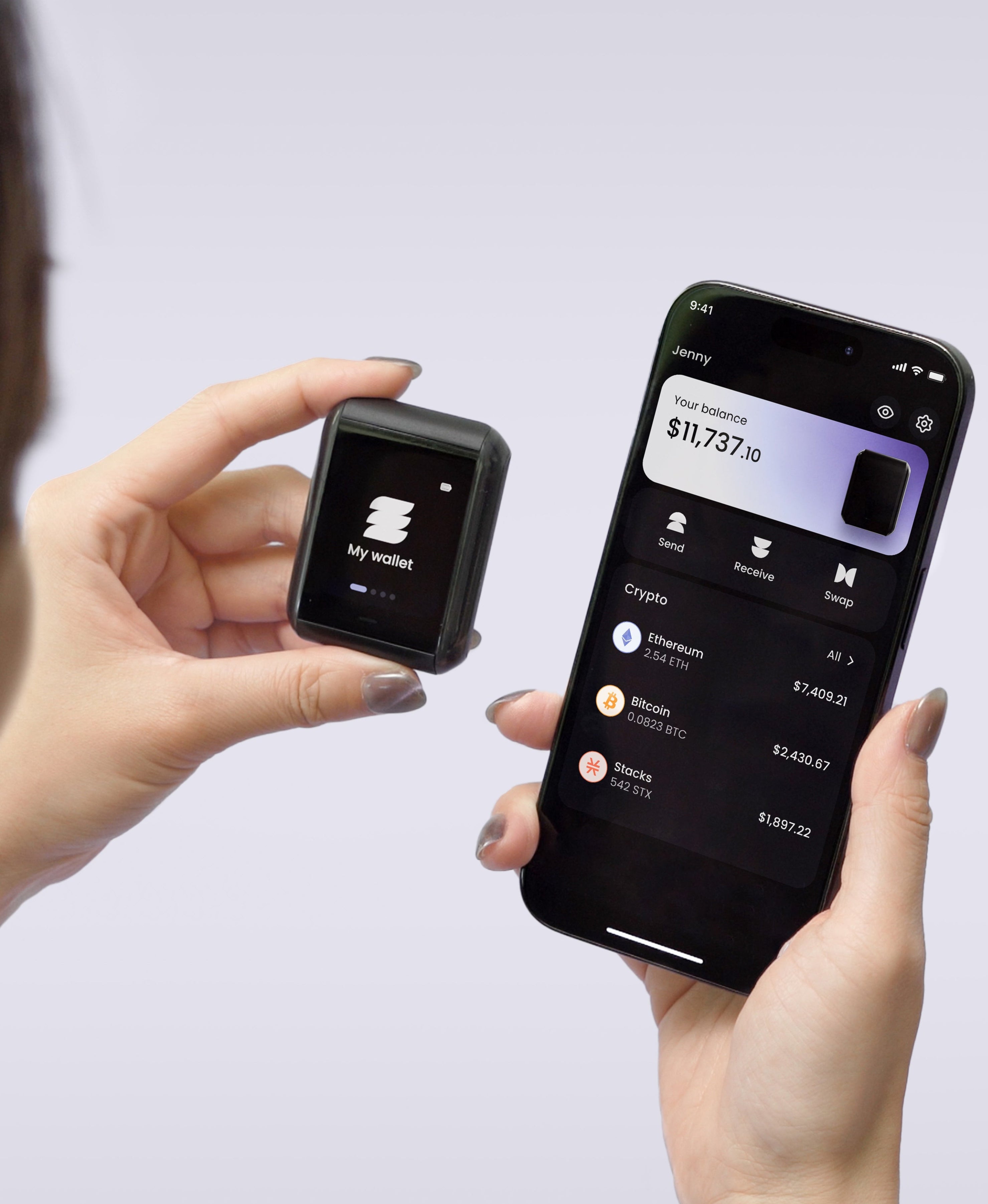
We landed on a 1.6-inch AMOLED touch display. Not because it was the obvious choice from day one, but because it was the one that survived every test we put it through: readability, clarity, responsiveness, and the simple question of "can you actually verify what you're signing?"
Why NFC, Not Bluetooth
Most hardware wallets need a connection to process transactions. Bluetooth, USB, WiFi. Every one of those opens an attack surface.
We debated this internally for a while. Bluetooth was the expected choice. It's what most competitors use. But every time we mapped the threat model, the same vulnerabilities came up. Range. Pairing exploits. Persistent connections.
NFC changed the conversation. The communication range is measured in centimeters, not meters. There's no persistent connection. You tap, you transact, you're done. It's the same mechanic behind Apple Pay and Visa PayWave, so the interaction is already familiar to most people. And it keeps Ryder One fully air-gapped, with no unauthorized remote access and no always-on radio.
It wasn't the trendy choice. It was the right one.
Secure and Durable
Julien, our CPO, has shipped over 200,000 consumer hardware products across four countries. When he joined to lead the hardware development of Ryder One, he brought a non-negotiable principle: the device has to feel right in your hand before anything else matters.
Ryder One has been given an IP67 rating, meaning that it’s dust-proof and water-proof. The reason we set out for this is for additional peace of mind in knowing that in the worst (and best) case scenarios, your assets are going to be safe for the long-run.
The device was made with you in mind. The button is directly linked to the secure element to ensure that the end user (you) is the only one who can sign any transaction. Additionally, the LEDs play a role in guiding decisions and warning you to ensure there aren’t any faults along the way.
Ryder One was made for more than just security. It was crafted with sophistication inside and out.
Designed to Defy Time
We worked with award-winning designer and Japan-based artist, Ray Horacek to design Ryder One. In his words, he wanted to explore the contrasts of the world we live in, balancing polar edges. Bridging the gap between human and technology and encapsulating history and the present in one form factor.
With Ryder One, Ray’s inspiration came from ancient rock forms, like geodes and amber things that survived extreme conditions, heat, pressure, and trauma to create beauty. Like these forms, Ryder One was built to represent the unbreakable.
Julien worked closely with Ray for the eight months of clay iterations and prototyping designs that made the Ryder One you see today. Julien chose aluminum, glass, and polycarbonate as the main materials in order to have durability, ideal weight, and warmth. Yes, physical warmth so you’re comfortable holding your Ryder One.
Ryder One was designed to look like it would outlast everything around it. Because it should.
The Bigger Vision
We strive to be the go-to for self-custody solutions, whether it’s for beginners to the space or crypto veterans. The long term goal is to move beyond transactions and utilize blockchain technology’s full potential, towards data sovereignty and personal control on-chain.
The future needs better tools, and Ryder One is our answer to that need. We hope you make it yours.


Share: