

A hardware wallet sits in a kitchen drawer for two years. The owner moves house, and six months later they go to send some bitcoin only to find that the drawer it was in doesn't exist anymore. The wallet is in a box somewhere, or it isn't.
That moment is what most people imagine when they ask, "what happens if you lose your hardware wallet?" The fear is reasonable, and the answer surprises most people because the device is rarely the part that matters.
This guide covers what happens when a hardware wallet goes missing, the failure mode that turns a misplaced device into something irreversible, and the steps that keep "I can't find it" from ever turning into "the crypto is gone."
Losing the device isn't losing the wallet
A hardware wallet isn't your crypto. It's a tool that holds the private keys that control your crypto. Those keys, on most devices, are derived from a seed phrase generated during setup. The phrase is the source. The device is one of many ways to express it.
That distinction is the thing most people miss until the day they need it. If the seed phrase is intact and private, the device is replaceable. You buy another hardware wallet, ideally the same model, enter the seed phrase, and your funds reappear in the new device, identical to before.
This works because the BIP-39 standard is open. A 24-word phrase generated on a Ledger can be restored on a Trezor or a Coldcard, and vice versa. The wallet brand doesn't lock you in. The phrase is portable across any compatible device.
So "I lost my hardware wallet" isn't, on its own, a disaster. It's annoying, and it costs you the price of a replacement device and a few hours of recovery time. The catastrophe is when the seed phrase is gone too, and that's a separate problem with separate causes.
What happens when you lose your hardware wallet, step by step
The standard recovery procedure on every BIP-39 device is the same. You buy a new device. During setup, instead of choosing "create new wallet," you choose "restore from seed phrase." You enter the 12 or 24 words from your backup. The device derives the same private keys, scans the blockchain, and shows you the same balances.
Done correctly, the entire recovery takes 15 to 30 minutes. The only step that matters is getting the words right. A single misspelling, a swapped word, or a missing word produces an empty wallet that looks identical to the right one, and people sometimes panic and assume their funds are gone when in reality they have just typed one word wrong.
For self-custody holders this is the moment that exposes how the backup was stored. A backup written carefully on the recovery card and kept in a fireproof container in a secondary location restores in 20 minutes. A backup that was never made, or that was photographed and then lost when the phone was wiped, doesn't restore at all.
Theft of the device alone, without the seed phrase, is recoverable in most cases too. Most hardware wallets require a PIN to use, and after three to five wrong PIN attempts the device wipes itself, leaving the thief with a brick. You buy a replacement, restore the phrase, and your funds are intact, though best practice is to move the funds to a new wallet generated from a fresh seed in case the thief had the old one.
This is the recovery path on every BIP-39 device. It's also the path we replaced on Ryder One with TapSafe Recovery, where rebuilding a wallet is a tap on a Recovery Tag and a confirmation on your phone instead of a complex twelve or twenty-four word transcription.
What happens if you lose the seed phrase too
This is when "lost hardware wallet" becomes "lost crypto."
If both the device and the seed phrase are gone, the keys are unrecoverable. There is no support channel that can help. There is no hardware vendor with a master copy. The keys are derived mathematically from the seed phrase using deterministic functions, and without the phrase, there is no path back to them. The funds remain on the blockchain forever, visible to anyone who looks at the address, but they can't be moved.
Chainalysis estimates that roughly 3.7 million bitcoin are permanently lost, about 20 percent of the total ever mined. A sizable share of those losses come from owners who had a hardware wallet, lost or destroyed it, and couldn't produce the seed phrase backup when they needed to. In each case, the cold storage setup was a single point of failure dressed up as two.
How to lower the odds of losing both
The rule that prevents most of these losses is location separation. The device and the seed phrase backup live in different places. A single event should not be able to destroy both at once. Not a fire, not a burglary, not a flood, not a move.
For most people, that means the hardware wallet stays at home in a discreet location, and the seed phrase backup lives somewhere else entirely. A bank safe deposit box, a trusted family member in another city, a sealed container at a property you own elsewhere. The exact location matters less than the principle of physical distance.
Beyond that, the four shortcuts that undo every backup are the same four every time: photographing the phrase, pasting it into a password manager, reading words to fake "support," and storing the backup in the same drawer as the device. Every shortcut that makes a backup easier for you to reach makes it easier for someone else to reach too.
Every rule in this section is a workaround for the same structural problem: the backup is one fragile object that has to survive everything. TapSafe Recovery is what we built when we decided to fix that at the source instead, and the Ryder One section below covers how.
How we built Ryder One so "lose the device" isn't a crisis
We built Ryder One for the case most people walk into without realizing it: a single point of failure dressed up as two. With most hardware wallets, the device and the recovery card are nominally separate, but the recovery card carries the entire wallet on its own. If someone reads it, they have your crypto. If you lose it along with the device, you haven'thing.
We replaced that ritual with TapSafe Recovery, a weighted Shamir Secret Sharing scheme that splits the secret across three places: a battery-free NFC Recovery Tag you keep somewhere safe, your phone, and an optional circle of Recovery Contacts (friends or family running the Ryder App). Any two shares rebuild the wallet. No single share reveals it. Losing the device is one missing piece. The other two are still there. Recovery is a tap on the Recovery Tag and a confirmation on your phone.
A BIP-39 seed still exists under the hood and can be shown on the device if you ever want to export it. You are never locked to our hardware. It's simply not the path most people will need to touch, and "lose the device" is no longer the same question as "lose the wallet."
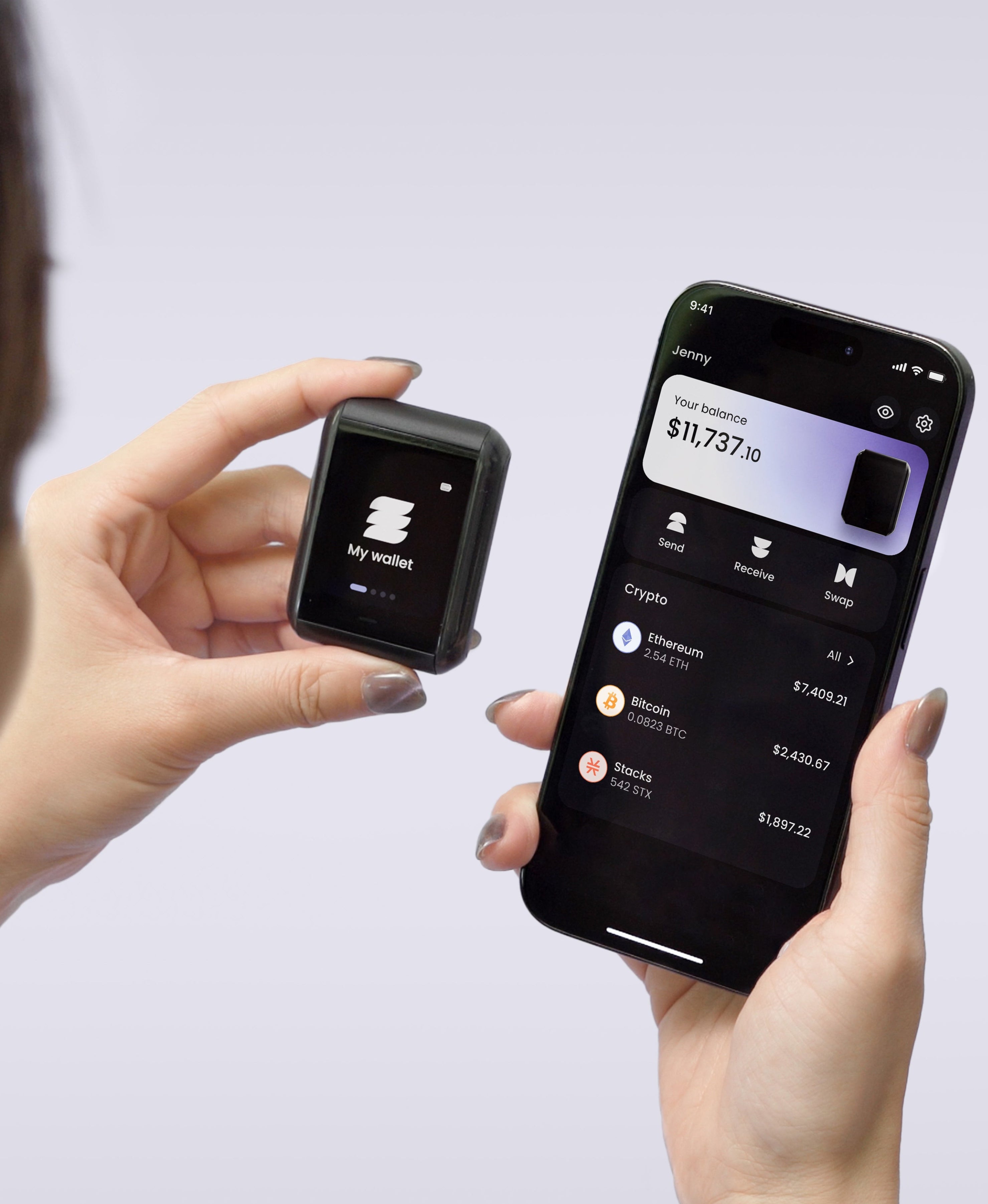
Ryder One is 229 US dollars, includes the Recovery Tag, wireless charger, and travel pouch, and is available now at ryder.id. Setup takes about a minute. Sending, swapping, and recovering are each one tap. The 1.6-inch AMOLED display shows the full destination address before you approve, so what you see on the device is what you are signing.


Share: