

People search for the Uphold wallet expecting one answer and find three products wearing similar names. Some of the confusion is Uphold's doing, since the company calls the balances inside your account wallets, and some of it is the industry's, because the word covers everything from an app on your phone to a chip in your pocket. Sorting out which one you have changes what you should do next.
We build hardware wallets, so read the last third knowing where our interest sits. The description of how Uphold works is drawn from the company's own material and from published reviews, and you can check all of it.
What an Uphold wallet is
Uphold is a trading platform that handles crypto, precious metals and cash in one account, and it has been around long enough to have a track record. Buy Bitcoin there and the coins are held by the company on your behalf. The balance you see is a record in Uphold's ledger, the private key behind those coins belongs to Uphold, and your ability to move the money depends on the firm staying solvent, staying online and agreeing that the request is yours.
That arrangement is a custodial wallet, and it is the default for almost everyone who signs up. Calling it a wallet is fair enough in everyday language. It behaves like an account.
There are advantages, and pretending otherwise would be silly. Forget your password and support can help, send funds to a wrong address and there is sometimes a path back, and nothing about your holdings depends on you managing a backup correctly for the next twenty years.
Is the Uphold wallet a cold wallet
No, and the distinction matters more than the terminology suggests. A cold wallet keeps the key offline and under the control of the person who owns the coins. Uphold may well store a large portion of customer assets in offline systems, as most sizeable platforms do, and that protects the company's holdings against remote theft while leaving the ownership question untouched. The key is still theirs.
There is a short test that settles it in every case, and it has nothing to do with what the product is called or how the balance is displayed in the app. If you can recover access by emailing support, somebody else is holding the key. If losing your own backup would end the matter permanently, the key is yours.
On reserves, Uphold makes a stronger claim than most of its peers, stating that customer funds are always more than fully reserved, publishing assets and liabilities in close to real time, and holding SOC 2 Type 2, ISO 27001 and PCI DSS certifications. CryptoSlate's review credits the transparency and adds the caveat worth carrying: the figures are self-reported, with no mechanism that lets you verify your own balance is backed. Good disclosure is a reason for confidence rather than a substitute for control.
Vault, and what assisted self-custody means
Uphold does offer a way out of the custodial model, and it is more thoughtful than a simple withdraw button. Vault is described by the company as assisted self-custody built on a three-key arrangement: you hold two keys, Uphold holds one, and two keys are needed to move anything. Uphold states that it can never control your crypto under this setup, and that if you lose one of your keys it can help you replace it and restore access.
Credit where it belongs, because the design targets the correct problem. Most people who stay on exchanges do so out of fear of losing a backup, and a recovery path that does not hand the company unilateral control is a sensible middle position.
Two things are worth weighing before you rely on it. The arrangement is Uphold's own description of a product whose full mechanics are not public, so you are trusting an account of the cryptography rather than checking it. And the assistance itself is a service, which means it depends on a company continuing to exist and continuing to offer it.
Taking coins off the platform, and backing them up
Withdrawing from Uphold to hardware you control settles the ownership question outright. Nobody can freeze the coins, no court order aimed at the company touches them, and no change in Uphold's business affects whether you can spend them. The responsibility lands entirely on you at the same moment, which is the part worth preparing for rather than discovering later.
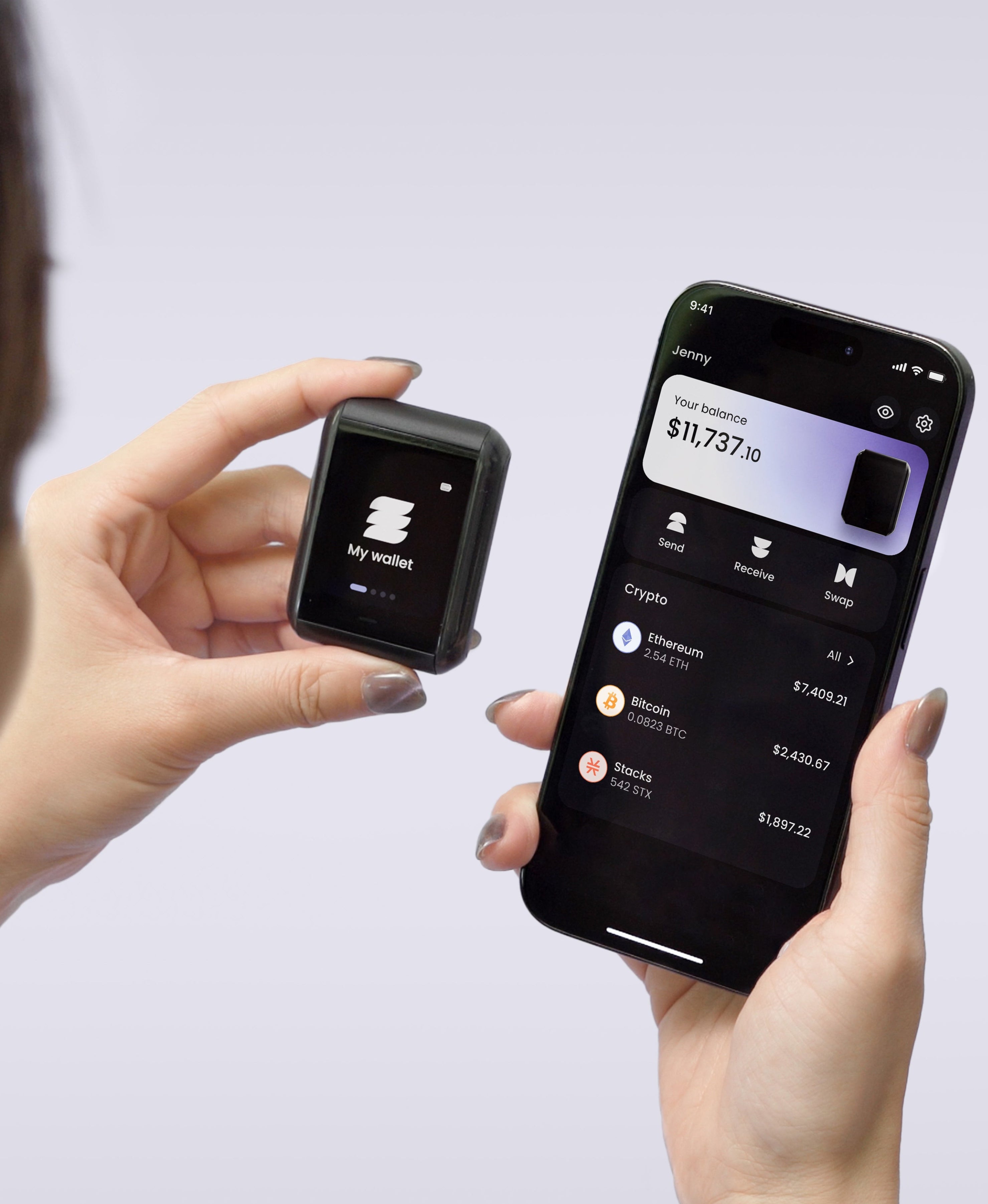
Ryder One generates the key inside an EAL6+ certified Infineon secure element where it stays, with the firmware independently audited by Halborn and the full report published. Transactions are rendered on the 1.6-inch AMOLED touchscreen on the device, receive addresses can be verified there before you hand one out, and the confirm button is wired directly to the chip so no software path signs without a press. Communication runs over NFC only, so there is no USB data path and no wireless radio listening between taps.
Backup is where people freeze, and the standard advice is weaker than it sounds. Paper is exposed to fire, water and a helpful relative with a recycling bag, while a steel plate handles those and still leaves your whole balance resting on one object staying unfound for decades. TapSafe Recovery takes recovery apart instead of fortifying a single copy: a Recovery Tag holds 50%, your paired phone holds 50% stored encrypted in your iCloud or Google Drive rather than on the handset, and optional Recovery Contacts hold 25% each while seeing nothing about your wallet. Built on our own implementation of Shamir's Secret Sharing, it means no single item an attacker or an accident reaches is enough on its own. The BIP-39 seed phrase stays available on the device as a last resort, so you are never tied to our hardware.
Where that leaves you
If you use Uphold to buy, sell and move between assets, it does that job and the disclosure record is better than much of the field. Treat the balance as what it is, which is money held by a company you have chosen to trust, and size it accordingly.
If you are holding for years rather than weeks, the question stops being which platform is sound and becomes who holds the key. Vault is a reasonable halfway house for someone who wants a recovery net. Hardware you own answers the question outright, and the setup that used to take an afternoon now takes about a minute.
Ready to hold the key yourself? Get your Ryder One for 149 USD.
Meta description: Is the Uphold wallet a cold wallet or an exchange account? Who holds the keys, what Vault's assisted self-custody covers, and when to move coins to hardware.
Target keyword: uphold wallet


Share: