


# TON (Toncoin) in 2026: Telegram's Blockchain Explained
Most people who own Toncoin picked it up without opening a wallet app. They tapped a coin icon inside Telegram, watched a hamster earn imaginary points, or claimed a DOGS airdrop out of curiosity, and then found a balance in a bot they never installed. That funnel is what makes TON different from every other L1 in 2026: the chain lives inside the most-used messaging app on the planet, and its onboarding hides the word "crypto" from the user until the user chooses to look at it.
Here we look at what TON and Toncoin are, how the network reaches sub-second finality, the story behind the @wallet bot inside Telegram, the mini-app economy that grew on top, and the self-custody read for anyone holding Toncoin.
What TON and Toncoin are
TON stands for The Open Network, a layer-1 blockchain first drafted by Nikolai and Pavel Durov as a payment layer for Telegram back in 2018. The project ran a 1.7 billion USD private token sale, hit legal trouble with the U.S. Securities and Exchange Commission over the sale in 2019, and the Durov brothers walked away in May 2020 after settling. The codebase was picked up by a group of independent developers who rebranded the effort and kept building. Today the network is stewarded by the TON Foundation, an outside group that no longer sits under Telegram's corporate umbrella, though Telegram has publicly named TON as its blockchain of choice.
Toncoin is the native asset that keeps the whole system running. It pays validators for staking and gas, secures the network under proof-of-stake, and covers fees on the mini-apps and DEXes on top. Circulating supply sits around 5.1 billion tokens as of mid-2026 per CoinGecko, with a chunk locked at any given time by validators posting collateral to sign blocks. Fees stay under a cent for a typical transfer, and confirmation lands in well under a second because TON splits its workload across parallel chains.
Adaptive sharding and BFT consensus
TON is built as a chain of chains. There is a master chain that coordinates the network and a set of worker chains that process transactions in parallel. The trick is adaptive sharding: when a worker chain gets overloaded, the protocol splits it into two shards, and when demand drops the shards merge back together. That mechanic is documented in the TON docs, and it is what lets the network claim a throughput ceiling that keeps growing with load.
Consensus runs on a Byzantine Fault Tolerant proof-of-stake protocol. A rotating validator set proposes and signs blocks, and the network tolerates up to a third of the set being malicious or offline before liveness suffers. Finality lands quickly because validators sign each block in parallel across shards, and a transaction is considered final once the block is anchored back into the master chain. Native asset issuance uses a shared set of standards: Jettons for fungible tokens, an NFT standard for collectibles, TON DNS for human-readable names, TON Storage for decentralized files, and TON Sites for reachable domains.
The Telegram wallet story: @wallet inside the chat
Here is what pulled TON into a billion pockets. Telegram bundles a custodial wallet, addressable as @wallet, that lives inside any chat window. Users open it like they would open a sticker pack, verify their phone number, and buy Toncoin or stablecoins with a card. No app-store download, no seed phrase to write down, no browser extension to install. That single design decision moved crypto onboarding from "you need to understand keys" to "tap the button." The bot rolled out globally in late 2023 and has since been used by hundreds of millions of Telegram users.
@wallet does two useful things and one risky one. On the useful side, it lets any Telegram user send Toncoin to any other user by @username, and it turned Telegram into an on-ramp for crypto in regions where card-to-crypto rails were spotty. The risky part is that @wallet is custodial. Your Toncoin sits under keys the wallet operator controls, and those keys live inside the same environment as your chat account. If your Telegram session is compromised, the balance in @wallet is exposed the same way any hosted balance would be. That trade-off is fine for small spending balances and dangerous for size.
The self-custody alternative on TON is a set of non-custodial wallets that hold their own keys on your device. Tonkeeper is the flagship, with docs and downloads at tonkeeper.com. MyTonWallet and Tonhub cover the same ground with different UX choices, and each of them can be paired to a hardware wallet where the firmware supports TON.
The 2026 ecosystem: mini-apps, memes, and DEXes
The story that put TON on every trader's radar was Notcoin. A tap-to-earn mini-game launched inside Telegram in early 2024 pulled roughly 40 million players through a season of tapping a giant coin, graduated with a token airdrop, and set the template every mini-app since has copied. Hamster Kombat followed with a claim of 300 million players at its peak in 2024, becoming the largest tap-to-earn phenomenon crypto had ever seen. DOGS ran another chart-topping airdrop that year, and TapSwap, Yescoin, and Blum each pulled tens of millions of participants through similar loops.
Not every mini-app graduated cleanly, and plenty of the token launches saw sharp price drops on listing day. What survived is the infrastructure those loops attracted. STON.fi is now the largest native DEX by volume, DeDust runs a competing venue with its own liquidity pools, and Storm operates onchain perpetuals for TON-native traders. Stablecoin issuance grew after Tether launched USDT natively on TON in April 2024, and by mid-2026 TON's native USDT supply has climbed into the low billions of dollars. DeFi total value locked tracks in the mid-hundreds of millions on DefiLlama, smaller than the Ethereum L2s but growing steadily quarter over quarter.
The self-custody read on TON
Two details matter if you are moving Toncoin off @wallet into keys you control. First, TON uses ed25519 signatures across its base wallet contracts, the same signing curve Solana and Sui use. Second, TON defined its own mnemonic spec instead of adopting BIP-39. The words look similar and the length is 24 in most wallets, but the derivation is different: a 24-word TON seed will fail to restore in a BIP-39-only wallet, and a BIP-39 seed generated for Bitcoin will fail to restore into a TON wallet. The full write-up sits in the TON developer docs.
That distinction has bitten people. Users have moved keys between wallets assuming the standard 24 words worked everywhere, only to find their account missing on the other side. If you keep Toncoin off @wallet, pick a wallet that has published its mnemonic implementation openly and test a small transfer before you rely on the backup.
The bigger custody question on TON is where your keys sit while you are using them. Balances inside @wallet inherit the security of your Telegram session, and SIM-swap attacks on Telegram accounts have been a running story across 2023 and 2024. Any balance you would rather not lose to a session hijack belongs on a non-custodial wallet, and any balance beyond casual spending belongs behind a hardware wallet where the private key sits inside a secure element that stays offline whatever the host computer is doing.
Where Ryder One fits
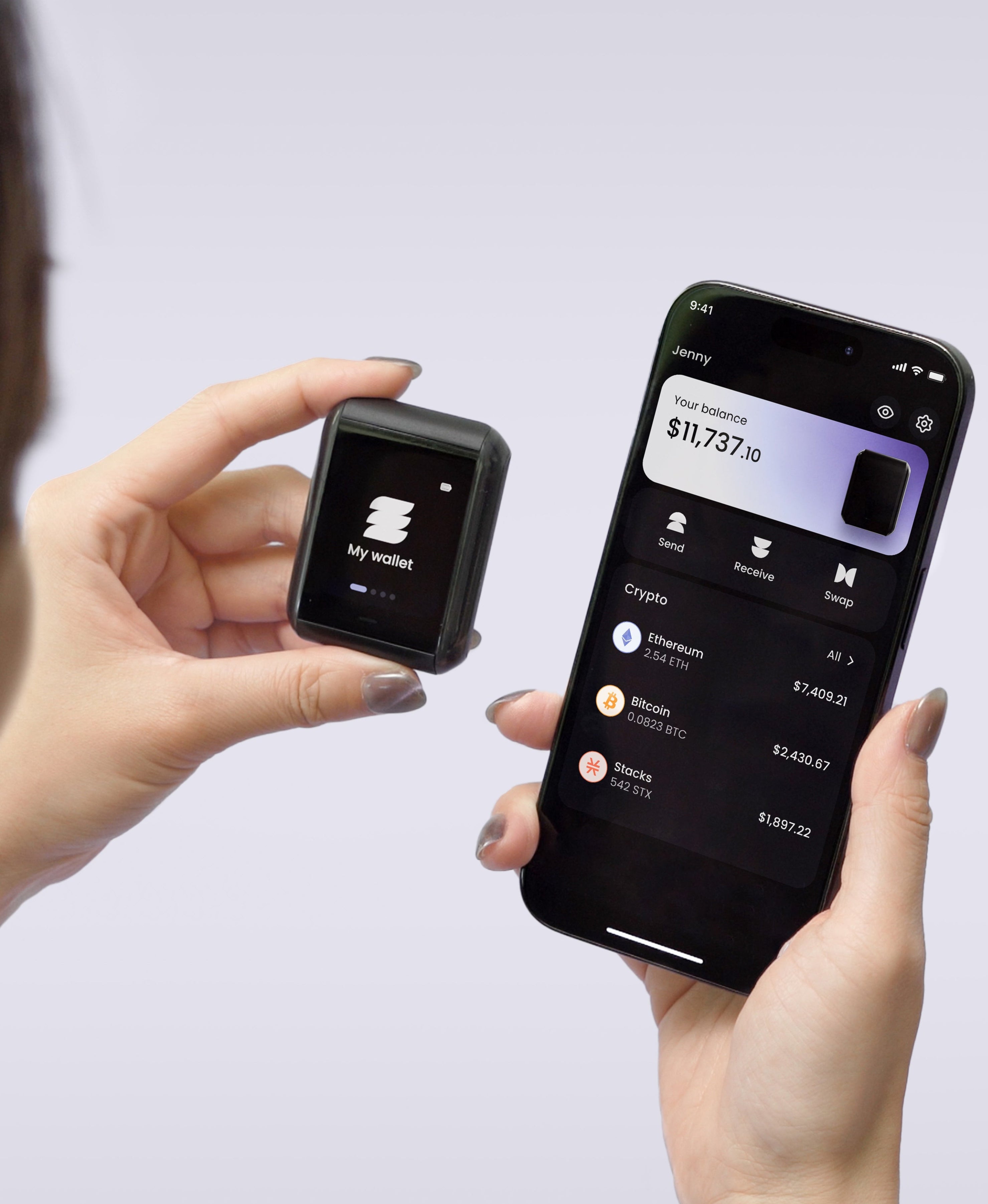
Ryder One is a compact hardware wallet built around an EAL6+ Infineon SLC38 secure element, a 1.6-inch AMOLED touchscreen, and NFC-only communication. It signs Bitcoin, Ethereum, Solana, and a growing list of top ERC-20 and SPL tokens today. TON sits outside the current supported set, so if your portfolio includes Toncoin and you want it behind a hardware wallet in 2026, check the current supported-chain list on the Ryder One product page before you order.
For the chains Ryder One does sign, the custody model that applies here is the same one that applies to TON. Every transaction renders on the device screen in full readable detail before you tap the button, and the button wires directly to the secure element so no software path can sign without your input. Recovery uses TapSafe instead of writing a paper seed: a Recovery Tag holds 50 percent of the wallet share and carries an IP69K rating for high-pressure water and dust, and a phone backup stored encrypted in your iCloud or Google Drive holds the other half. Optional Recovery Contacts add 25 percent shares apiece, paired in person over NFC, with none of those contacts able to see your balance or your keys. The BIP-39 seed phrase sits on-device as a last resort, so you are never locked to Ryder hardware. Ryder One ships at $229 with the Recovery Tag, a Qi wireless charger, and a pouch in the box.
The bottom line
TON reached mass scale by hiding the word "crypto" from most of its users. Telegram-native onboarding, an @wallet bot inside every chat, and a mini-app economy that grew from Notcoin to Hamster Kombat to DOGS put Toncoin into hundreds of millions of hands with almost no friction. The trade-off is that most of those balances sit in a custodial wallet inside a messaging session, and that concentration of custody plus session is a bigger attack surface than most users think about.
Any Toncoin you would miss belongs off @wallet and onto a wallet that respects TON's ed25519 keys and its own mnemonic spec. Any balance beyond a daily-spending float belongs on a device where the keys stay behind a secure element and every signature is verified on a screen you own.
SEO
Target keyword: toncoin
SEO title: TON (Toncoin) in 2026: Telegram's Blockchain Explained
Meta description: Toncoin is Telegram's blessed L1 chain with billion-user reach in 2026. Here is how TON crypto works and the self-custody read for holders.
Hero alt text: TON Toncoin Telegram blockchain 2026 — Ryder self-custody hardware wallet


Share: