

The Tangem Ring is the most interesting object in hardware wallets right now, and searches for it have been climbing all month. It is a zirconia ceramic band you wear on your finger, it holds a private key inside a certified chip, and it signs transactions when you tap it against your phone. There is no charging cable, no screen, and no twelve words to write down. For a category that has spent a decade asking people to guard a slip of paper, that is a substantial rethink.
It is also a set of trade-offs, and the trade-offs are the part nobody covers well. Here is what the Tangem Ring does, where the design gives something up, and how it compares to the approach we took with the Ryder One. If you are weighing the flat Tangem cards instead, we covered those in Tangem vs Ryder One.
What the Tangem Ring is
Tangem sells the Ring at 160 USD as a set with two backup cards. Inside the band sits a Samsung S3D350A secure chip certified to EAL6+, the same certification tier used for payment cards and biometric passports, and the ring carries an IP69K rating that covers dust and high-pressure water. It draws its power from the phone's NFC field, so there is nothing to plug in and no battery that ages. Sizes run from 6 to 13 US, and you cannot resize it later, which makes measuring your finger a one-shot decision.
The recovery model is where Tangem departs from everyone else. Rather than generating a seed phrase for you to write down, Tangem's default setup copies one private key across a set of devices during activation. Tangem's own explainer describes a maximum of three cards or rings sharing that key, and it is blunt about the consequence: devices cannot be added once setup is finalized, and if you lose every device in the set with no seed phrase enabled, the funds are gone for good. You can opt into a standard BIP-39 phrase instead, but that puts you back where you started, guarding words.
What it gets right
Wearability is a security feature, and it is underrated. A wallet on your finger is a wallet you have not left in a drawer at your parents' house or in a hotel safe you forgot to open before checkout. Tangem removed the charging habit as well, which sounds minor until you remember how many people have opened a drawer to find a dead device on the one afternoon they needed it.
Copying the key to three objects is a sound instinct too. Losing one card is an inconvenience instead of a disaster, and the setup is quicker to explain to somebody who has never held crypto than any seed phrase ritual has ever been.
Where the design gives something up
The ring has no display, and everything follows from that. When you approve a transaction, the amount and destination address are drawn by your phone, and the chip signs whatever the phone hands it. If your phone is compromised, or if a site swaps the destination address between what you read and what gets sent, the ring has no way to show you the mismatch and no way to warn you. That is the blind signing problem, and a screenless device cannot solve it by design.
The three-device set has a second edge as well. Three copies of one key means three objects that each grant complete access to everything, so your risk of loss falls while your exposure to theft rises, and the two backup cards need hiding places you trust as much as the ring on your hand. A burglar who finds one card in a nightstand has the whole wallet.
Tangem has also had one incident worth knowing about. In December 2024, a logging bug in the mobile app recorded private keys into support logs when a user generated or imported a seed phrase, and Tangem disclosed and patched it within a day of the public report, estimating that under 0.1% of users could have been exposed. The company handled it about as well as a company can handle that, and it stays on the record because every manufacturer eventually ships a mistake and the useful question is what the architecture does when one lands.
Ryder One takes the same problem from the other end
We agreed with Tangem on the premise. Asking ordinary people to hand-copy twenty-four words and then guard that paper for thirty years was never going to work at scale, and the industry's insistence on it is the single biggest reason self-custody stalled.
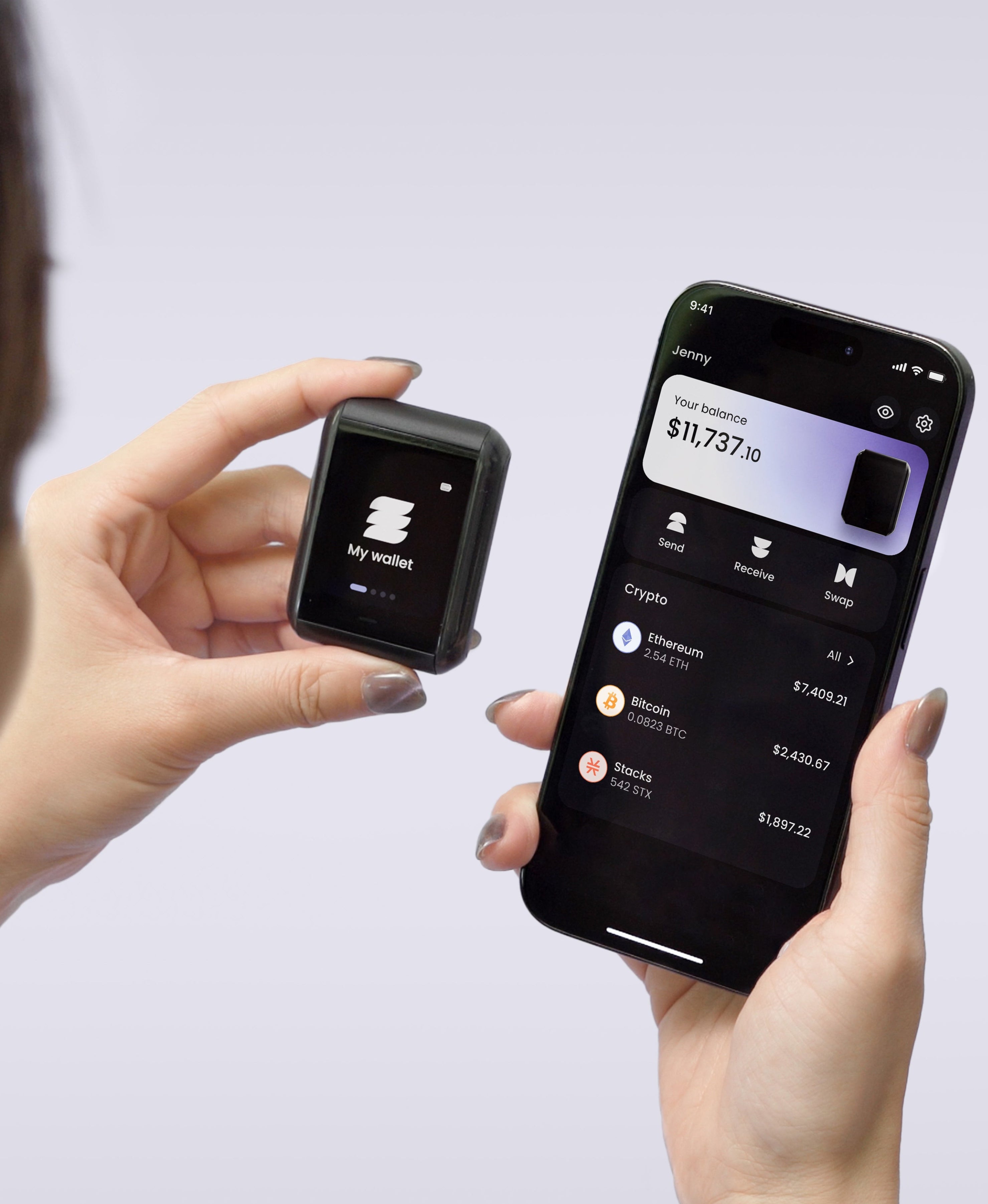
Where we went a different direction is on what the device shows you and what recovery looks like when something goes wrong. The Ryder One is a compact device at 41 by 55 by 14.5 mm and 38 grams, with an aluminium body and a 1.6-inch AMOLED touchscreen that renders every transaction in readable detail before you approve it. The button that triggers a signature is wired directly to the EAL6+ certified Infineon SLC38 secure element, so no software path can sign without a deliberate press, and what appears on the screen is what gets signed. Communication runs over NFC alone, with no USB data channel, no Bluetooth radio and no Wi-Fi. It carries a 200 mAh battery and charges over Qi wireless, with the charger in the box.
TapSafe Recovery answers the loss question differently from a set of identical copies. Your Recovery Tag holds half of what is needed and your paired phone holds the other half, encrypted in your own iCloud or Google Drive rather than on the handset, so losing the phone does not lose the backup. Optional Recovery Contacts each hold a quarter, set up in person over NFC. No single object opens the wallet, which means a stolen tag is not a stolen wallet, and the seed phrase stays available on the device as a last resort under the BIP-39 standard. You are never locked to our hardware, and you are never one lost item away from the end.
Side by side
| Tangem Ring | Ryder One | |
|---|---|---|
| Form | Zirconia ceramic ring, sizes 6 to 13 US | Compact device, 41 x 55 x 14.5 mm, 38 g |
| Screen | None; transaction shown on the phone | 1.6-inch AMOLED touchscreen on the device |
| Secure element | Samsung S3D350A, EAL6+ | Infineon SLC38, EAL6+ |
| Connectivity | NFC | NFC only |
| Power | Drawn from the phone's NFC field | 200 mAh battery, Qi wireless charging |
| Water and dust | IP69K | IP67 |
| Default recovery | Same key copied to up to 3 devices | TapSafe: Tag 50%, phone 50%, contacts 25% each |
| Seed phrase | Optional; off by default | Always available on-device as a last resort |
| Independent audit | Chip certification published | Firmware audited by Halborn, full report public |
| Price | 160 USD (ring plus two cards) | 149 USD Starter Combo, 179 USD Super Safe Combo |
Which one fits you
If your priority is having your wallet on you at all times and you hold a modest amount that you move rarely, the Tangem Ring is a well-made object and the wearable format is a legitimate advantage nobody else is offering in that shape. Go in knowing you are trusting your phone's screen for every transaction, and that your two backup cards need storage as careful as anything you would hide a passport in.
If you want to see what you are signing on the device itself, and you want recovery that degrades gracefully instead of ending at a lost object, the Ryder One was built for that. Every transaction renders in full before approval, the firmware was audited by Halborn with the report published rather than summarized, and setup takes about 60 seconds. It supports Bitcoin, Ethereum and Solana along with a growing list of top ERC-20 and SPL tokens, and the Starter Combo is 149 USD.
Pick the one whose failure mode you can live with, and hold the keys either way. See the Ryder One.
Meta description: The Tangem Ring is a 160 USD wearable wallet with no screen and no seed phrase by default. What that design gets right, and what it quietly costs you.


Share: