


In October 2024, Stripe re-enabled crypto payments after a six-year pause, this time built around USDC stablecoin payment rails on Solana, Ethereum, and Polygon. A few months later, the company bought stablecoin infrastructure startup Bridge for $1.1 billion, the largest crypto acquisition on record. PayPal's own PYUSD stablecoin, launched in 2023, crossed $1 billion in circulating supply in mid-2024 and now settles on both Ethereum and Solana. By the time the GENIUS Act passed in 2025, the question for retail holders had shifted from "will stablecoins go mainstream" to "what do you do once they have."
If you're sitting on USDC or USDT and watching the payments rails come online, this piece is for you. We'll walk through what Stripe and PayPal are shipping in 2026, why this matters for self-custody holders specifically, and where the line falls between holding stablecoins on a platform and holding them under your own keys.
What Stripe is shipping
Stripe's 2024 launch reopened crypto payments after the company killed Bitcoin support back in 2018, and the second attempt looks nothing like the first. The product accepts USDC from customers in 150 countries, settles to merchants in either crypto or fiat, and runs on three chains (Ethereum, Solana, Polygon) without exposing the merchant to chain selection. Settlement on Solana clears in roughly one second; the fee structure sits around 1.5%, well under typical card-processing rates.
The Bridge acquisition matters more than the headline price. Bridge built APIs that let businesses move stablecoins across chains and convert between USDC, USDT, and PYUSD on the back end. By owning that infrastructure, Stripe can offer merchants a "pay-in-anything, receive-in-anything" experience where the customer pays in USDC and the merchant sees dollars in their bank account the next day. The Block reported in early 2025 that Stripe processed over $5 billion in stablecoin volume in its first six months back, with cross-border B2B making up most of the flow.
For retail holders, the practical change is the off-ramp problem getting solved by accident. If your contractor in Buenos Aires accepts USDC through Stripe, you can pay them directly from a hardware wallet without going through Coinbase, a bank wire, or any intermediary that would charge 3% and take three days.
What PayPal is shipping
PYUSD is PayPal's own dollar-backed stablecoin, issued by Paxos and fully reserved with cash and short-duration Treasuries. It launched in 2023 on Ethereum, expanded to Solana in 2024 for cheaper transfers, and now circulates through PayPal's existing 400-million-user payment graph. Holders inside PayPal can send PYUSD peer-to-peer with zero fees, swap it into USD instantly, and (as of 2025) earn interest on balances through a partnership with Paxos.
The strategic move is what comes next. PayPal has been quietly rolling out stablecoin acceptance on the merchant side, letting Shopify and Stripe-competitor merchants accept PYUSD as a payment method with same-day USD settlement. Bloomberg covered the 2025 expansion that brought PYUSD to over 20 million PayPal-connected merchants, and the company has framed PYUSD as the rail it expects to win on for cross-border remittances by 2027.
Here's where the self-custody question gets sharp. PYUSD inside PayPal sits in a custodial wallet that PayPal can freeze, restrict, or claw back under court order, since Paxos retains the freezing keys at the contract level. The same PYUSD held in your own wallet behaves like any ERC-20 or SPL token, with full transfer freedom (subject to the same blacklist any regulated stablecoin issuer maintains).
The regulatory backdrop in two paragraphs
The GENIUS Act (Guiding and Establishing National Innovation for U.S. Stablecoins), signed into law in July 2025, gave the U.S. its first federal framework for payment stablecoins. The law requires issuers to back tokens 1:1 with cash or short-duration Treasuries, undergo monthly reserve attestations, and meet bank-like capital rules. Circle (USDC), Paxos (PYUSD), and a handful of bank-issued tokens fit cleanly inside the framework; Tether (USDT) has signaled it will register a U.S.-compliant subsidiary while keeping its global product separate.
What the GENIUS Act doesn't change is your right to hold a payment stablecoin in self-custody. The law's scope is issuers and intermediaries; wallets are outside it. A USDC balance on a hardware wallet stays under your control with the same blacklist exposure it always had: Circle can freeze a specific address under court order, but they can't move funds out of it, and they don't custody the keys. That distinction is what makes self-custody durable even as the regulated rails around it expand.
Why this matters for self-custody holders
If you've held USDC or USDT for years as a dollar-denominated escape hatch, the 2026 picture is the first time those balances have a real spending path that doesn't route through a centralized exchange. A few practical reads come out of that.
Stablecoin payment infrastructure now has multiple rails. Stripe handles merchant acceptance for businesses that want to receive crypto and settle in fiat. PayPal handles consumer payments and peer-to-peer through PYUSD. Visa added USDC settlement to its corporate network in 2023 and expanded the program through 2025. Each rail accepts stablecoins from self-custodied wallets without requiring the holder to deposit funds anywhere first.
Custodial versus non-custodial is the line that still matters. PYUSD inside PayPal is a balance, not a token you control: PayPal owns the keys, sets the rules, and can pause transfers. PYUSD in a self-custody wallet is a token you hold directly, with all the rights and risks that come with that distinction. The same is true for USDC inside Coinbase versus USDC on a hardware wallet. The brand on the dollar is identical; the custody model underneath is not.
Counterparty risk lives at the issuer level as well as the platform level. Circle, Paxos, and Tether each carry distinct risk profiles around reserve composition, audit cadence, and jurisdiction. When Silicon Valley Bank failed in March 2023, USDC briefly depegged to roughly 0.87 USD before Circle confirmed the $3.3 billion of stuck reserves was made whole. The lesson isn't that USDC is unsafe; it's that even the cleanest stablecoin issuer has reserve-side exposure, and diversifying across USDC, PYUSD, and (with eyes open) USDT is closer to prudent than concentrating in one.
Where Ryder One fits
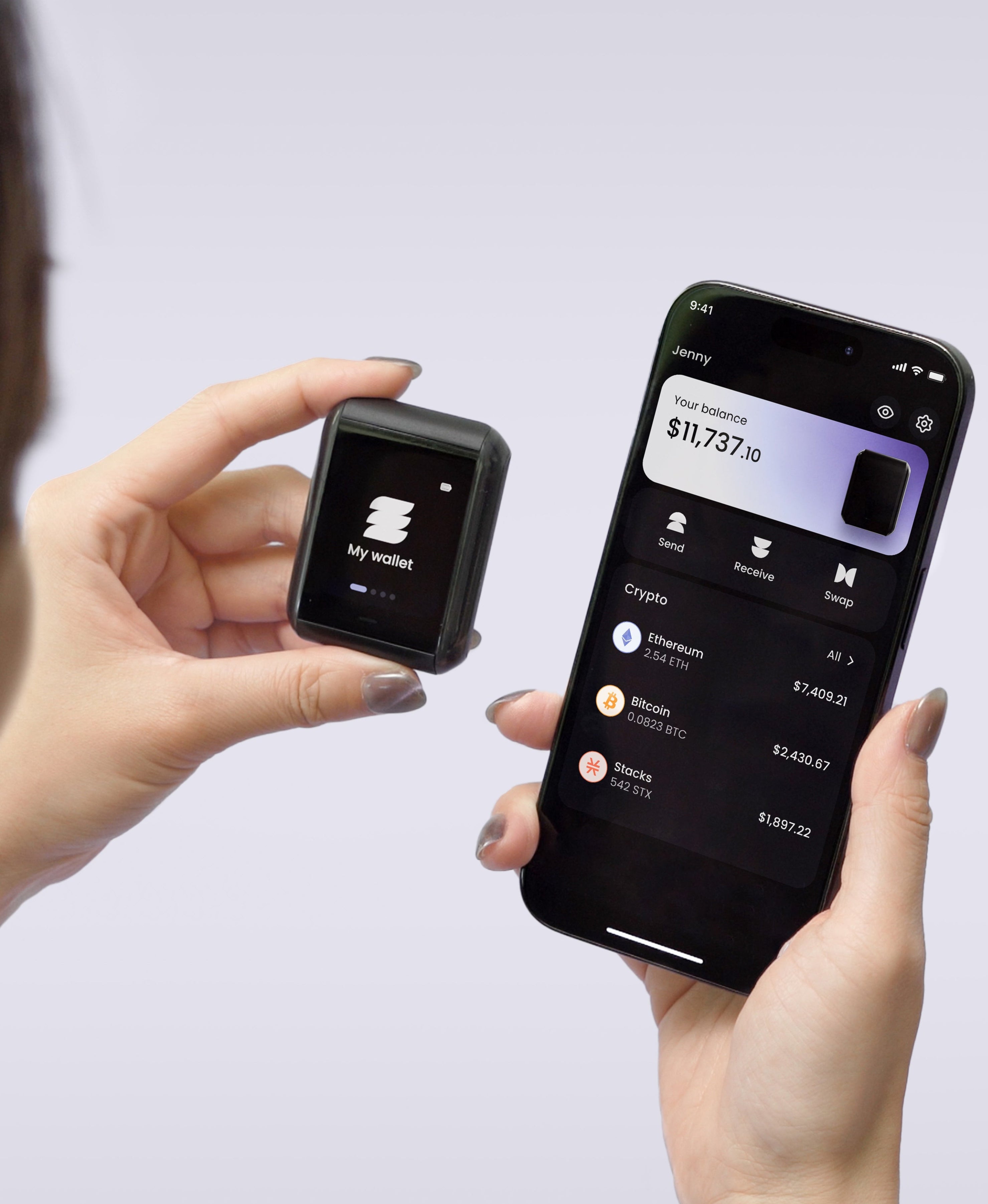
Ryder One holds USDC, USDT, PYUSD, and the rest of your stablecoin balances offline on an EAL6+ Infineon SLC38 secure element. Every transaction is verified on the 1.6-inch AMOLED touchscreen, with a physical button wired directly into the secure element, so the address you see is the address you sign. NFC-only communication means no USB, no Bluetooth, no wireless data path that a remote attacker could exploit while you're paying a merchant or sending PYUSD to a friend.
We built TapSafe Recovery so the backup doesn't become its own weak link. The Recovery Tag holds 50% of the recovery secret. Your paired phone holds the other 50%, encrypted in iCloud or Google Drive (not on the phone itself), so losing the phone doesn't lose the backup. You can optionally hand 25% to each of up to four Recovery Contacts, who can't see anything about your wallet and who only matter if you've lost both the device and the tag. The BIP-39 seed phrase stays accessible on-device as a last resort, so you're never locked to our hardware. Ryder One ships at $229 with a Recovery Tag, Qi wireless charging pad, and travel pouch in the box.
If your USDC is going to start moving through Stripe checkouts and your PYUSD through PayPal merchants, the wallet holding the keys becomes the part of the stack you most want to get right.
The bottom line
Stripe and PayPal have turned stablecoin payments from a theoretical use case into a working payment rail in 2026, with USDC and PYUSD running through Stripe's 150-country merchant network and PayPal's 400-million-user consumer base. The GENIUS Act gave the rails federal cover without touching your right to hold stablecoins in self-custody. For holders who've been waiting for crypto to do something other than sit there, the off-ramp is finally on the other side of a hardware wallet rather than a centralized exchange. The position you control is the one that benefits from every rail that opens up.
Spend stablecoins without giving up the keys. Ryder One keeps USDC, USDT, and PYUSD offline on an EAL6+ secure element, with TapSafe Recovery as the backup.
SEO
- Target keyword: stablecoin payment
- SEO title: Stablecoin Payment Rails: What Stripe and PayPal's 2026 Moves Mean (66 chars)
- Meta description: Stripe and PayPal turned stablecoin payments into a real rail in 2026. Here's what that means for self-custody holders of USDC, USDT, and PYUSD. (148 chars)




Share: