


Solana is trading near $148 as of mid-June 2026, holding the range it found after the early-June Bitcoin drawdown. For the rest of 2026, analyst targets sit between $130 on the bearish floor side and $400 on the bullish institutional side, although the credible base case from research desks clusters at $180 to $280.
In this piece we walk through what's pricing Solana right now, the bull and bear paths laid out in plain numbers, the chain-specific risks worth knowing about, and what holders should focus on regardless of where price lands at year end.
What's moving Solana in 2026
Five forces are doing the work this year. The ETF pipeline is the biggest near-term catalyst: five spot Solana ETF applications sit under active SEC review (VanEck, 21Shares, Bitwise, Canary Capital, Grayscale), and most analysts expect at least one approval by Q4 2026. An approval would unlock measurable institutional inflows on the model already proven by Bitcoin and Ethereum spot products.
Application-layer activity is the second force, and it's where Solana's bull thesis gets its strongest support. The chain's daily active addresses, transaction count, and DEX volume have outpaced Ethereum on several 2026 metrics, and the apps doing the work (Jupiter, Helium, Magic Eden, Solana Mobile) are hosting use rather than just speculation. Artemis data shows the gap between Solana and the next L1 cohort widening through the first half of the year.
Validator economics is the third driver. Solana's staking yield sits in the 5 to 7% range annually, which creates demand from validators and long-term holders alike, and roughly 65% of circulating SOL is staked, removing it from active selling pressure. Stablecoin adoption is the fourth: USDC on Solana now exceeds $5 billion in circulating supply, and stablecoin transfer volume on the chain rivals Tron for emerging-market remittances, which gives a non-speculative demand source for SOL gas.
Reliability is the fifth, and it's a story that has shifted. Solana's downtime in 2025 and 2026 has dropped below 0.1%, with the Firedancer client launched on mainnet in mid-2024 and now carrying meaningful load. Each outage in 2022 and 2023 was a price headwind, and the current reliability profile no longer carries the bear thesis it once did.
The bull case ($280 to $400)
The bull path requires the Solana spot ETF landing by Q4 2026, with first-year inflows of $3 to $8 billion (scaled proportionally to Solana's market cap against the Bitcoin ETF experience). Continued application-layer growth pulls in more developers and TVL, and the altcoin rotation that's been missing through 2025 finally arrives as Bitcoin dominance starts to reverse.
If that scenario plays out, Solana retests its early-2025 all-time high near $295 and breaks higher. The $400 target requires both ETF approval and a broader altcoin rotation, since one without the other gives a sharp move but not a sustained reprice.
The base case ($180 to $280)
In the base case, ETF approval slips into early 2027 as the SEC takes its usual conservative path, application-layer activity keeps growing but doesn't accelerate, and Bitcoin dominance stays elevated, capping altcoin upside. Solana then trades a $180 to $280 range, long-term holders see modest appreciation, and active traders work the chop.
This is the outcome current data points toward, and it's where most credible desk targets sit. It lacks the headline appeal of the bull case, but it's the path with the highest probability mass if you're sizing a position.
The bear case ($90 to $140)
The bear case stacks three drags: a macro recession, an ETF rejection, and either a major outage or a competing L1 (Sui, Aptos, Monad) capturing developer mindshare. Alternatively, the staking yield could compress as more SOL gets staked, eroding the demand floor that today supports the validator economy.
Bear-case probabilities are present but lower than base or bull. The arguments that lifted Solana through 2025 and 2026 (real usage, working consensus, growing application layer) have strengthened over the last 18 months rather than weakened.
Solana-specific risks worth knowing
Three things sit outside what most public targets price in. Validator concentration is the first: Solana's network has historically had higher validator concentration than Ethereum's, and a small number of large operators stake a sizeable share of SOL. If a consortium were to coordinate, it could in theory influence consensus, though no such coordination has surfaced.
The Firedancer rollout is the second risk. The new validator client launched in late 2024 and continues to roll out gradually, which is good for the chain's long-term performance but means migration risk isn't zero. A Firedancer-related issue would land as a one-time price event rather than a thesis break.
Foundation token unlocks are the third. The Solana Foundation holds a sizeable SOL balance, and unlock schedules through 2026 release modest amounts on a periodic cadence. The market has absorbed these without incident so far, but they're worth tracking if you're sizing a large position.
What this means for self-custody Solana holders
For a long-term holder, the specific 2026 print matters less than two inputs: ETF approval timing, and continued application-layer growth. Both are observable, both are uncertain, and neither is something you can hedge from inside a brokerage account.
The custody question sits separately. SOL on a hardware wallet earns staking yield (if delegated), can be used for any on-chain activity, and doesn't depend on any crypto exchange continuing to operate. SOL inside an ETF, when one is approved, lacks all three properties: no yield capture, no on-chain composability, no independence from the custodian.
For holders building a long-term SOL position, the answer is direct custody plus delegation. Stake the SOL through your hardware wallet to a validator of your choice, capture the 5 to 7% yield, and hold through the cycles. The ETF wrapper, when it lands, is an optional add-on for the financial-exposure-only slice of a portfolio.
Where Ryder One fits
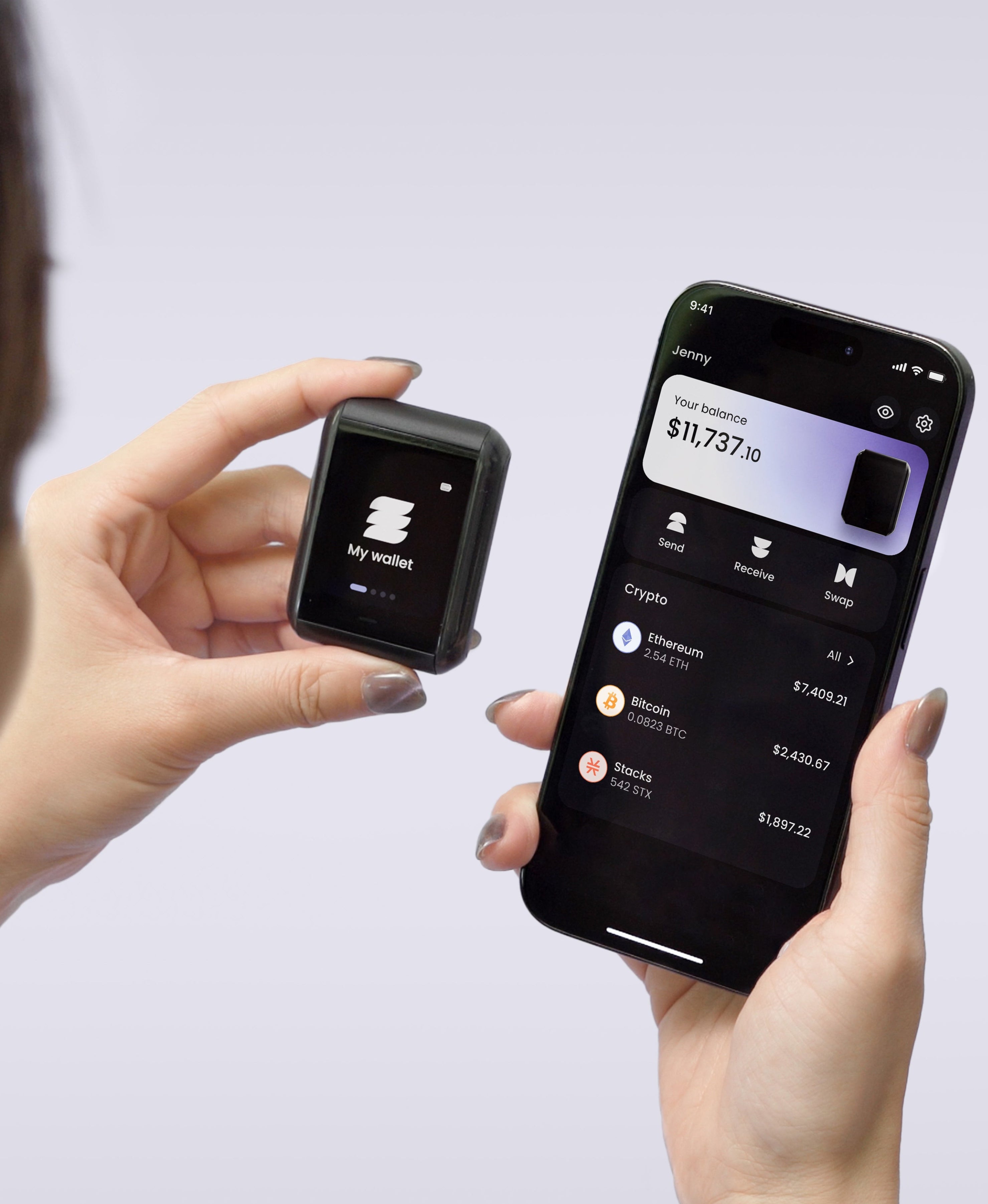
We built Ryder One to hold SOL on an EAL6+ Infineon SLC38 secure element, with staking, swaps, and any other on-chain Solana activity routed through on-device verification. Every transaction is signed on the 1.6-inch AMOLED touchscreen with a physical button press, and connectivity is NFC-only so there's no Bluetooth or USB attack surface. Charging happens over Qi wirelessly, and the device itself is compact enough to slip into a pocket.
For the backup, we built TapSafe Recovery to split your wallet across three layers so no single object carries the whole position. The Recovery Tag holds 50% of your wallet, your paired phone holds 50% (stored encrypted in iCloud or Google Drive, not on the device itself), and optional Recovery Contacts each hold 25%. Your BIP-39 seed phrase is always available on the device as a last resort, so you're never locked to our hardware.
For Solana holders watching the ETF cycle and the application-layer growth, we handle the position itself: direct custody, staking yield captured, on-chain activity available without leaving the device.
The bottom line
Solana price targets for 2026 cluster at $180 to $280 in the base case, with bull case targets at $400 if the ETF lands and altcoin rotation kicks in. The underlying inputs (application-layer growth, staking demand, ETF pipeline) are intact, and the reliability story has shifted from headwind to neutral. For self-custody holders, the price question matters less than the custody question: direct custody captures staking yield, supports on-chain activity, and doesn't depend on which scenario unfolds.
Hold SOL and capture the staking yield. Ryder One keeps your Solana on an EAL6+ secure element, with TapSafe Recovery as the backup. The wallet doesn't watch the chart.
SEO
- Target keyword: solana price prediction
- SEO title: Solana Price Prediction 2026: Bull, Bear, and What Drives SOL (60 chars)
- Meta description: Solana price targets for 2026 cluster $180-$280 base case with bull case at $400. Here's what's driving price, the ETF pipeline, and the custody question. (155 chars)



Share: