

# Solana Firedancer in 2026: Why Client Diversity Matters When You Self-Custody SOL
For most of Solana's history, every validator on the network ran the same piece of software. That worked when the chain was quiet and broke loudly when it wasn't. A complete outage history compiled by Helius counts seven full or partial mainnet incidents since 2021, five of which traced back to bugs in a single client. When Jump Crypto's Firedancer started producing live mainnet blocks in May 2026, CoinDesk reported that a second, independent validator implementation was finally carrying live user traffic. That shift is the biggest change to Solana's reliability story in years, and it deserves a plain-language read for anyone who holds SOL in their own wallet.
In this piece we cover what Firedancer is, why validator diversity is a network-security question, what the 2022 and 2023 outages taught the ecosystem, and what a self-custody holder should take from all of it. The short version: your keys still need a home you control, and the chain your assets live on now has a better shot at staying up when a single client trips over its own code.
What Firedancer is, in plain terms
Firedancer is a from-scratch Solana validator client written in C by Jump Crypto, the technology arm of Jump Trading. The original validator software, which powered the network from launch, was maintained by Solana Labs and later forked into a project called Agave. Agave is now stewarded by Anza, a company spun out from the Solana Labs core team in 2024. Every Solana node used to run some version of that codebase. If a bug lived in Agave, it lived on every machine at once.
Firedancer shares none of that lineage. Jump Crypto wrote it as a clean-room implementation of the Solana protocol, matching the specification without copying any Agave source. The intermediate step, called Frankendancer, stitched Firedancer's networking layer onto Agave's runtime so validators could adopt the fast pieces early while the full client finished. Frankendancer went live on mainnet in September 2024 and has since climbed above 20% of stake according to Solana Compass. Full Firedancer, the C-only implementation with no Agave code inside, entered mainnet production during the phased rollout Jump described this year.
Speed gets most of the headlines. Firedancer is engineered around a one-million-transactions-per-second ceiling, and its networking stack has already benchmarked in the 600,000 TPS range under load. Speed is not the reason it matters most, though. The reason it matters most is that there are now two of it.
Why client diversity is a security story
Ethereum figured this out first. Multiple execution clients (Geth, Nethermind, Besu, Erigon) run alongside multiple consensus clients (Prysm, Lighthouse, Teku, Nimbus), and validators split their stake across the mix. If one client hits a consensus bug, the network keeps producing blocks because most of the stake is still running a different implementation. The bug becomes a client problem, contained, patched, and rejoined. It does not become a chain problem.
Solana did not have that structure. When something went wrong deep in Agave, it went wrong for everyone on the network at the same moment, which is how a single edge case in the codebase turned into a global halt more than once. Client diversity means the odds of every validator sharing the exact same latent bug drop toward zero. Two implementations reading from the same spec but written by different teams in different languages are unlikely to fail in the same way at the same time.
That is the argument for Firedancer as a resilience upgrade, separate from any throughput number. A Solana that runs two independent validator clients is a Solana where a client-side incident is a rough patch rather than a full outage.
The 2022 and 2023 lessons
The reason the diversity argument lands with weight is that we have watched the alternative up close. Solana's February 25, 2023 outage was traced by Anza's engineering team to a bug in the block-propagation logic that no other client could route around, because there was no other client. A single malfunctioning shred service pushed an oversized block into Turbine, and the deduplication filter in the retransmission pipeline failed to catch the loop. Block production stopped, and the network needed a coordinated validator restart to recover. It took roughly nineteen hours from the moment the fault appeared to full chain resumption.
The September 2021 halt and the June 2022 halt shared a similar shape. A single implementation flaw expressed itself simultaneously on every node, because every node was running the same implementation. Even the August 2024 incident, a vulnerability quietly patched before it could be exploited, followed the pattern: one client, one bug, one blast radius covering the entire validator set. Jump Crypto's rollout plan for Firedancer references those incidents as the motivating case. So does the wider Solana engineering community, which has treated client diversity as the top reliability priority since 2023.
For a SOL holder, none of those events cost anyone their coins. Keys were untouched. Balances remained accurate once the chain came back. What people did lose was the ability to move funds, trade, or interact with any application while the network was down. During each outage, whether your SOL sat on an exchange or in a wallet on your desk made no difference to whether you could act on it. The chain was closed.
What Firedancer changes for SOL holders
For someone who keeps their SOL in self-custody, Firedancer changes the network under your assets without changing the assets themselves. Your private keys are still your private keys. The signature scheme is still Ed25519. The addresses you have used since 2021 continue to work. What improves is the odds that when you go to sign a transaction, the network is there to accept it.
Two practical consequences follow from that. The first is uptime. If a bug lands in Agave next year, roughly a fifth of Solana's stake is on a different codebase and stays online. Enough validators keep producing blocks for the network to limp forward rather than halt outright, and the affected client can be patched without the full-restart choreography that made past outages hurt. The second is throughput headroom. Firedancer's networking layer is measurably faster, which means periods of heavy demand (memecoin launches, NFT mints, DePIN traffic spikes) have less risk of degrading into congestion collapse. Fees stay cheap, confirmations stay quick, and the user experience holds up.
What it does not change is who holds your SOL. The chain running better is a public-good improvement. Your custody arrangement is still yours to design. If your coins live on a centralized exchange, a Firedancer-enabled Solana does nothing to protect you from the exchange itself; the FTX collapse in 2022 was a custody failure, not a network failure. If your coins live in a hot wallet on the same phone you use for everything else, network resilience does not stop a malicious dApp signature from draining the account. Client diversity fixes the layer below your wallet. Your wallet still has to fix the layer that touches you.
Where Ryder One fits
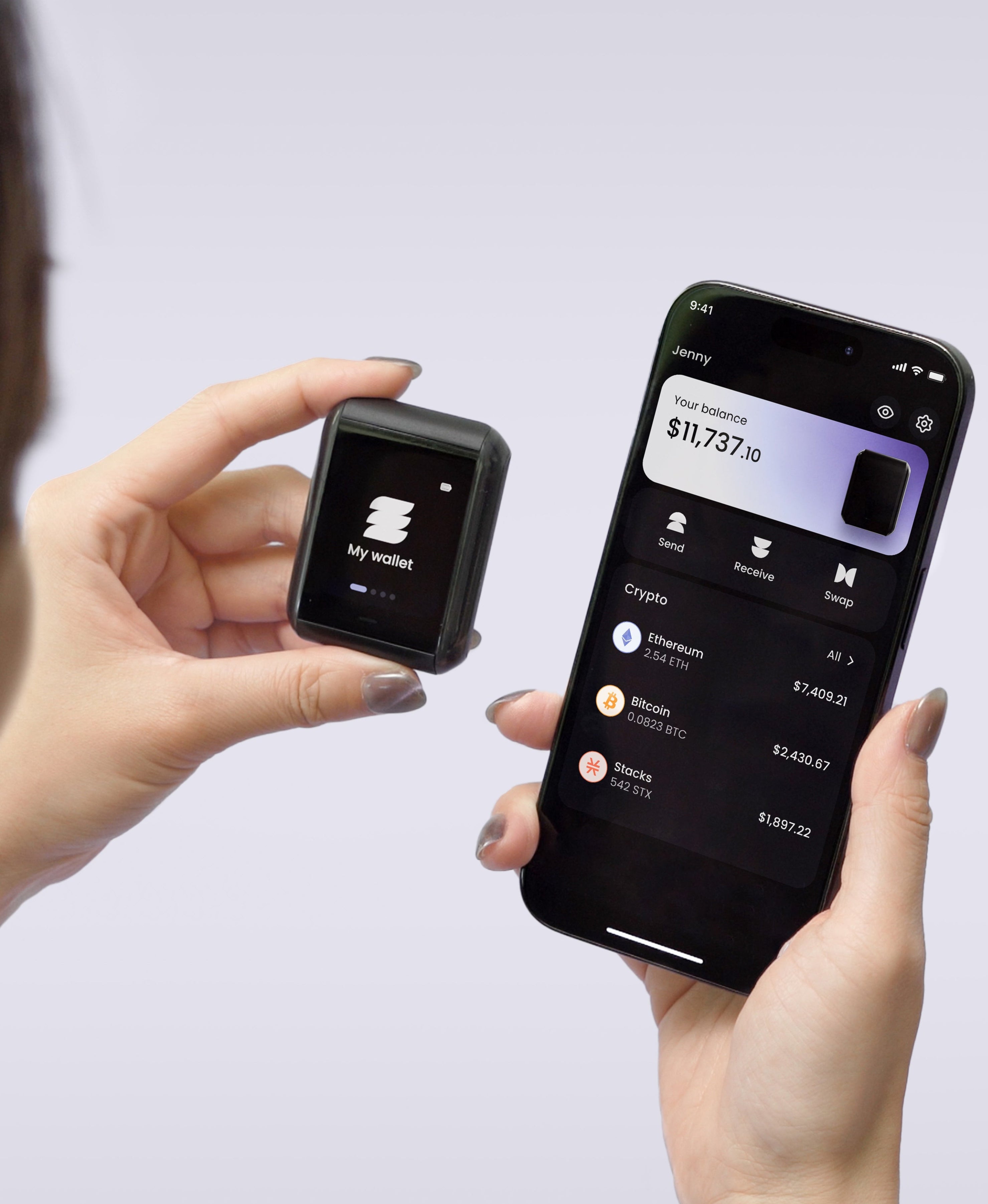
We built the Ryder One for the layer Firedancer cannot touch: the moment your key signs a transaction. Ryder One is a compact hardware wallet with a 1.6-inch AMOLED touchscreen, an EAL6+ Infineon SLC38 secure element, and NFC-only communication. There is no USB, no Bluetooth, no Wi-Fi. Every Solana transaction (a swap on Jupiter, a stake delegation, an approval on a new program) renders on the device screen with full readable detail before you press the button to sign. That button is wired directly to the secure element, so no software path can produce a signature without your tap.
Recovery is handled by TapSafe rather than a paper seed. The Recovery Tag holds 50% of the wallet share and is IP69K rated. A phone backup, stored encrypted in your iCloud or Google Drive (not on the phone itself), holds the other half. Either share alone is useless to an attacker, and either share alone is useless to you, which is the design. Optional Recovery Contacts can add 25% shares apiece, up to four, paired in person over NFC; contacts cannot see your balance or your keys. The BIP-39 seed phrase is available on-device as a last resort, so you are never locked to Ryder hardware. Ryder One ships at $229 with the Recovery Tag, a Qi wireless charger, and a pouch in the box.
The point of the pairing is symmetry. Firedancer hardens the chain against client-level failures. A hardware wallet hardens your custody against signature-level ones. When the network is a public good you rely on and your keys are a private good you defend, both halves of the picture need attention.
The bottom line
Solana in 2026 is a healthier network than the one that stalled twice inside eighteen months. Firedancer is live, Frankendancer holds meaningful stake, and Anza continues to ship Agave releases at a fast pace. The chain has moved from a one-client system with a rough uptime record to a two-client system with real redundancy, and the throughput headroom that Jump Crypto set out to unlock is landing alongside the reliability gain.
If you hold SOL and you have been waiting for the network to feel less brittle before treating self-custody as the default, this is the shift you were waiting for. Put the keys in your pocket and let the validators sort out the rest. The Ryder One was built for exactly that job.
SEO
Target keyword: solana firedancer
SEO title: Solana Firedancer in 2026: Client Diversity Explained
Meta description: Firedancer is Solana's second validator client, live on mainnet in 2026. Here's what it fixes and what a self-custody SOL holder should take from it.


Share: